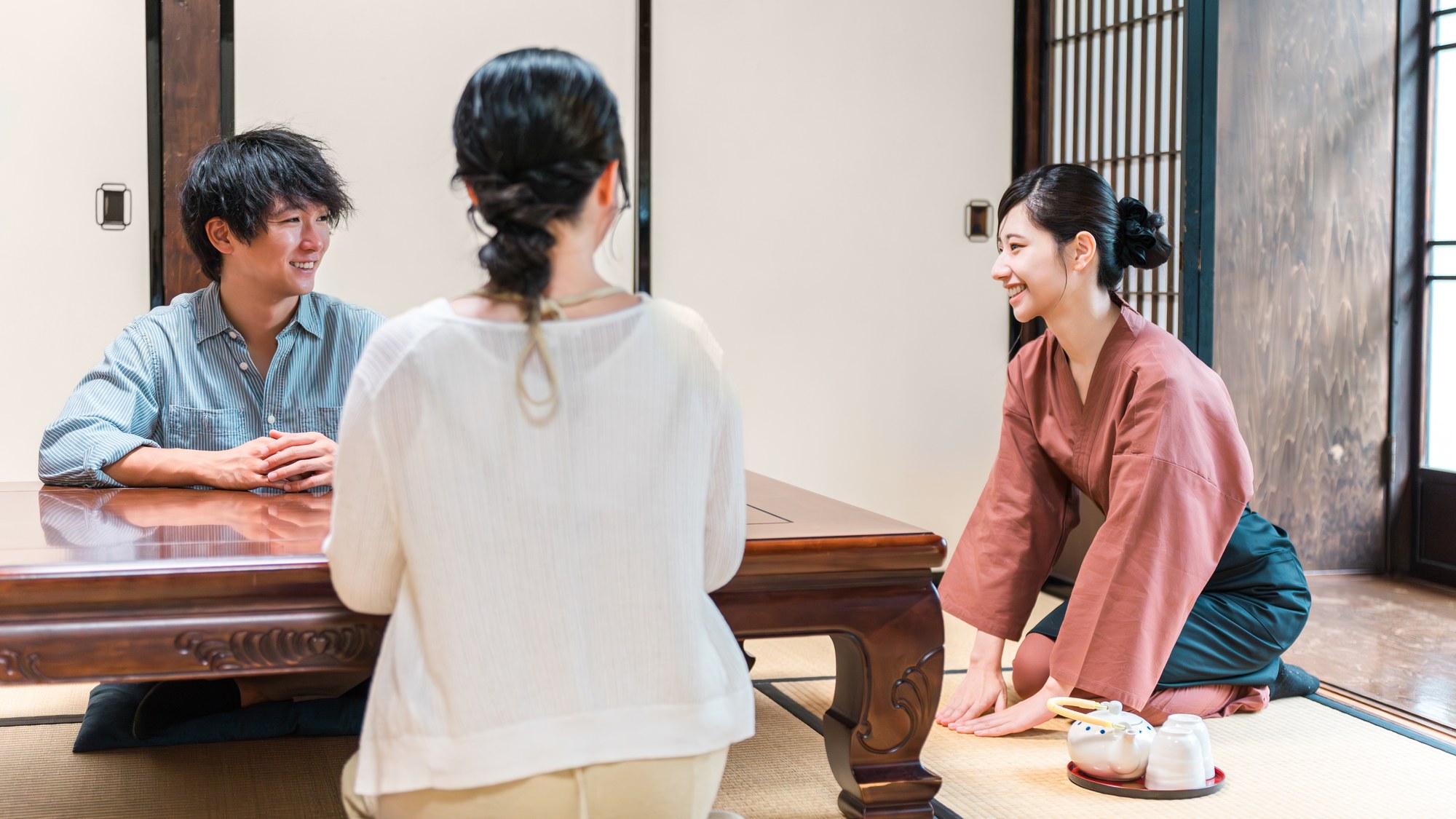
If you have read anything about Japan in English, you have probably read that omotenashi means “Japanese hospitality.” The word arrived in international vocabulary somewhere around the 2013 Tokyo Olympics bid, when a presenter pronounced its five syllables one at a time on a global stage, and ever since then it has lived a double life. In Japan it is a word people use to describe a particular kind of attention. In English-language travel writing it has become shorthand for “the staff was nice.”
The two are not the same thing.
Real omotenashi is closer to a discipline than a feeling. Tourist guides describe the output — the warm towel, the perfect tea, the bow at the door — and skip over the part that makes those things omotenashi rather than ordinary service. That part is what this article is about.
The shape of the word
Etymologically, omotenashi comes from the verb motenasu (to entertain, to receive a guest), with the polite prefix o-. There is a folk etymology that breaks it apart as omote (front, surface) plus nashi (without) — “without front and back,” meaning the host treats the guest the same whether watched or not. The folk reading is linguistically shaky but culturally accurate. It is what people mean when they use the word approvingly.
If you remember nothing else, remember that: omotenashi is the kind of attention that does not require an audience.
Anticipation, not response
The first thing that distinguishes omotenashi from English-language hospitality is the direction of attention. Western service training, broadly, teaches staff to respond well — to be friendly when addressed, to fix problems when raised, to upsell when there is an opening. Omotenashi runs upstream of that. The work happens before the guest knows there is a thing to ask for.
The classic illustration is the wet umbrella. You walk into a department store on a rainy afternoon, and at the entrance there is already a thin plastic sleeve waiting at the right height, already opened, already at the angle a wet umbrella enters. Nobody approaches you. Nobody offers it. The thing is just there, the way a path through a forest is there. Someone has thought about you arriving with a wet umbrella and has removed every transactional moment from the encounter.
The opposite of that is not bad service. The opposite is good service — the kind where a friendly attendant runs over with the sleeve and helps you in. That is hospitality. It is fine. It is just not the same thing.
The invisibility test
Here is a quiet way to recognize omotenashi when you encounter it: the work is invisible until you imagine it not being there.
- The taxi door that opens by itself, not because the driver pressed a flashy button but because he timed it, with one hand, while you were still reaching.
- The ryokan futon laid out while you were at dinner, not because you asked, but because someone watched the meal pace from a distance.
- The convenience-store clerk who, during a sudden downpour, has already moved the umbrella stand a half-meter inside the door so customers don’t trip over it. You will never know she did this. You are not supposed to.
This is the part that makes omotenashi hard to write about in marketing copy. It does not photograph well. The whole point is that the guest does not notice. If you praise the host afterward, you have failed at being the guest, and the host has slightly failed at being the host — because the encounter has been pulled into the foreground when it was supposed to stay in the background.
Why “no tipping” makes sense in this frame
Visitors to Japan are often surprised that tipping is not just unnecessary but mildly insulting in many contexts. The reason most travel guides give — “it is included in the service” — is true and not very interesting. The reason underneath it is that omotenashi is structurally not a transaction.
A tip says this exchange was good, here is the variable portion of your reward. It assumes a baseline service plus an optional bonus tied to performance. Omotenashi is not built that way. The host is not performing for a tip; the host is performing for the encounter to be complete. Adding money to it implies the host had a choice about whether to do it well, which is not the model.
You can see the same logic in the absence of a “service charge” line on most restaurant bills, in the way department-store wrappers fold the corners of your purchase even when nobody is watching, in the way a Shinkansen cleaning crew bows toward the empty train as it departs. None of these things are tipped. None of them are negotiated. They are part of the shape of the work.
Where it gets uncomfortable
This article would not be honest if it stopped at the warm-towel stage. Omotenashi has a harder edge that tourist writing rarely acknowledges.
The same discipline that anticipates a wet umbrella also produces workers who will not leave on time, will not voice a problem to a customer, and will absorb unreasonable demands as a matter of professional obligation. The Japanese term okyaku-sama wa kami-sama (“the customer is god”) is half a slogan and half a trap. Anticipation as a culture-wide expectation creates real labor — emotional, mental, often unpaid — and that labor falls on people who cannot easily push back without breaking the implicit contract.
You can see this most clearly in retail and hospitality jobs where customer rudeness goes unchallenged because responding would itself be a failure of omotenashi. The word, in its everyday workplace usage, can become a polite ceiling on what employees are allowed to say.
This is not a contradiction so much as a feature. A discipline that requires the host to disappear into the work has, by design, no built-in mechanism for the host to make demands. Whether that is beautiful or extractive depends on which side of the encounter you are on.
How to read it as a guest
If you visit Japan and want to actually experience omotenashi rather than read about it, here is the practical advice nobody quite gives:
- Slow down. Most omotenashi is timed. It assumes a guest who pauses, looks around, takes off coats deliberately. If you sprint through the encounter, you will outrun the choreography.
- Notice the empty space. The trash can placed at exactly the elbow height of someone holding a coffee. The chair angled so two people can sit without facing each other. These are the fingerprints.
- Don’t perform gratitude. A small arigatou gozaimasu and a slight bow is enough. Loud thanks pull the encounter into the foreground, which is the one thing the host has worked to avoid.
- Don’t ask for things you can see have not been offered. If something hasn’t been put out, there is usually a reason — the kitchen rhythm, the next guest’s reservation, the season. Asking is fine; expecting is the move that breaks the spell.
The single sentence version
Omotenashi is the practice of doing the work before the guest knows the work is required, in such a way that the guest never has to acknowledge it.
Tourist guides cannot quite say this, because the marketing version of omotenashi needs to be visible — needs to photograph. The lived version is the opposite. It is the small adjustment, made out of frame, that you will only notice if you imagine its absence. Once you start looking for that adjustment, you start seeing it everywhere in Japan: in stations, in elevators, in the particular angle at which a bowl is placed on a counter. And once you see it, the country gets a little quieter, and a little more crowded with care, in a way that is hard to put down.