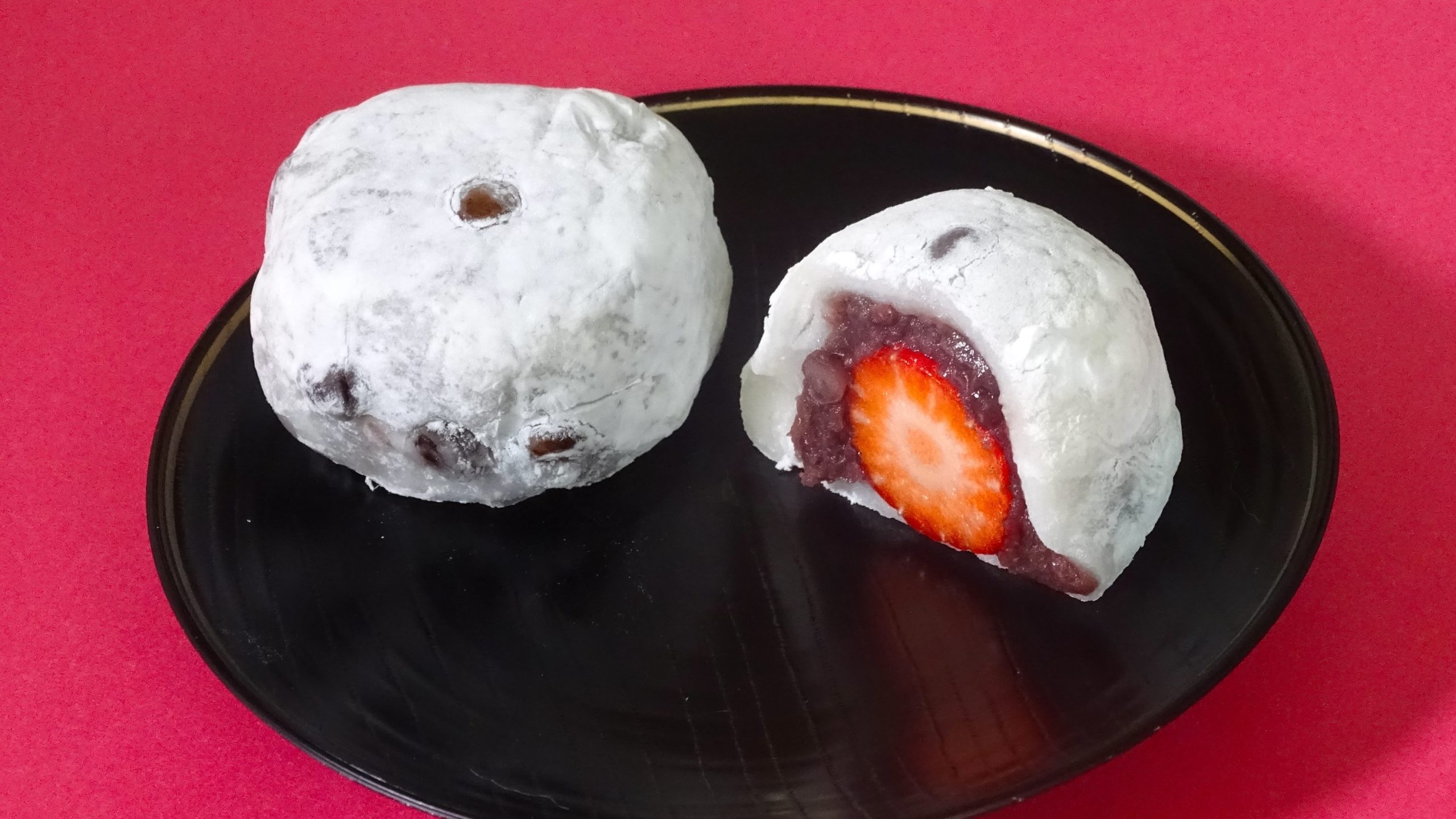
A small white sphere sits on a square of paper at a confectionery counter. It is dusted with potato starch — a fine white powder that comes off on your fingers when you pick it up — and yields slightly to pressure, like a soft pillow. When you bite into it, the outside layer of mochi stretches against your teeth before giving way, and the inside reveals a generous layer of dark sweet bean paste with the texture of soft fudge.
This is daifuku (大福), one of Japan’s most widespread traditional confections. The structure is straightforward — soft rice-flour dough wrapped around a sweet filling — but the variations are endless, and the cultural position the daifuku occupies says something specific about how a centuries-old confection survives in a market that prefers Western desserts.
This article traces what daifuku is structurally, the Edo-period origin story, the strawberry revolution of the 1980s, and how daifuku relates to the global mochi phenomenon that has appeared in supermarket freezer sections around the world.
Table of Contents
- What daifuku is
- The Edo origins
- Anko and its grades
- Ichigo daifuku and the 1980s
- Beyond strawberries
- The mochi ice cream confusion
- How it is eaten
- Daifuku in the everyday
What daifuku is
A daifuku consists of two parts: an outer layer of soft mochi dough and an inner filling, traditionally sweet azuki bean paste. The mochi is made from glutinous rice (mochigome) that has been pounded or, in modern production, processed from shiratamako (glutinous rice flour) into a soft, stretchy dough. It is rolled into a thin disc, the filling is placed in the centre, and the edges are pinched together over the filling and rolled into a smooth ball.
The exterior is typically dusted with starch — potato starch (katakuriko) or rice flour (joshinko) — to keep the mochi from sticking to itself, to the wrapper, or to fingers. This dusting is partly functional and partly visual; the white powder coating reads as fresh and traditional.
A finished daifuku is roughly the size of a small egg, around four to five centimetres across. It feels soft and slightly heavy in the hand. It compresses easily, and its skin will tear if handled too aggressively. This delicacy is part of why fresh daifuku is best eaten the day it is made — it dries out and stiffens within twenty-four hours, losing the soft pillowy texture that defines it.
The Edo origins
Daifuku‘s origin stories trace it to the Edo period (1603–1868), with the most commonly cited version dating its emergence to around the late 1700s in the city of Edo (present-day Tokyo). The original confection was reportedly known as uzura mochi (quail mochi) for its egg-like shape, or as harabuto mochi (belly-fat mochi) — neither name suggesting the elegance the modern daifuku aspires to.
The name daifuku (大福) translates literally as “great luck” or “great fortune,” with characters meaning “great” and “fortune/blessing.” The shift to this name was deliberate marketing — a confection called “belly-fat mochi” sells less well than one called “great fortune” — and it stuck. The associations with luck and prosperity made daifuku a popular gift confection, particularly around New Year and at celebrations, where the auspicious name added meaning beyond the simple act of eating.
The Edo period was when wagashi (Japanese confectionery) developed many of its modern forms, partly through the rise of merchant-class urban populations who could afford small luxuries, and partly through the elaborate aesthetic culture of the tea ceremony — see chanoyu. Daifuku was a relatively casual confection compared to the tea-ceremony namagashi, but it benefited from the broader cultural attention to refined sweet-making.
Anko and its grades
The traditional filling is anko — sweet azuki bean paste — and the quality of the anko matters significantly. There are two main forms: tsubuan (chunky, with whole-bean texture preserved) and koshian (smooth, with the bean skins sieved out for a fine, uniform paste). High-end daifuku shops often offer both, and customers develop strong preferences.
Anko is made by simmering azuki beans with sugar over hours, gradually reducing the liquid and concentrating the flavour. The sugar-to-bean ratio determines the sweetness and the keeping quality; traditional ratios produce a paste sweet enough to balance the unsweetened mochi exterior, but not cloying. Modern industrial anko tends to be sweeter than the traditional version.
The colour of anko runs from deep purple-brown to nearly black, depending on the cooking method and the variety of beans. Holland-bean white anko (shiroan) made from kidney beans is also used, particularly in seasonal daifuku where pale colours work better — strawberry, matcha, or fruit-filled versions. Shiroan has a different texture and a milder flavour, and skilled confectioners use it as a canvas for blending other flavours.
A handful of small confectionery shops have built reputations around their anko specifically. Customers go to those shops not for the mochi exterior, which is roughly the same everywhere, but for the depth and texture of the bean paste at the centre. Anko is the daifuku‘s defining ingredient, and the best examples justify a slightly longer queue.
Ichigo daifuku and the 1980s
The defining innovation in modern daifuku is ichigo daifuku (苺大福) — strawberry daifuku. A whole fresh strawberry is wrapped in a layer of anko, then in mochi. The result is a small confection that combines three textures and three flavours: the soft yielding mochi, the dense sweet bean paste, and the bright acidic burst of fresh strawberry at the centre.
The invention is disputed. Multiple Tokyo confectioners claim to have created ichigo daifuku in the early 1980s, with the most widely cited claim coming from Tamaeidou Manjuya in Bunkyo Ward. The exact origin matters less than the rapid spread; by the late 1980s, ichigo daifuku had become a national phenomenon, sold at major wagashi shops, supermarket prepared-food sections, and convenience stores.
What the strawberry version did was open up daifuku to fresh-fruit fillings generally and signal that the form could absorb modern Western-influenced sweetness without losing its traditional identity. The mochi and anko exterior remained traditional; only the centre was adapted. This pattern of innovation — keeping the form but updating the filling — has continued for the past forty years.
The seasonal availability of ichigo daifuku matters. Strawberries in Japan are at their peak from January through March, and ichigo daifuku is a winter-and-spring confection. It disappears from most shops by early summer, returning only when fresh strawberries are again in season. The seasonality is part of its appeal; a year-round ichigo daifuku would feel less special.
Beyond strawberries
After the strawberry success, daifuku makers experimented with other fruits and modern flavours. The current landscape includes kuri daifuku (chestnut), mikan daifuku (mandarin orange), budou daifuku (grape — sometimes a single large Muscat or Kyoho), momo daifuku (peach), yuzu daifuku (citrus), matcha daifuku, coffee daifuku, cream daifuku (with whipped cream replacing or supplementing anko), and many others.
Some are more successful than others. The fruits that work tend to share certain qualities — moderate juiciness that doesn’t soak through the mochi, sharp enough flavour to register against the sweet bean paste, a size that fits in a single bite. Strawberries hit these criteria almost ideally, which is part of why ichigo daifuku has remained dominant.
There are also regional variations that lean into local agriculture. Aomori prefecture, where apples are a major export, sells apple daifuku. Yamanashi, with its grape industry, sells Muscat daifuku. The Hokkaido melon harvest yields melon daifuku in summer. These regional fruit daifuku have become a kind of agricultural-tourism souvenir, sold at train stations and rest stops along travel routes.
The mochi ice cream confusion
For many people outside Japan, the first encounter with mochi-based confection is mochi ice cream — a small ball of ice cream wrapped in mochi, sold frozen in supermarkets in the US, UK, and elsewhere. This is sometimes confused with daifuku, but they are different products.
Mochi ice cream was invented in California in the 1980s by Frances Hashimoto of Mikawaya, a long-established Japanese-American confectionery in Los Angeles. The product takes the daifuku form (mochi exterior, filling inside) but replaces the bean paste with ice cream and stores the result frozen. It became a hit in mainstream supermarkets in the 2000s and has driven much of the global awareness of mochi as a confection format.
Mochi ice cream is genuinely Japanese-American — invented by a Japanese-American maker, drawing on daifuku technique, but specifically adapted for a frozen-supermarket product market that does not exist in Japan. In Japan, mochi ice cream exists but is less common and is typically found in upscale supermarkets rather than as a mass-market staple. The dominant mochi confection in Japanese shops remains traditional daifuku with bean-paste filling, eaten fresh.
The confusion is harmless but worth disentangling. A traveller in Japan looking for “mochi” will find a far broader landscape than supermarket mochi ice cream suggests — fresh daifuku in shop windows, seasonal varieties cycling through the year, and the act of mochitsuki (rice pounding) that generates the raw mochi used for traditional New Year preparations.
How it is eaten
A daifuku is small enough to be eaten in two or three bites. The conventional approach is to take a deliberate first bite that breaks through the mochi exterior and exposes the filling, allowing the eater to experience the contrast between the layers. Continuing to eat, the second bite typically brings most of the remaining filling, and the third bite finishes the mochi skin.
A traditional Japanese sweets tea pairs daifuku with green tea — typically matcha or sencha — because the slight bitterness of green tea balances the daifuku‘s sweetness. The tea is poured first, the daifuku presented on a small wooden or ceramic dish, and the eater alternates between tea and confection.
In casual everyday consumption, this ceremony is dispensed with. People eat daifuku as a snack with whatever beverage they happen to have — convenience-store coffee, bottled tea, water. The flavour pairing with green tea is technically optimal but practically optional.
The mochi exterior should not be sticky to the touch; this is what the starch dusting prevents. If a daifuku feels sticky, it has either been touched too much or left out too long. Fresh daifuku from a respected shop has a clean, slightly powdery exterior that yields without trace residue.
Daifuku in the everyday
What separates daifuku from many other traditional Japanese confections is the breadth of contexts in which it appears. Specialist wagashi shops sell artisanal versions at premium prices. Department-store sweets sections sell brand-name versions from major confectioners. Supermarkets and convenience stores stock industrial versions at low prices. Station kiosks sell regional fruit versions to travellers. Festival stalls sell seasonal versions.
This range means daifuku is genuinely accessible — a person who has never visited a confectionery shop in their life will encounter daifuku through an ordinary supermarket purchase. The form stays the same across price points; what differs is the quality of the mochi, the depth of the anko, and the freshness on the day it’s eaten.
The result is that daifuku operates in modern Japan as the kind of cultural artefact that has survived not by being preserved as heritage but by remaining genuinely useful. It is sweet without being a Western dessert. It carries traditional weight without requiring traditional context. It absorbs new ingredients without losing its identity. The form first stabilised in Edo over two hundred years ago, and remains, with strawberries added, a reliable everyday confection — a small soft pillow that tells you where in the year you are, and that asks for nothing more than a moment of attention before it dries out.