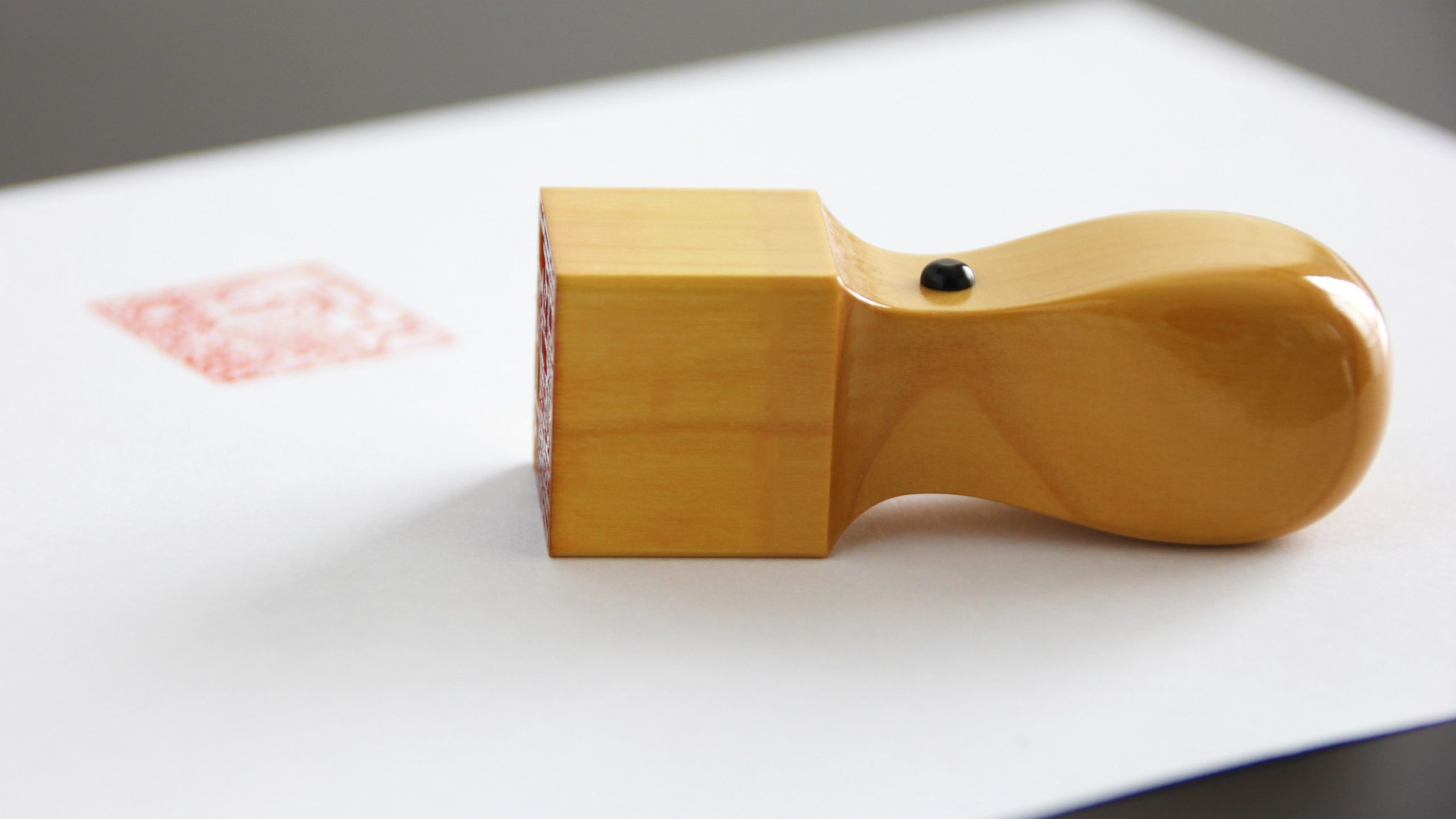
You have just rented an apartment in Japan. The contract runs to forty pages. The agent slides it across the table, points to a column of red circles printed down the margin of each page, and says: here, here, here, and here. You reach for the pen you brought. The agent produces a small cylinder of carved stone, no larger than a lipstick, presses it into a pad of deep red paste, and demonstrates what is needed. Not a signature. A stamp.
This is the hanko (判子) — or, in its more formal register, the inkan (印鑑). It has served as the binding mark of identity in Japan for over a thousand years. It predates the standardized handwritten signature in most of the world, and despite a serious government push to eliminate it from administrative life, it remains embedded in contracts, bank accounts, marriages, and property transfers in ways that resist quick removal.
Understanding it requires understanding not just what it is but what it is meant to guarantee — and why that guarantee turned out to be surprisingly difficult to replicate.
Table of Contents
- What hanko literally is
- Three types and when each applies
- Shuniku: the ink that is not ink
- When it is legally required
- The digital reform push and where it stalled
- Foreigners and the hanko problem
- The principle underneath
What hanko literally is
A hanko is a small cylindrical seal — typically 10–18 mm in diameter — carved with a person’s name in a stylized script and pressed in ink to produce a circular imprint. The material varies: cheap ones are carved from synthetic resin or wood; mid-range ones from harder woods like tsuge (boxwood); expensive ones from animal horn, stone, or crystal. The carving style ranges from legible block characters to highly abstract tensho (篆書) script that requires expertise to read.
The terminology distinction matters: hanko and inkan refer to the same object, but usage differs slightly. Hanko is the colloquial term for the stamp itself. Inkan is more formal and often refers specifically to a registered seal — one that has been submitted to the municipal government and recorded against your identity. Unregistered seals are also called mitome-in or mitome hanko. The overlapping vocabulary confuses even native speakers in casual conversation.
The name inscribed is typically the family name only. This means that two members of the same family can theoretically use the same hanko — an aspect of the system that has always carried a structural weakness, returned to below.
Three types and when each applies
Japanese adult life tends to require three distinct seals, each for a different tier of transaction.
The jitsuin (実印, “real seal”) is the highest tier. This seal is registered with the municipal office (jūminhyō toroku) and comes with a certificate of registration (inkan shōmeisho). To use your jitsuin on a document, you typically present the certificate at the same time, proving that the seal in your possession matches the registered record. The jitsuin is used for the most consequential transactions: real estate purchase and sale contracts, vehicle registration, and — in combination with a witness signature — for certain legal documents. Losing a jitsuin requires immediate notification to the municipal office and cancellation of the registration, because anyone in possession of the seal and its certificate can act as you.
The ginkō-in (銀行印, bank seal) is registered with your bank and used only for banking transactions. Most people keep it completely separate from their jitsuin — the reasoning is security through separation. If your bank seal is stolen, the damage is limited to your accounts; your property transactions are unaffected.
The mitome-in (認め印, acknowledgment seal) is unregistered and used for everyday transactions: signing for package delivery, internal company documents, casual agreements. Most Japanese adults have one of these — a mass-produced seal with their common family name, bought at a stationery shop for a few hundred yen. The name mitome comes from mitomeru (認める), to acknowledge or recognize — this seal acknowledges; it does not legally bind in the way the jitsuin does.
Shuniku: the ink that is not ink
The red paste used with hanko is called shuniku (朱肉) — literally “cinnabar flesh.” Traditional shuniku was made from shu (朱, cinnabar or vermilion pigment) mixed with castor oil and silk fibers, producing a paste with the consistency of thick clay. It dries to a matte finish on paper and resists fading for decades. High-quality shuniku is still formulated this way; cheap versions use synthetic pigment in silicone-based carriers.
The color red is not arbitrary. In East Asian ritual and administrative tradition, red is the color of authority — documents sealed in red by officials carry legal force; red stamps on certificates and ID documents signal authenticity. The shuniku pad connects the personal seal to that larger tradition of red as mark of legitimacy.
The physical act of inking — pressing the seal into the pad with a slight rotation to ensure even coverage, then pressing it onto paper with controlled, direct pressure — requires practice to do cleanly. An uneven impression, a smear, or an impression made at an angle is considered careless and sometimes prompts the request to redo it. Receiving a clearly executed impression is a form of due care. This detail matters because in high-stakes transactions, the quality of the impression can be grounds for a document to be returned.
When it is legally required
The hanko retains legal primacy in a specific set of transactions where Japanese law has not yet accepted digital or handwritten alternatives:
Real estate transactions over ¥5 million require the jitsuin and its certificate. Property registration at the hōmukyoku (法務局, Legal Affairs Bureau) requires a physical impression. Marriage registration (konin届, konin-todoke) at the municipal office requires the seals of both parties — though this requirement was relaxed in 2021 for the civil registration form, a significant exception. Divorce registration similarly. Vehicle registration and transfer. Proxy documents (inin-jō, 委任状) for acting on behalf of another person in a legal matter.
The corporate equivalent is called the kaishaiban (会社判) or jitsuinkan (実印鑑): a company seal registered with the registry office, required for corporate contracts, board resolutions, and filing with government agencies. The physical custody of the company seal has historically been the responsibility of the company’s official administrator, and its loss or theft can legally paralyze certain corporate actions until a new seal is registered.
The digital reform push and where it stalled
In 2020, Prime Minister Yoshihide Suga made the elimination of hanko requirements a centerpiece of his administrative digitization agenda. The Deji-in (デジ印) controversy — as it was called in some press — highlighted a genuine inefficiency: millions of hours annually spent by workers physically traveling to offices to affix seals to documents that could be processed digitally.
Progress was made. The civil registration for marriage and divorce no longer requires a hanko. Many government submission forms that previously required a physical seal now accept digital signatures or online ID verification through the My Number (マイナンバー) card system. Some private sector companies eliminated internal hanko requirements entirely, replacing them with digital workflow approval.
What did not change: the legal infrastructure around property, vehicles, and registered corporate activity. The jitsuin system is embedded in the legal code at a depth that requires separate legislation to modify. The hōmukyoku registration system has not moved to accept digital signatures as a full equivalent. Banks remain conservative — some have moved to digital authentication for standard transactions but retain physical seal requirements for account opening or high-value operations.
The result is a reform that has trimmed the everyday burden of hanko in administrative life while leaving the high-stakes legal infrastructure mostly intact. The hanko has not been abolished. It has been partially displaced — in the middle tier of transactions, replaced by digital alternatives; at the top, still entrenched.
This is consistent with how Japan tends to handle legacy institutions: the core is preserved, the periphery adapts. See the discussion of business card protocol in Japanese business card etiquette for a parallel case — a practice being gradually modernized while its core logic remains in place.
Foreigners and the hanko problem
Foreign residents in Japan face a practical issue: their names are typically not registered in the standard kanji or katakana format, and the jitsuin registration process requires a name matching the official address register. A foreign national registered under their Roman-script name can register a hanko carved with their name in Roman characters — this is now explicitly permitted. A hanko carved in katakana phonetic equivalents of a foreign name is also accepted in most cases.
The more immediate problem is the mitome-in for everyday use. Generic name seals sold at stationery shops cover the most common Japanese family names — Yamamoto, Tanaka, Sato. A foreign resident named Harris or Kowalski will not find a pre-made seal at the convenience store and will need a custom one carved. Several shops in major cities and online services specialize in exactly this, turning around a custom seal in 24 hours for ¥1,000–¥5,000 depending on material.
For apartment rental, the most common stumbling block, most landlords now accept a handwritten signature in lieu of a hanko for foreign tenants — but it is worth asking explicitly before arriving at the signing, because agents will assume a seal is available unless informed otherwise.
The principle underneath
The persistence of the hanko in the face of clear digital alternatives says something about how identity and authority are structured in Japanese administrative culture. A handwritten signature, in the Western legal tradition, is assumed to be unforgeable because it requires the unique motion of a unique hand. A seal is assumed to be authoritative because it is registered — linked to an official record that verifies its authenticity independent of the person wielding it.
This is a different theory of identity verification. It trusts the system of registration over the uniqueness of the biological body. The weakness — that anyone who physically possesses the seal can use it — is acknowledged and partly mitigated by the two-document requirement for the jitsuin (seal plus certificate). The strength is that the verification process is entirely bureaucratic and therefore auditable: you check the seal against the register, not against a person’s handwriting.
The etiquette and social codes of Japanese administrative life more broadly reflect this preference for legible, registered structures over individual expression. The hanko is one instance of a deeper pattern: identity in Japan is constituted through recognized forms, not individual performance. The seal is not you — it represents your registered relationship to the state, the bank, and the legal system. What it stamps, the system vouches for.