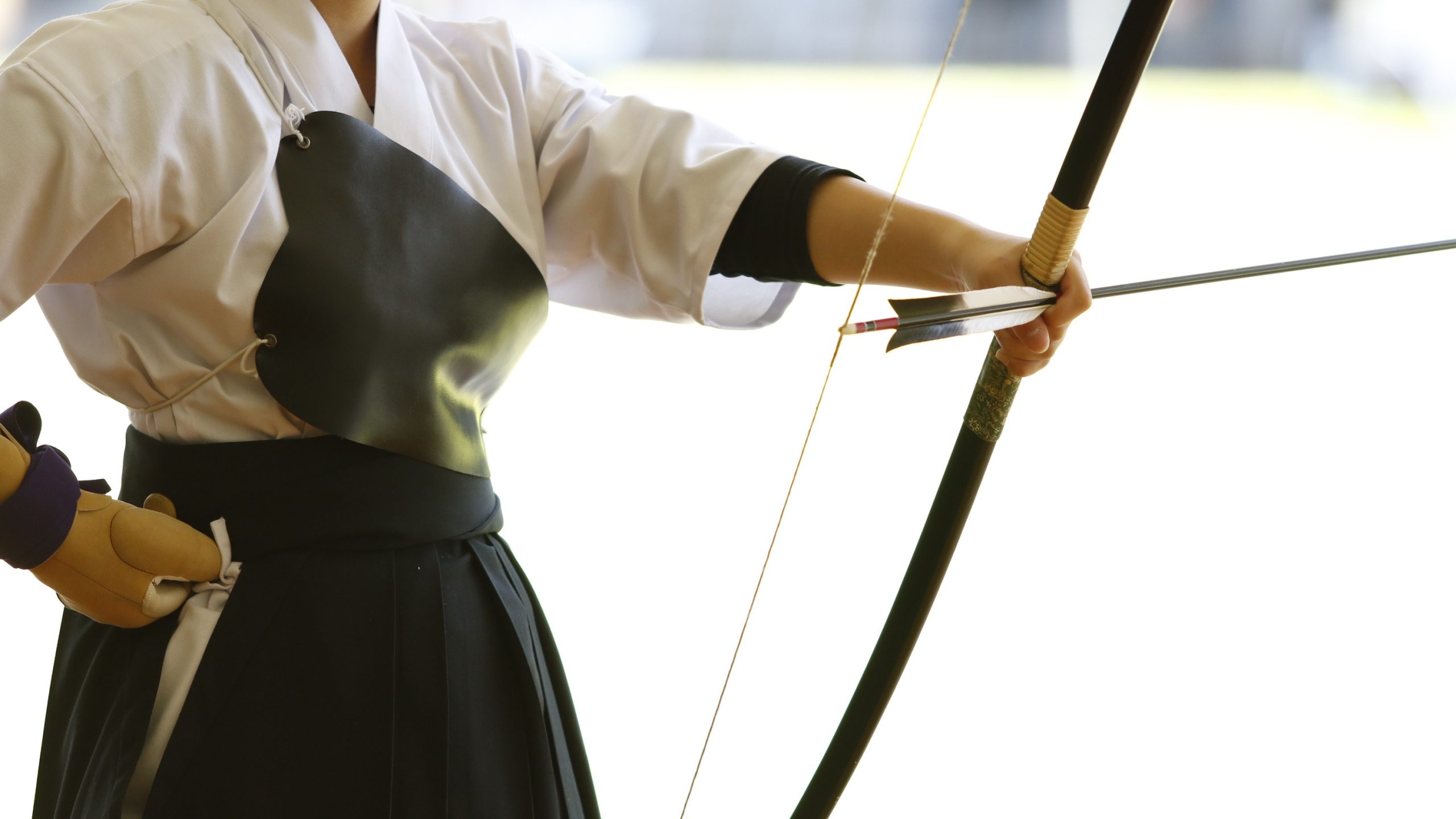
In a long narrow archery hall (kyudojo), an archer in white kimono and divided black hakama trousers stands at one end. At the other end, twenty-eight metres away, a circular target hangs against a sand-filled backstop. The archer raises a tall bow above her head, lowers it slowly while drawing the bowstring back — the bow growing into a long curve, the arrow pulled past her ear — and holds the position. Several seconds pass. Then she releases. The arrow flies, hits the target near the centre, and the wooden frame absorbs the impact with a clean thud. She lowers the bow without expression and steps backward to give the next archer the space.
This is kyudo (弓道), the Japanese way of the bow. It descends from the kyujutsu battlefield archery of the samurai era but has been transformed in the modern period into something closer to a meditative discipline than to a combat skill. The bow itself — long, asymmetric, made of laminated bamboo and wood — is unique to Japan. The shooting technique, the preparatory rituals, and the entire framing of the practice as do (a “way”) rather than as jutsu (a “technique”) all distinguish kyudo from archery as practiced anywhere else in the world.
This article traces what kyudo is technically, the asymmetric bow that defines it, the eight-step shooting sequence (hassetsu) that organises every arrow, why hitting the target is not necessarily the goal, and how the discipline has become an unusual export in the modern global martial-arts landscape.
Table of Contents
- What kyudo is
- The asymmetric bow
- Hassetsu, the eight stages
- Shin, zen, bi
- Hitting and missing
- From kyujutsu to kyudo
- The Zen association
- International practice
What kyudo is
Kyudo is the modern Japanese discipline of archery, practiced as a form of physical, mental, and spiritual training. A practitioner — kyudoka — typically practices in a dedicated facility called a kyudojo, dressed in formal traditional clothing (white kimono jacket, black hakama divided trousers), and shoots specific Japanese-style arrows from a Japanese-style bow at a target placed at a standardised distance.
The standard target distance for indoor practice is 28 metres, with the target measuring 36 centimetres in diameter. This is a substantial distance, requiring serious technique to shoot accurately. There is also a longer-range outdoor practice (enteki) at 60 metres with a larger 1-metre target, used in some traditional schools and competitions.
A typical practice session consists of multiple sets of shots, with the archer moving through carefully prescribed steps each time: entering the shooting line, taking position, raising the bow, drawing, releasing, lowering, and stepping back. Each step has its own form and expected duration; the entire shooting cycle for a single arrow may take a minute or more, with most of that time devoted to preparation rather than the actual release.
This deliberate pace is one of the most distinctive features of kyudo compared to other archery traditions. Olympic archery shoots arrows quickly, with multiple shots per minute. Kyudo archers may shoot only twenty or thirty arrows in an hour-long practice session. The practice is not about volume but about depth — the quality of each shot.
The asymmetric bow
The yumi — the kyudo bow — is one of the most distinctive bows in any archery tradition globally. It is asymmetric: the handgrip is positioned not at the centre of the bow but at roughly the lower third, with the upper limb being noticeably longer than the lower limb. The bow is also extremely long — typically over 220 centimetres, often around 224 centimetres for a standard adult bow. This makes it taller than the archer using it.
The asymmetry is functional. The bow originally evolved for use from horseback during the samurai era, where the lower limb needed to clear the horse’s neck. Even after the bow was adapted for foot archery, the asymmetric design was retained because it produced specific stability and release characteristics. The result is a bow that looks unbalanced to anyone familiar with Western archery but that operates within its own coherent design logic.
The construction is laminated. A traditional yumi is made from bamboo and wood layers glued together — outer bamboo strips, middle wood core, inner bamboo facing. The lamination requires specialist craftsmanship; bow-making is a specific shokunin discipline with its own master traditions. A high-quality bamboo yumi takes weeks to construct and costs substantially more than synthetic bows. Synthetic versions made with fibreglass or carbon fibre are available and are often used for practice; traditional bamboo bows are reserved for serious students and formal contexts.
The string (tsuru) is made of hemp or synthetic fibres twisted into a heavy cord. The arrow rest (where the arrow sits during draw) is on the right-hand side of the bow handle, opposite to most Western bows. This means the arrow is drawn over the bow rather than under it, and the bow is rotated slightly during release in a motion called yugaeri — the bow turns in the hand as the string is released, completing roughly a half-rotation. This rotation absorbs energy and is part of why kyudo has its characteristic clean release.
Hassetsu, the eight stages
Every shot in kyudo is performed according to hassetsu (八節), the eight prescribed stages. These are:
1.
Ashibumi (足踏み) — footing. The archer establishes a firm stance with feet at proper width and angle.
2.
Dozukuri (胴造り) — torso preparation. The archer adjusts hips, spine, and shoulders to a stable upright posture.
3.
Yugamae (弓構え) — readying the bow. The archer adjusts grip, sets the arrow on the string, and prepares the body for the shot.
4.
Uchiokoshi (打起し) — raising the bow. The bow is raised vertically above the head while still held with relatively low tension on the string.
5.
Hikiwake (引分け) — drawing apart. The bow is brought down while the string is drawn back to the archer’s ear, with the bow held at full draw extending across the body.
6.
Kai (会) — full draw / meeting. The archer holds the full draw position, the arrow drawn to the ear, and waits for the moment of release. This is the longest sustained position of the shot.
7.
Hanare (離れ) — release. The arrow is released, with the bow rotating forward in the yugaeri motion.
8.
Zanshin (残心) — remaining mind / continuation. The archer holds the post-release position, maintaining awareness and form before lowering the bow.
The hassetsu is not optional. Every shot in formal practice is performed through this sequence, with attention to the form and quality of each step. Beginners learn the steps individually before assembling them into complete shots. Advanced practitioners may perform a single shot for over a minute, devoting substantial time to kai (full draw) before release.
Each step has specific technical requirements that are evaluated by senior practitioners. Kai, in particular, is supposed to be a state in which the archer’s body, mind, and bow have reached a unified balance — the release should happen not because the archer decided to release but because the unified state has reached completion. This is a high standard that takes years to approach reliably.
Shin, zen, bi
Modern kyudo practice is often summarised through the phrase shin-zen-bi (真善美) — “truth, goodness, and beauty.” This phrase represents the three aims of the discipline: technical truth (correct form), ethical goodness (proper attitude and respect), and aesthetic beauty (the visible elegance of well-executed shooting).
These three aims operate together. A shot that hits the target through poor form is incomplete — it lacks shin (truth) even if the arrow lands well. A shot performed with technically correct form but with anger or impatience lacks zen (goodness). A shot that lacks the visible grace of fluent movement lacks bi (beauty). The ideal is a shot that succeeds on all three measures simultaneously: correct form, calm intention, beautiful execution.
This three-fold framing distinguishes kyudo from most other archery traditions. Western competitive archery focuses on accuracy: did the arrow hit the target, and how close to the centre? Kyudo takes accuracy as one factor among others, and the others — form quality, mental state, aesthetic completeness — can be more important than where the arrow lands.
The framing has roots in older Japanese aesthetic theory and in Confucian ethical thought. The idea that practice has aesthetic, ethical, and technical dimensions runs through many traditional Japanese disciplines, and kyudo makes the three dimensions explicit in its evaluation criteria.
Hitting and missing
A famous aspect of kyudo in popular discussion is the saying that hitting the target is not the goal. This is true but requires unpacking. Kyudo practitioners do hit the target, and accuracy is part of the discipline. But the orientation toward accuracy is different from competitive archery.
The traditional formulation is that a properly performed shot — one with correct hassetsu, calm mind, unified body, and beautiful execution — will tend to hit the target. The accuracy is the consequence of the practice, not the goal. Aiming for the target directly, without regard for the form that produces accuracy, is considered a beginner’s error — and a category error in the discipline’s logic.
The implication is that an archer who hits the target through luck or through compromised form has not actually shot well. Conversely, an archer who misses the target after a shot of perfect form has shot well in the relevant sense, even if the arrow lands poorly. The form is the substance; the result follows from the form.
This is genuinely how senior teachers evaluate practice. A student who lands every arrow but with stiff or rushed form will be corrected; a student who misses arrows but with developing form may be praised. The pedagogy is oriented toward building the form first, with accuracy expected to develop later.
In practice, of course, accurate form does produce accuracy, and senior kyudo practitioners hit targets reliably. The teaching framework simply reverses the usual order of priority: form first, accuracy as result.
From kyujutsu to kyudo
The Japanese sword arts evolved from kenjutsu (technique) to kendo (way) in the modern period; the bow arts followed a similar trajectory from kyujutsu to kyudo. The change was both nominal and substantive — a different name signalling a different orientation.
Kyujutsu — the older tradition — was practical battlefield and hunting archery. It included multiple schools (ryu) with different techniques optimised for different contexts: mounted archery (yabusame), foot archery from various distances, military shooting in coordinated battlefield formations, ceremonial archery for shrine rituals. Each school had its own techniques, its own bow variants, and its own training curriculum.
The Meiji Restoration (1868) ended the samurai class and removed most of the practical justifications for kyujutsu. The bow had already been losing relevance to firearms; the social abolition of the samurai removed its remaining cultural anchor. Many kyujutsu schools dissolved or shrank substantially in the late 19th century.
What replaced them was kyudo as a modern discipline. The Dai Nippon Butokukai (which also reorganised kendo) helped formalise kyudo as a unified practice with standardised techniques. The form was simplified — many of the school-specific variations were merged into a more uniform contemporary practice — and the framing was reoriented from combat preparation to self-cultivation. The All Nippon Kyudo Federation, founded in 1949, became the modern governing body and continues to define the contemporary practice.
Some kyujutsu lineages have survived alongside modern kyudo. Schools like Ogasawara-ryu, Heki-ryu, and others maintain older tradition of mounted archery, ceremonial shooting, and pre-modern technique. These coexist with mainstream kyudo and serve different communities. Visitors to certain Shinto shrines can still see yabusame (mounted archery) demonstrations during festivals — preserving forms of the original kyujutsu that kyudo has otherwise moved past.
The Zen association
The single book that has most shaped non-Japanese understanding of kyudo is Zen in the Art of Archery by Eugen Herrigel, published in 1948. Herrigel, a German philosopher, studied kyudo in Japan in the 1920s under the master Awa Kenzo and wrote about his experiences in a framing that emphasised Zen Buddhist philosophy and the relationship between the archer’s mind and the bow’s release.
The book has been enormously influential, particularly in Western introductions to Japanese culture. It is often cited as a starting point for Westerners interested in kyudo, in Zen, or in Japanese martial arts generally. The phrase “the bow shoots the arrow” — describing the desired state in which the archer’s intention has dissolved into the unified moment of release — has become widely quoted.
The book has also been criticised, particularly by scholars of kyudo and Zen, for overstating the connection between kyudo and Zen Buddhism specifically. Awa Kenzo’s teaching was distinctive and may not have represented mainstream kyudo of the period. The Zen framing was more Herrigel’s interpretation than the canonical understanding within Japanese kyudo. And the book’s romantic, almost mystical tone has produced a certain kind of Western expectation about kyudo that does not always match the more practical, technical experience of actually practicing.
That said, the connection between kyudo and meditative attention is real. The long held positions, the focus on breath, the requirement of mental stillness during draw — all of these create conditions for meditative awareness. Whether one calls this Zen or simply concentration, the practice of kyudo genuinely does cultivate mental states that overlap with what meditation traditions describe.
International practice
Kyudo has spread internationally to a moderate but committed degree. The International Kyudo Federation has affiliated organisations in over thirty countries. Kyudojo exist in major cities across Europe, North America, South America, and Australia. Japanese teachers travel to give seminars; international students travel to Japan for extended training periods.
The international community is small relative to other martial arts. The space requirements (a 28-metre shooting range), the cost of bows and equipment, and the relative obscurity of the discipline compared to karate or aikido limit broader appeal. Those who do practice kyudo internationally tend to be deeply committed — the casual student who quits after a year is rare in kyudo circles.
The exchange has been respectful in both directions. Japanese teachers have generally welcomed serious foreign students and have travelled extensively to support international practice. Foreign students in turn have generally engaged seriously with Japanese cultural elements of the practice rather than treating it as a sport to be adapted to local preferences. The result is that kyudo practiced in Berlin or San Francisco looks remarkably similar to kyudo practiced in Tokyo, with the same hassetsu, the same equipment, and the same evaluation standards.
What kyudo offers, in the end, is a discipline that converts a martial activity into a meditative one without losing the technical substance. The bow is real; the arrows fly; the targets are hit or missed. But the orientation of practice — toward form, toward attention, toward the unified state of kai — turns each shot into a small exercise in concentration that has its own value beyond the question of accuracy. This is what survives when battlefield archery is removed from the equation, and it is what continues to attract practitioners to a discipline that asks for years of patient repetition before it begins to give back what it can give.