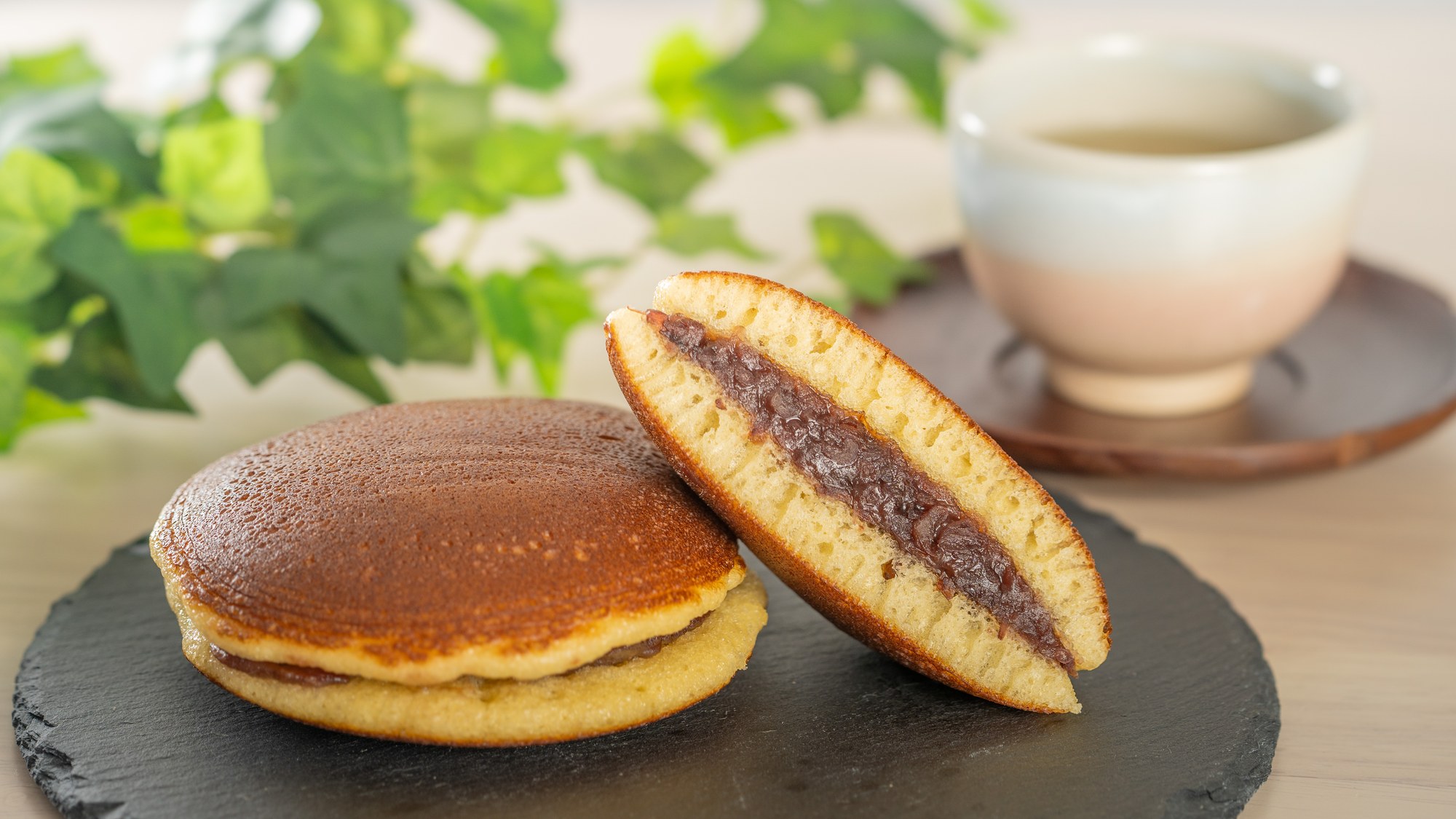
Two small golden-brown pancakes, about the size of a teacup saucer, are pressed around a generous layer of sweet bean paste. They are slightly domed rather than flat, soft in the hand, and easy to eat in a few quiet bites. In Japan they show up everywhere: in supermarket sweet aisles, at convenience stores, in department-store basements, and on plates beside afternoon tea.
This is dorayaki (どら焼き), a small, soft sandwich you can eat with one hand. It sits somewhere between a pancake and a traditional Japanese sweet, which is part of its charm: familiar enough that it does not need explaining, but still unmistakably tied to wagashi culture. Its strongest modern association is with Doraemon, the blue robot cat who has been chasing dorayaki across manga and anime for decades.
This article looks at what makes a dorayaki a dorayaki: the pancakes, the anko, the gong-shaped name, the Doraemon effect, and the reason this modest shop sweet became one of the Japanese confections people recognise even outside Japan.
Table of Contents
- What dorayaki is
- The pancakes
- The anko
- The name and the gong
- The Doraemon association
- Variations and experiments
- How it is made
- In the everyday
What dorayaki is
A dorayaki consists of two small round pancakes, usually about seven to ten centimetres across, with sweet bean paste sealed between them. The pancakes are not thin like French crepes. They are thicker and more cake-like, with a slight dome and a dappled brown surface from the griddle.
That colour matters. A good dorayaki has a deep golden exterior, sometimes with darker spots where the batter touched the hot surface. Inside, the pancake is paler and more yellow, especially where the egg-rich batter shows after the first bite. The contrast is one of the little pleasures of eating one.
The filling is traditionally anko, sweet azuki bean paste. The amount is important. A well-balanced dorayaki has enough anko to feel generous, often a centimetre or more in the middle, with the filling showing slightly at the edge. Too little makes the whole thing feel dry; too much turns a tidy snack into a sticky one.
The whole sweet is firm enough to pick up without ceremony. You hold it between your fingers and bite straight in. That portability is one reason dorayaki works so well as an everyday snack rather than something reserved for a formal tea setting.
The pancakes
The pancake batter is made from flour, eggs, sugar, and a small amount of leavening agent — typically baking soda. Some recipes use honey or mirin in addition to or in place of part of the sugar, which contributes to the deeper colour and a slightly more complex flavour. The batter is liquid but thick, with a pourable consistency similar to American pancake batter.
The cooking is done on a flat hot griddle (tetsuita) at moderate temperature. Each pancake is poured as a measured circle, allowed to cook until small bubbles form on the surface and the bottom has darkened, then flipped and finished briefly on the second side. The shape comes from the consistency of the batter rather than from any kind of mould; thicker batter holds a domed shape, while thinner batter spreads flat.
The pancake itself is mild and slightly sweet, close to a Western pancake but with stronger egg and honey notes. On its own it is pleasant but not especially memorable. Its real job is to soften and balance the anko, not to compete with it.
The texture of a fresh pancake is moist and slightly springy; the texture of a stale or refrigerated pancake is denser and drier. Most commercial dorayaki is sealed in plastic packaging that preserves freshness for several days, and the pancakes maintain a reasonable softness during that period. After about a week the texture begins to suffer.
The anko
The anko in a dorayaki is normally tsubuan — chunky, with whole beans visible — though some makers offer koshian (smooth) versions for a different texture. The bean paste is made the same way it is for daifuku and other traditional sweets: simmering azuki beans with sugar over a long, slow cook until the liquid reduces and the beans break down into a paste.
What matters in dorayaki is not only the flavour of the anko, but how it behaves. It has to be thick enough to stay put between the pancakes, even when you bite down. If it is too soft, it squeezes out. If it is too firm, the whole sweet feels heavy. Good shops get this texture exactly right.
Some shops have built their reputations almost entirely on that balance. Usagiya in Tokyo’s Ueno district, founded in 1913, is the famous example. Its dorayaki is often treated as the standard version, and the lines outside the shop on busy weekends make it clear that this is not just nostalgia talking.
Modern variations sometimes substitute or supplement the anko with other fillings — whipped cream, matcha paste, chestnut paste, custard. Traditionalists view these as deviations rather than improvements, but they have a real market presence and have helped keep dorayaki visible in a sweets landscape that is dominated by Western-influenced desserts.
The name and the gong
The name dorayaki (どら焼き) translates literally as “gong-grilled” or “gong-baked.” Dora (銅鑼) is a brass or bronze gong, and the word yaki refers to the cooking method — yaki is the same character used in yakitori (grilled chicken) and takoyaki.
There are two main stories about the name. The simpler one is visual: the round pancake looks like the face of a dora gong. Both are flat, round, golden-brown discs, so the connection is easy to see.
The second story — more colourful but probably apocryphal — involves the medieval samurai-monk Benkei. According to the legend, Benkei was injured during his travels and stayed in a peasant’s house to recover. Before leaving, he is said to have left his gong behind, and the household used it as a griddle to cook a sweet honey-batter pancake. The pancake took the name of the cooking surface.
Whichever story is closer to true, the name dorayaki was in use by the late Edo period in some form, though the modern double-pancake-with-anko configuration is more recent. Earlier versions were single pancakes folded over the filling like a turnover, or simply pancakes served with bean paste alongside. The double-pancake sandwich format that we now recognise as dorayaki solidified in the early 20th century.
The Doraemon association
For many people in Japan and far beyond it, dorayaki is inseparable from Doraemon, the blue robot cat from Fujiko F. Fujio’s manga series. Doraemon has a fourth-dimensional pocket full of impossible gadgets, but his most ordinary weakness is just as famous: he loves dorayaki.
The manga and anime return to the gag constantly. He buys boxes of them, hides them, fights over them, and occasionally treats them with the urgency of a cosmic emergency. Generations of children grew up with that image, which is why many adults still cannot see dorayaki without thinking of Doraemon first.
The branding followed naturally. Confectionery companies sell Doraemon-themed dorayaki with character marks stamped into the pancake. Theme parks sell oversized novelty versions. Convenience stores bring out limited collaborations. Because Doraemon is also popular across Asia and Latin America, many children outside Japan know the word dorayaki from the show before they ever taste the sweet itself.
This pairing has strengthened dorayaki‘s position in modern Japanese food culture. Many traditional confections lack a strong popular-culture anchor; dorayaki‘s Doraemon connection means it has continued cultural relevance with younger generations even as the original 19th-century context has faded.
Variations and experiments
The dorayaki form has proved adaptable. Beyond the traditional anko version, common modern variants include:
Cream dorayaki (生クリームどら焼き): with whipped cream replacing or supplementing the anko. Often combined with fruit — a slice of strawberry, banana, or kiwi inside.
Matcha dorayaki: with matcha-flavoured anko, or with a matcha-batter pancake giving the exterior a green colour.
Kuri dorayaki: with chestnut paste or a whole sweet chestnut (amaguri) embedded in the anko. Particularly popular in autumn.
Shio dorayaki (salt dorayaki): with a small amount of salt added to the anko to balance the sweetness. A reform-minded variation.
Mini dorayaki: smaller, two-bite versions sold in multipacks. Common at convenience stores and in lunch boxes.
The willingness to experiment has kept dorayaki commercially alive. Each season brings limited flavours from major confectioners: sweet potato in autumn, strawberry in spring, sakura during hanami season. The basic shape barely changes, but the fillings give people a reason to notice it again.
How it is made
Making dorayaki at home is more approachable than it looks. The pancakes need no special equipment beyond a flat skillet or griddle, and the batter uses ordinary ingredients. Pre-made anko is sold in cans and packets at Japanese grocery stores, though patient cooks can make it from dried azuki beans.
The basic process is simple: combine flour, sugar, eggs, a little baking soda dissolved in water, and optional honey or mirin. Whisk the batter smooth, let it rest for 15-30 minutes, then pour neat rounds onto a moderate-heat skillet. Once bubbles appear, flip the pancakes and finish them briefly on the second side. Let them cool before sandwiching a generous layer of anko between two pieces.
The most common mistake is heat that is too high, which produces pancakes that are dark on the outside but raw inside. Patient moderate-temperature cooking yields the canonical golden-brown surface and properly cooked interior.
The cooled pancakes can be made in advance and assembled later. Sealed in plastic wrap or an airtight container, finished dorayaki keeps for about three days at room temperature and longer refrigerated, though refrigeration affects the texture.
In the everyday
Dorayaki is one of the easiest traditional Japanese sweets to find in modern Japan. Convenience stores stock packaged versions year-round. Supermarkets carry branded and own-brand varieties. Specialist wagashi shops sell fresh versions made that day, and train station shops often offer regional versions with local fruit or seasonal fillings.
A dorayaki can be an afternoon snack with green tea, an after-school treat, a small gift to bring to someone’s house, or a quick convenience-store bite on the way home. It is sweet without being overwhelming, traditional without feeling formal, and sturdy enough to carry in a bag.
Internationally, dorayaki has spread mainly through East Asian markets and through Japanese specialty shops in Western cities. The Doraemon association has helped recognition; many foreign travellers seek out dorayaki in Japan specifically because of the cartoon, even if they had never previously encountered the confection. The supply has expanded to meet this demand, with airport gift shops, Don Quijote tourist stores, and major confectionery chains all stocking dorayaki in tourist-accessible formats.
What dorayaki shows is how easily a traditional sweet can carry a modern pop-culture story without losing itself. Doraemon did not make dorayaki less authentic; he made it more visible. A sweet that may have begun as a shop experiment, borrowed its name from a gong, settled into its anko-filled form, and became the favourite food of a fictional blue robot cat still sits quietly on supermarket shelves beside chocolate bars and modern desserts: small, round, faintly sweet, and unmistakably itself.