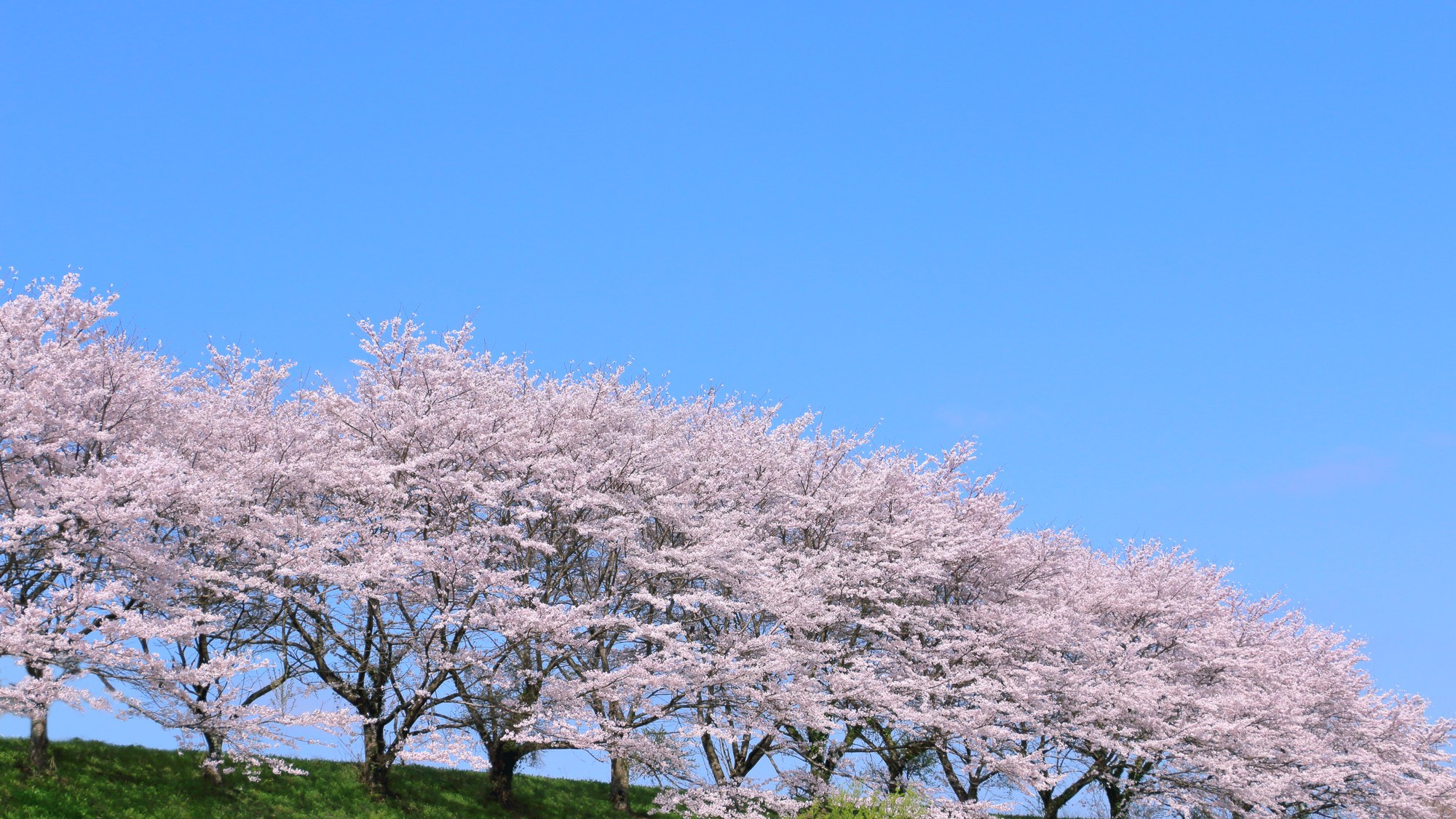
For about ten days each spring, large parts of Japan reorganize themselves around looking at trees. Office workers send the most junior employee to a park at dawn to spread a blue tarp and hold a spot beneath a particular row of branches. Convenience stores stock a temporary wave of sakura-themed snacks. Weather forecasts add a separate map showing the bloom front advancing northward across the country, day by day. Then, when the trees in a given city open, the parks fill — families on tarps, friends with bento boxes and beer, salarymen still in suits eating directly under the canopy, the petals starting to drift down within a few days of opening and gone within two weeks. This is hanami (花見), and the standard English description — “cherry blossom viewing” — captures the tree-watching part while missing what the form is actually doing.
Hanami is not really about looking at flowers. Looking at flowers is the occasion; what hanami is for is something more specific — a country-wide ritualized acknowledgment of brevity, conducted through picnics. Understanding what makes the form work means understanding the species, the forecast, the social choreography, and the aesthetic concept the whole thing is calibrated around.
Table of Contents
- What the word literally is
- The species (and why it matters)
- The forecast as national infrastructure
- The format of an actual hanami
- The mono no aware connection
- Yozakura — night cherry-viewing
- Beyond cherry: ume and momiji
- The tourism export
- The principle underneath
What the word literally is
花見 (hanami) reads as hana (花, flower) + mi (見, looking, seeing). Literally: “flower-looking.” Despite the generic name, in modern usage hanami almost always specifically means cherry blossom viewing. If you mean plum-blossom viewing, you say umemi (梅見). If you mean autumn-leaf viewing, you say momiji-gari (紅葉狩り). Hanami unmodified defaults to sakura.
The practice has documented roots in the Nara period (8th century) and was formalized in the Heian court, which originally focused on plum blossoms imported from China. The shift toward cherry blossoms as the canonical hanami flower happened gradually through the Heian and Kamakura periods, with sakura becoming the unambiguous default by the medieval era. By the Edo period (1603–1868), large public hanami in places like Ueno and Asukayama in what is now Tokyo had become a mass urban event, with the ruling shogunate planting cherry trees specifically to encourage public viewing.
The species (and why it matters)
Most of the cherry trees Japanese people view at hanami are a single cultivated variety: Somei Yoshino (染井吉野). This cultivar was developed in the late Edo period in what is now part of Tokyo, and it has two properties that together explain almost everything about modern hanami.
First, Somei Yoshino is a clone. Every Somei Yoshino tree is genetically identical to every other, propagated by grafting rather than seed. This means trees of the same age, in the same climate, bloom at almost exactly the same time. A row of Somei Yoshino along a riverbank does not show staggered bloom — they all open within a day or two of each other and shed within a week.
Second, Somei Yoshino blooms before producing leaves. The flowers appear on bare branches, creating the familiar pure-pink-against-sky effect with no green to dilute it. Other cherry varieties bloom alongside or after their leaves, which is visually beautiful but produces a different, less concentrated impression.
The clone-and-leafless combination is what makes hanami logistically possible. If cherries bloomed on staggered schedules over six weeks, no national forecast and no synchronized social calendar could form around them. The tightness of the bloom — and its visibility against bare wood — is what creates a brief, predictable, country-wide window.
The forecast as national infrastructure
The sakura zensen (桜前線, “cherry blossom front”) is a daily-updated weather map showing the predicted opening date of Somei Yoshino across Japan. The Japan Meteorological Agency and private weather services publish staggered bloom predictions weeks in advance and refine them as spring progresses. The front advances roughly south-to-north and lower-elevation-to-higher, opening in Kyushu in late March, Tokyo in late March or early April, Tohoku in mid-April, and Hokkaido in early May.
For Japanese readers this is treated as practical infrastructure, not novelty. People plan hanami parties around the predicted opening date for their region; companies adjust which weekend they book outdoor venues; families scheduling visits between cities consult the front to see whether the timing will overlap. National news broadcasts include sakura updates alongside ordinary weather. The cherry blossom front is, in effect, a piece of public-good information the country has decided to maintain.
There is no equivalent in most other countries. The closest analogy might be ski-condition reports or fall-foliage maps in regions where those matter — but those are regional, niche services. Cherry blossom forecasting in Japan is a generalized cultural utility.
The format of an actual hanami
A typical hanami in an urban park has a recognizable shape:
The reservation. Popular parks fill from before dawn on hanami weekends. In some companies, the most junior employee is assigned to arrive at 6 or 7 a.m. with a blue plastic tarp, mark out the group’s territory under a chosen tree, and hold the spot for hours until the rest arrive. This task — basho-tori (場所取り, “place-taking”) — has become a famous shorthand for the texture of new-employee life. The tarp. Almost all ground-level hanami uses a blue plastic tarp (būrū shīto), spread flat with shoes removed at the edge. Why blue is universal is partly a manufacturing accident — blue tarps are cheap and durable — but the effect is striking from above: parks turn into mosaics of blue rectangles under pink canopies. The food and drink. Bento boxes, convenience-store snacks, beer, sake, soft drinks. Some hanami are catered with seasonal sakura-themed foods (mochi colored pink, sakura-leaf-wrapped sweets); many are casual potluck. Drinking is normalized; loud cheerful conversation is normalized. The viewing. The tree itself is the framing device, but most of the actual time is spent talking, eating, and being together. People look up at the canopy, take photographs, comment on the petals — but the activity is more like a rooftop dinner party using the sky as the ceiling than a contemplative aesthetic exercise. The looking is a pretext for the gathering. The end. When the petals begin to fall, hanami enters its second phase: hanafubuki (花吹雪, “flower-snowstorm”), the swirling shower of petals on a windy day. This is widely considered the most beautiful moment, and also the cue that the season is ending. Within days, the trees go from peak bloom to bare branches with green just starting to appear.
The mono no aware connection
The concept that gives hanami its specific cultural weight is mono no aware (物の哀れ) — the gentle sadness of impermanence, the heightened beauty of things that are about to end. Cherry blossoms are the standard textbook example because their bloom is so visible, so unified, and so brief.
A hanami spent watching petals fall is participating in mono no aware whether the participants articulate it that way or not. The whole social choreography — gather quickly, look closely, accept that this exact configuration of tree and weather and friends will not exist again — enacts the aesthetic. Japanese cultural commentary frequently connects sakura’s brevity to attitudes toward life and death, to the historical aestheticization of warrior death (the falling petal as the falling warrior), and to a generalized appreciation of brief beauty.
This connection should not be over-romanticized. Most contemporary hanami participants are not consciously meditating on impermanence; they’re drinking beer with colleagues. But the cultural framing is there in the background — the reason why cherry blossoms specifically, rather than other beautiful flowers, occupy this canonical place is partly the brevity, partly the historical aestheticization, partly the way the whole country has decided to use these trees as a shared annual marker.
Yozakura — night cherry-viewing
A distinct sub-form of hanami is yozakura (夜桜, “night cherry”), in which trees are illuminated by lanterns or floodlights for evening viewing. Many famous hanami spots — Ueno Park in Tokyo, the Philosopher’s Path in Kyoto, the Meguro River canal — install temporary lighting during peak bloom, and the parks stay open late.
Yozakura has a different character from daytime hanami. The crowds are smaller, the temperature cooler, the lighting transforms the petals into something almost theatrical. Couples and small groups predominate over large company parties. For visitors deciding when to go to a famous spot, the daytime gives you the social texture of hanami; the evening gives you the visual one.
Beyond cherry: ume and momiji
Cherry blossoms get the cultural spotlight, but they’re part of a larger calendar of seasonal viewing:
Umemi (梅見) — plum blossom viewing in February and early March. The plum blooms earlier, in colder weather, and has a sharper fragrance. Plum-viewing is older as a Japanese practice than cherry-viewing — it was the original Heian-era hanami before sakura took over. Plum blossoms are still celebrated at certain shrines (Kitano Tenmangu in Kyoto, Yushima Tenjin in Tokyo) but no longer command a country-wide festival in the way sakura does. Momiji-gari (紅葉狩り) — autumn-leaf “hunting,” the autumnal equivalent of hanami. People travel to mountain temples and parks in November to see Japanese maples in their red and orange peak. Kyoto, Nikko, and the Japan Alps are among the most famous destinations. The format is more often a hike or temple visit than a tarp-and-bento picnic, but the underlying logic — go look at trees doing something temporary together — is the same.
Together these mark the spring and autumn poles of a year that pays close attention to what the flora is doing.
The tourism export
In the past two decades, the international image of hanami has become a major tourism driver. Foreign visitors plan trips around the cherry blossom forecast; international news media run sakura coverage; “cherry blossom season in Japan” is one of the country’s most exported cultural images.
This has produced both real benefits (Japanese tourism revenue, cultural exchange) and real friction (overcrowding at famous viewing spots, behavior conflicts in parks where local hanami norms aren’t shared by visitors). Some of the most famous spots — Yoshino in Nara, the Philosopher’s Path in Kyoto, parts of central Tokyo — have become difficult to enjoy at peak times because of crowd density.
For visiting readers, the practical consequence is that the most famous spot in any given city is rarely the best place to actually do hanami. Local parks, suburban riverbanks, and university campuses with cherry rows give a more relaxed and more authentically domestic version of the experience than the headline destinations.
The principle underneath
What hanami really demonstrates is what happens when a country decides, collectively and over many centuries, that a specific natural event is worth pausing for. The cherry blossom front is not a more beautiful natural phenomenon than autumn leaves in New England, or spring wildflower blooms in California, or jacaranda season in southern Africa. What makes it function as hanami is the unified social commitment to treat it as a moment that the calendar should bend to accommodate.
That commitment is what makes the picnic possible. If only individuals or small subcultures cared about cherry blossoms, you could still go look at them, but you couldn’t book a park, eat with twenty colleagues, watch the same petals fall over the same canal that everyone in the city is watching. The synchronization is the substance — the trees provide the trigger, but the country provides the ritual.
For a non-Japanese reader, the practical takeaway is to treat hanami as a piece of social infrastructure rather than a sightseeing checklist. If you visit Japan during the bloom, the most rewarding thing you can do is go to an ordinary local park on a weekend afternoon, sit on the grass or a tarp at a respectful distance from a Japanese group, and experience the texture of a country temporarily organizing itself around a tree. The trees will be there. The synchronization is the part you can only see in person.