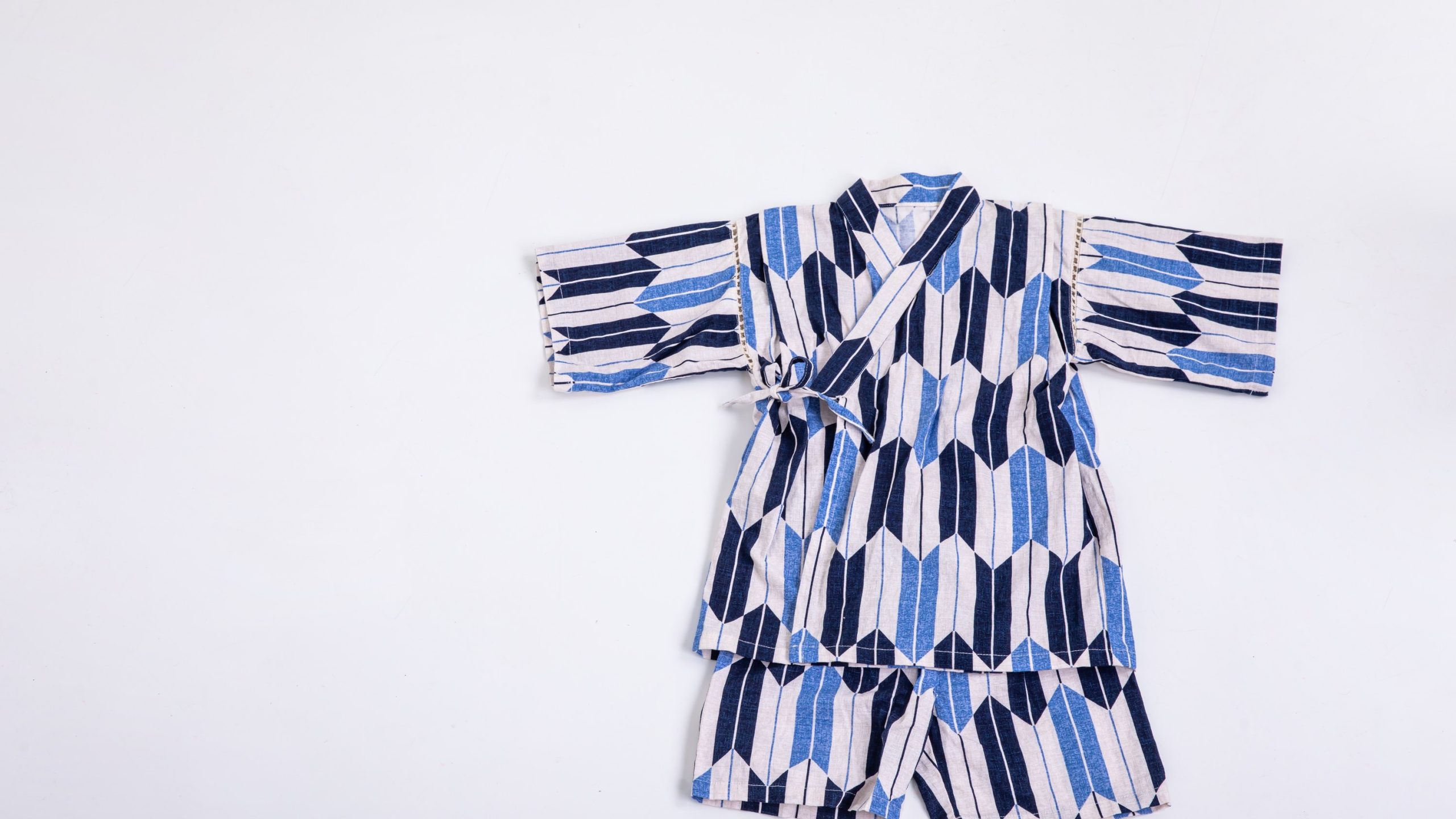
On a hot evening in late July, in almost any Japanese city, you will see men of every age step out in what looks, to the uninitiated, like very comfortable pajamas. A loose short-sleeved top with a V-neck collar, held together with fabric ties at the front. Matching shorts, also tied rather than buttoned, with wide legs that move easily in the heat. Usually in indigo, navy, or some dark-on-light pattern that prints as quietly confident rather than loud. The man wearing this might be heading to a neighborhood festival, to a convenience store, or simply sitting outside in the evening with a beer. He is dressed in jinbei (甚平), and he is completely appropriate for any of these situations.
Jinbei occupies a specific and well-understood slot in Japanese clothing culture — one that is casual, seasonally precise, gendered (though this is shifting), and increasingly interesting to non-Japanese eyes looking for the loose, comfortable silhouette that certain corners of fashion have been chasing for years. It is not a yukata, which is closer to a robe worn at festivals with some formality. It is not a kimono, which is a formal garment. It is something simpler: functional warm-weather wear that happens to be made well.
This article looks at what jinbei is, where it came from, how it differs from its textile relatives, and why it is attracting attention outside Japan.
Table of Contents
- What jinbei literally is
- The two-piece structure
- Jinbei vs yukata: formality and function
- Fabric and construction
- Festival wear and home wear
- Children and women’s jinbei
- The international moment
- The principle underneath
What jinbei literally is
The name jinbei (甚平) is written with characters meaning “very” (甚) and “flat” or “plain” (平). The etymology is genuinely disputed — some accounts connect it to a jinbaori (陣羽織), the sleeveless battle surcoat worn over armor by samurai, suggesting the jinbei as a casualized domestic descendant. Others connect the name to specific historical figures. Neither etymology is settled, and the garment’s precise origin in its current two-piece form is somewhere in the late Edo or Meiji period — the details blurred by the fact that working-class summer clothing was rarely documented with the care given to formal dress.
What is consistent is the garment’s regional and social associations: jinbei emerged from the practical clothing of craftsmen, merchants, and ordinary working people in the hot, humid summers of central and western Japan. It was work and leisure wear, not ceremonial wear, which is why it lacks the elaborate construction rules of the kimono tradition.
The two-piece structure
The defining feature of jinbei is that it is a matched two-piece set: top and shorts sold and worn together. This distinguishes it from the one-piece wraparound structure of a yukata or kimono.
The top (uwagi, 上着): A short-sleeved jacket with a V-shaped front opening. The garment closes with fabric cord ties (himo, 紐) rather than buttons or zippers — typically three pairs of ties, one at the inside left chest, one at the outside left chest, and one at the right side. The sleeve construction is notable: many jinbei tops have sagara (さがら) or musubi construction at the underarm, meaning the sleeve is not fully sewn closed at the bottom but attached only at the top, leaving a gap. This gap allows air to circulate under the arm and across the torso — a genuine ventilation feature, not a stylistic accident.
The shorts (shitabaki or hanbō, 半棒): Wide-legged shorts that fall to roughly mid-thigh or the knee. The waistband is typically a drawstring or, in traditional versions, tied fabric. The leg width gives freedom of movement and allows heat to escape.
The overall silhouette is deliberately loose. Jinbei is designed for thermal comfort in Japan’s July and August heat, when temperatures regularly exceed 35°C and humidity makes close-fitting clothing actively unpleasant.
Jinbei vs yukata: formality and function
The most common point of confusion for non-Japanese observers is the distinction between jinbei and yukata. Both are summer Japanese garments; both are associated with festivals and relaxed settings. But they occupy different positions.
A yukata (浴衣) is a one-piece garment structured like a simplified kimono: a long robe wrapped left over right, held by a sash (obi). It requires a specific wrapping technique and is associated with particular events — summer festivals (matsuri), bon odori dances, hot spring resorts. Wearing a yukata is a small social statement: it signals that you are dressed for an occasion, even if the occasion is relatively casual. Women’s yukata in particular can be quite elaborate, with ornate obi and accessories.
A jinbei makes no such statement. It is ordinary summer clothing. Wearing one to a festival is fine; wearing one to pick up convenience store snacks is equally fine; wearing one at home is the most common use of all. Jinbei lacks the wrapping ceremony and the obi. Getting dressed in jinbei takes roughly the same time and effort as getting dressed in shorts and a t-shirt. This is not a flaw — it is the point.
In terms of formality, yukata sits one or two levels above jinbei. You would not wear jinbei to a tea ceremony or to visit a formal shrine. You might wear a yukata to either. Jinbei is the most relaxed item in the spectrum of Japanese traditional summer clothing.
Fabric and construction
Traditional jinbei uses cotton or linen — both natural fibers that breathe well in heat. The fabric is typically lightweight, with a weave structure that prioritizes air circulation over opacity. Common textile patterns draw from the broad tradition of Japanese wafuku (和服, Japanese clothing) textiles:
- Seersucker (シアーサッカー): A puckered cotton weave that keeps fabric off the skin, increasing air circulation. Common in summer jinbei.
- Komon patterns (小紋): Small repeating geometric or floral motifs — asanoha (hemp leaf), seigaiha (overlapping waves), shibori-dyed spots — in subdued colorways.
- Solid indigo or navy: The most classic and widely worn. Reads as understated and traditional without requiring pattern expertise to wear.
Contemporary jinbei also appears in linen-cotton blends and occasionally in technical fabrics with moisture-wicking properties, marketed through outdoor and athletic clothing brands. The core silhouette is unchanged; the materials have been updated for the sportswear consumer.
Construction quality varies significantly. Department-store and specialty shop jinbei from established makers (montsuki, etc.) will use finer fabrics and more careful finishing than mass-market festival-season pieces sold at discount chains in July. The distinguishing details are the tightness of the weave, the evenness of the dye, and the quality of the cord ties. Like most traditional Japanese garments, the best examples are made with a lot of craft in parts that are invisible unless you know to look.
Festival wear and home wear
Jinbei’s primary social contexts are two: outdoor summer festivals and home loungewear.
At festivals (matsuri) in Japan, the dress code tends toward yukata for women and a mix of yukata and jinbei for men. Jinbei signals a slightly more relaxed relationship to the occasion — a man in jinbei at a festival is comfortable, appropriate, and not overdressed. He has made a choice that says “I know what I’m doing” without requiring the more complex dressing process of a yukata.
At home, jinbei functions as premium loungewear — comfortable enough to relax in, presentable enough to step outside in for a brief errand. In Japan’s urban apartment culture, where homes are often small and the line between “inside clothing” and “outside clothing” is meaningful, jinbei occupies the useful middle space: appropriate for the balcony, the vending machine run, and the neighbor conversation, without requiring a full change of clothes.
Many Japanese men and older women effectively use jinbei as summer sleepwear. The garment is loose enough for sleep, breathable enough for the heat, and considered presentable enough that a family member appearing at breakfast in jinbei requires no explanation.
Children and women’s jinbei
Jinbei is, in its traditional form, primarily associated with men and boys. Children’s jinbei is extremely common — often the first traditional-style garment a Japanese child owns, purchased for summer festivals and worn annually until outgrown. Children’s jinbei tends to appear in bright colors with motifs like fish, ships, or geometric patterns in high-contrast colors.
Women’s jinbei exists but was historically less common than yukata as women’s festival wear. In recent years, women’s and gender-neutral jinbei has grown significantly, driven partly by increased interest in comfortable traditional garments and partly by fashion markets that have recognized the garment’s aesthetic appeal. Women’s versions often use lighter fabrics, shorter shorts, and a slightly narrower silhouette than men’s, though the core construction — V-neck, tie closure, ventilated sleeves, wide shorts — remains consistent.
The international moment
Jinbei has been appearing in Western fashion contexts with increasing frequency since approximately the mid-2010s, driven by several converging currents.
Lounge and workwear aesthetics: The global shift toward comfortable, loose, natural-fiber clothing — accelerated significantly by the 2020 period of working from home — created appetite for garments that look deliberately chosen rather than defaulted to. Jinbei fits this space: visibly intentional, visibly comfortable, not athletic or casualwear in the Western sense.
Japanese craft appeal: Interest in Japanese craft traditions — ceramics, woodwork, natural dyes, woven textiles — has extended to clothing. Jinbei made from quality woven cotton or linen is a natural companion to the “considered objects” aesthetic that has spread through design-conscious consumer culture in North America and Europe.
Direct-to-consumer Japanese brands: Online retailers specializing in Japanese traditional and semi-traditional clothing — both Japanese brands shipping internationally and foreign retailers sourcing from Japan — have made jinbei accessible without requiring a trip to Japan or knowledge of the domestic market. Reviews on these platforms have a cross-pollination effect, introducing the garment to consumers who would not have encountered it otherwise.
The garment’s international adoption is still modest compared to, say, yukata at summer festivals or kimono as fashion inspiration. But jinbei’s specific advantages — two-piece structure (sizing and wearing are more forgiving than a wrapped robe), genuine thermal function, and a silhouette that translates easily to Western dressing contexts — give it a more practical path to everyday use outside Japan than most traditional Japanese garments.
The principle underneath
Jinbei represents one of the most honest expressions of Japanese functional design: a garment developed for specific climatic conditions, refined over generations of summer use, and built with exactly as much complexity as the function requires and no more. The ventilated sleeve construction, the drawstring waist, the matched top-and-shorts — each feature solves a problem of hot, humid living without adding ceremony.
What makes it interesting in a global context is precisely this lack of pretension. Unlike a kimono, it requires no instruction to wear. Unlike a yukata, it does not signal that an occasion is special. It is clothing for an ordinary hot evening — and in a world where ordinary hot evenings are becoming the norm, that turns out to be a useful thing to have well-designed.