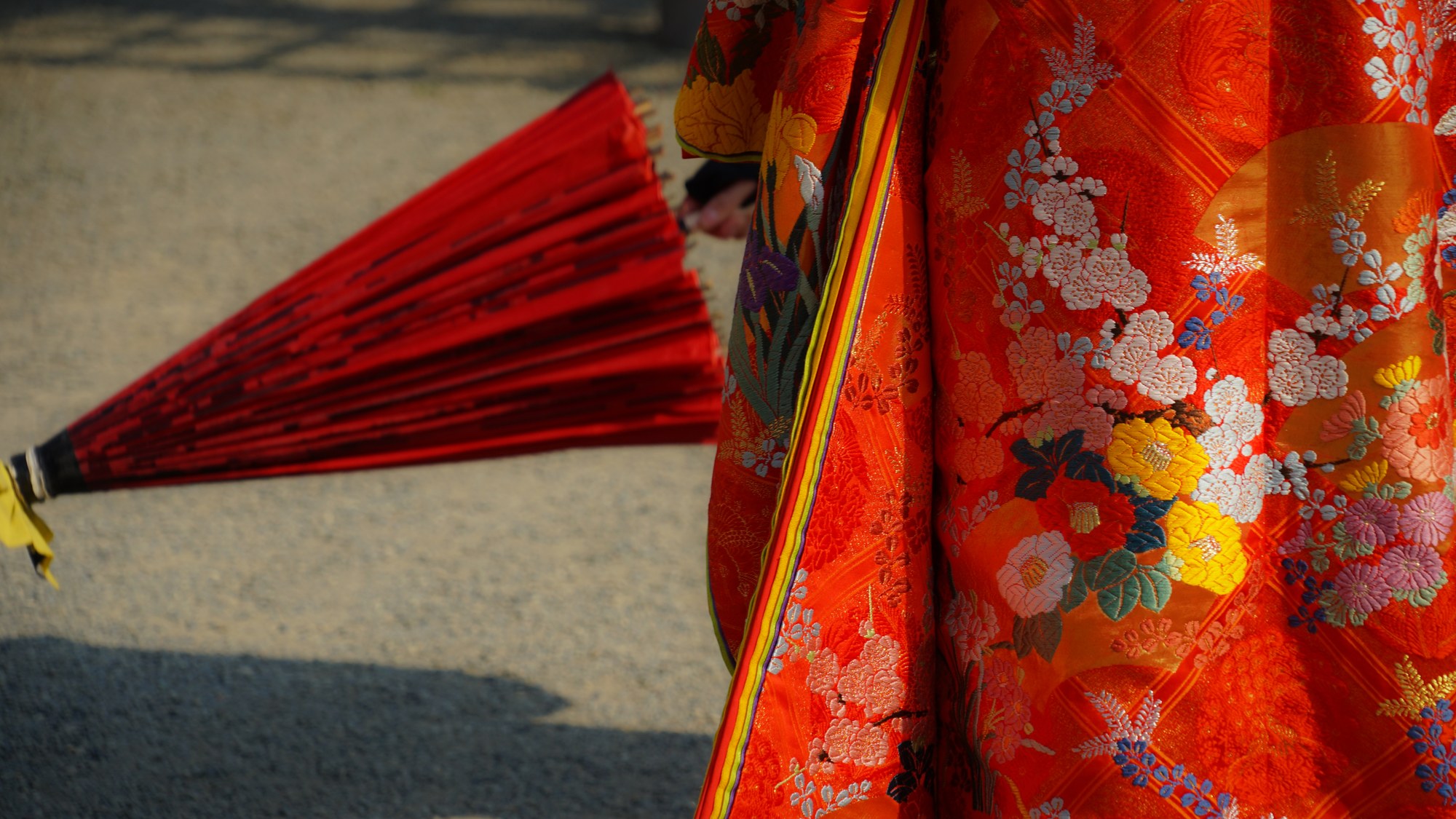
In photographs of imperial weddings or rare museum displays, you sometimes see a Japanese woman wearing what looks like an enormous, many-colored bell of fabric. The hem fans across the floor. The sleeves stack in visible bands — red against pale green against deeper red against white — each layer slightly shorter than the one beneath it. The effect is somewhere between a flower and an architectural cross-section. The wearer is almost hidden inside it; the garment is doing most of the talking.
This is junihitoe (十二単), the formal court dress of Heian-period (794–1185) noblewomen. The usual English description — “the twelve-layered kimono” — is useful, but only up to a point. Junihitoe was not always exactly twelve layers. It is not a kimono in the modern sense most readers know. And when it was worn daily, it was not an exotic costume. It was the working dress of a small class of women whose social lives unfolded in court rooms, behind screens, inside all that silk.
Table of Contents
- What the word literally is
- The actual layers
- The color combinations: kasane no irome
- The weight and the body inside it
- The Heian court context
- The decline and survival
- Where you see it now
- Relation to the kimono
- The principle underneath
What the word literally is
十二単 (juni-hitoe) reads as juni (十二, twelve) + hitoe (単, single layer / unlined robe). Literally: “twelve unlined robes.” As with many Japanese numerical names, the number is more conventional than exact.
The form’s fuller historical name is 五衣唐衣裳 (itsutsuginu karaginu mo), which names the actual components: the five inner robes (itsutsuginu), the Chinese-style outer jacket (karaginu), and the trailing skirt-train (mo). The “twelve” in junihitoe became the familiar shorthand later. In practice, the number of textile pieces could range from five to more than twenty, depending on period and formality.
The actual layers
A formal junihitoe is assembled from the inside outward:
Kosode (小袖) — the innermost short-sleeved white robe, in direct contact with the skin. The kosode is the historical ancestor of what later became the modern kimono. Hakama (袴) — long divided trousers, usually deep red for adult women, tied at the waist over the kosode. The hakama is largely hidden by outer layers but visible at the front edges. Hitoe (単) — an unlined robe worn over the kosode and hakama, usually of contrasting color. This is the foundational visible layer. Itsutsuginu (五衣) — five lined robes layered one over the next, each slightly shorter and showing as a band of color at the sleeves and hem. These five are where the famous color-gradient effect lives. Uchiginu (打衣) — a stiffened robe added between the inner five and the outer formal pieces, giving body to the silhouette. Uwagi (表着) — the principal outer robe, in the wearer’s most prominent color and pattern. Karaginu (唐衣) — a short Chinese-style jacket worn at the very top, with its own distinct color and weave. Mo (裳) — a pleated, embroidered skirt-train tied at the back, trailing behind the wearer when she walked or, more often, sat.
The full ensemble might include twelve or fifteen distinguishable garments. On the most ceremonial occasions, a fan, hair ornaments, and a long single ponytail tied with paper cords completed the composition.
The color combinations: kasane no irome
The defining feature of junihitoe is not the number of layers but the colors chosen for them. Heian court culture developed an elaborate system called kasane no irome (襲の色目, “layered color combinations”), in which palettes were tied to seasons, plants, festivals, and the wearer’s age and rank.
A combination called ume (plum) might pair white outer layers with deep red showing through, evoking plum blossoms in late winter. Wakakaede (young maple) used pale yellow-green with deeper green, suggesting fresh maple leaves in spring. Tsutsuji (azalea) layered pinks against green. The court catalogued dozens of these combinations, and wearing the wrong palette for the season was a small but real social error — like wearing a heavy wool suit to a summer garden party, but with sharper aesthetic stakes.
The interesting part is that the wearer never sees the full effect. The combinations are designed to be read by others: in the color bands at the sleeves and hem, in the way the outer karaginu sits against the inner uwagi, in the trailing edges of the mo. The robes tell other people what season you understand yourself to be in, what reference you are making, and how much aesthetic literacy you possess.
The weight and the body inside it
A complete formal junihitoe can weigh roughly 10 to 20 kilograms (22 to 44 pounds), depending on the number of layers, the silk, and the embroidery. That is comparable to a loaded backpack, except the weight sits around the body, and the wearer is expected to remain elegant and composed inside it for hours.
The garment shapes movement. Walking in a full junihitoe is slow, with small steps; the trailing mo and the volume of fabric make quick motion impossible. Sitting is more typical than walking. Heian noblewomen spent much of their court life seated on tatami behind sliding screens, their robes spread carefully around them. Much of Heian aristocratic literature, including The Tale of Genji and The Pillow Book, belongs to that seated, screened, robe-cushioned interior.
Wearing junihitoe today, even briefly, is reportedly intense. Modern wearers describe the weight as immediate, the heat as difficult, and even small movements — turning the head, reaching for a fan — as something that requires planning. The garment is its own environment.
The Heian court context
Junihitoe emerged in the mid-Heian period (around the 10th century) as the formal dress of women in the imperial court at Heian-kyo (modern Kyoto). It was not worn by commoners, by women of the warrior class, or by women in non-court contexts. Its meaning was inseparable from the closed aristocratic world that produced it — a world of perhaps a few hundred families, organized around the imperial palace, with elaborate codes of dress, language, poetry, and behavior.
The Heian court placed extraordinary value on aesthetic refinement. A noblewoman’s social identity was constructed largely through her cultural literacy — her ability to recognize a poetic allusion, choose the correct calligraphic style for a love letter, identify the kasane combination of a glimpsed sleeve. Junihitoe was both the medium and the product of this aesthetic culture: the layered colors gave the wearer something to be read against, and the act of being read was the social currency.
This context matters because it explains why the garment is so impractical by modern standards. It was never meant to be practical. It was meant to be the visible, wearable extension of a culture that understood itself through refinement, in a world where the wearers had no ordinary work for the robes to interrupt.
The decline and survival
The Heian aristocratic world began to lose political power in the 12th century, as warrior clans rose and the imperial court became increasingly ceremonial rather than governing. Junihitoe survived as ceremonial dress for imperial occasions — coronations, weddings, formal court appearances — but ceased to be daily wear for any class.
Through the medieval period (Kamakura, Muromachi) and the Edo period (1603–1868), junihitoe persisted in the imperial household and a small number of high-aristocratic families, but the fully elaborated 10–20 layer version became increasingly rare. Simpler court dress with fewer layers, or stylized representations of the form for theatrical and ritual use, became more common.
The Meiji Restoration (1868) reorganized the court along Western lines, and Western dress became the new formal standard for many imperial occasions. Junihitoe survived as a specifically Japanese ceremonial form — invoked when the occasion called for explicit reference to imperial tradition rather than to international protocol. This is the role it still plays.
Where you see it now
Modern occasions on which a real junihitoe appears include:
Imperial weddings. When a member of the imperial family marries in the Shinto tradition, the bride typically wears junihitoe for the formal ceremony. Photographs of Princess Masako’s 1993 wedding to then-Crown Prince Naruhito, or Princess Aiko’s 2021 coming-of-age ceremony, show contemporary versions of the form. Coming-of-age ceremonies (genpuku-style). For high-ranking imperial daughters, the formal coming-of-age ritual includes wearing junihitoe. Cultural and historical events. Some Shinto shrines host annual ceremonies in which performers wear junihitoe to evoke the Heian period. The Aoi Matsuri in Kyoto and the Heian Jingu shrine festival are notable examples. Museum displays. A small number of original Heian and later junihitoe survive in museum collections; reproductions are also displayed at sites like the Costume Museum in Kyoto, where visitors can see the layers up close. Wedding photography. Some non-imperial brides commission a junihitoe-style ensemble for ceremonial photographs, though this is rare and very expensive — a complete formal junihitoe can cost millions of yen and is usually rented.
Outside these contexts, many Japanese people today may go their whole lives without seeing a real junihitoe in person. It belongs to a specific historical world, preserved now in carefully bracketed ceremonial settings.
Relation to the kimono
A common confusion is whether junihitoe is “a kind of kimono.” The honest answer is that it is and isn’t, depending on how strictly you use the word.
Strictly speaking, the modern kimono — the T-shaped, ankle-length garment most non-Japanese people picture — descends from the kosode (小袖), which was originally one of the inner layers of junihitoe. As aristocratic court culture declined and warrior-class fashion rose, the kosode shifted from undergarment to outerwear, gained patterns and colors, and eventually became the standalone garment now called kimono. So the relationship is indirect but real: junihitoe contained, as one of its inner layers, the ancestor of the modern kimono.
In casual usage, people sometimes call junihitoe a kind of formal kimono, since both are silk wrap garments worn ceremonially. In precise textile or historical writing, they are separated: junihitoe is a multi-layer Heian court form, while the kimono is the later single-garment descendant. If you want to be careful, “Heian court robe” or simply “junihitoe” is more accurate. “Twelve-layered kimono” is useful shorthand, but it needs a footnote.
For more on the kimono family more broadly, see the overview of kimono types.
The principle underneath
What junihitoe really shows is what clothing becomes when the wearer’s job is to be aesthetically read. Most clothing balances comfort, mobility, climate, and identity. Junihitoe gives almost everything to the last category, in a world where the body is mostly stationary, often screened, and expected to move slowly within a small set of social scenes.
The robes are heavy because weight signals seriousness. The colors are precisely combined because precision signals literacy. The trailing mo is impractical because impracticality itself says the wearer is not expected to do practical work. The whole form is a language made of silk, and its grammar is the season.
For a non-Japanese reader, the interesting point is not that junihitoe is “old-fashioned” or “extreme.” It is that every clothing tradition makes assumptions about what the wearer is expected to do and communicate. Most hide those assumptions because they feel familiar. Junihitoe makes them visible. You can see immediately that the wearer is not going to chop wood, run for a train, or have a casual conversation in a noisy room. The garment has decided, in advance, what kind of life it belongs to. Every garment makes that decision. Most are quieter about it.