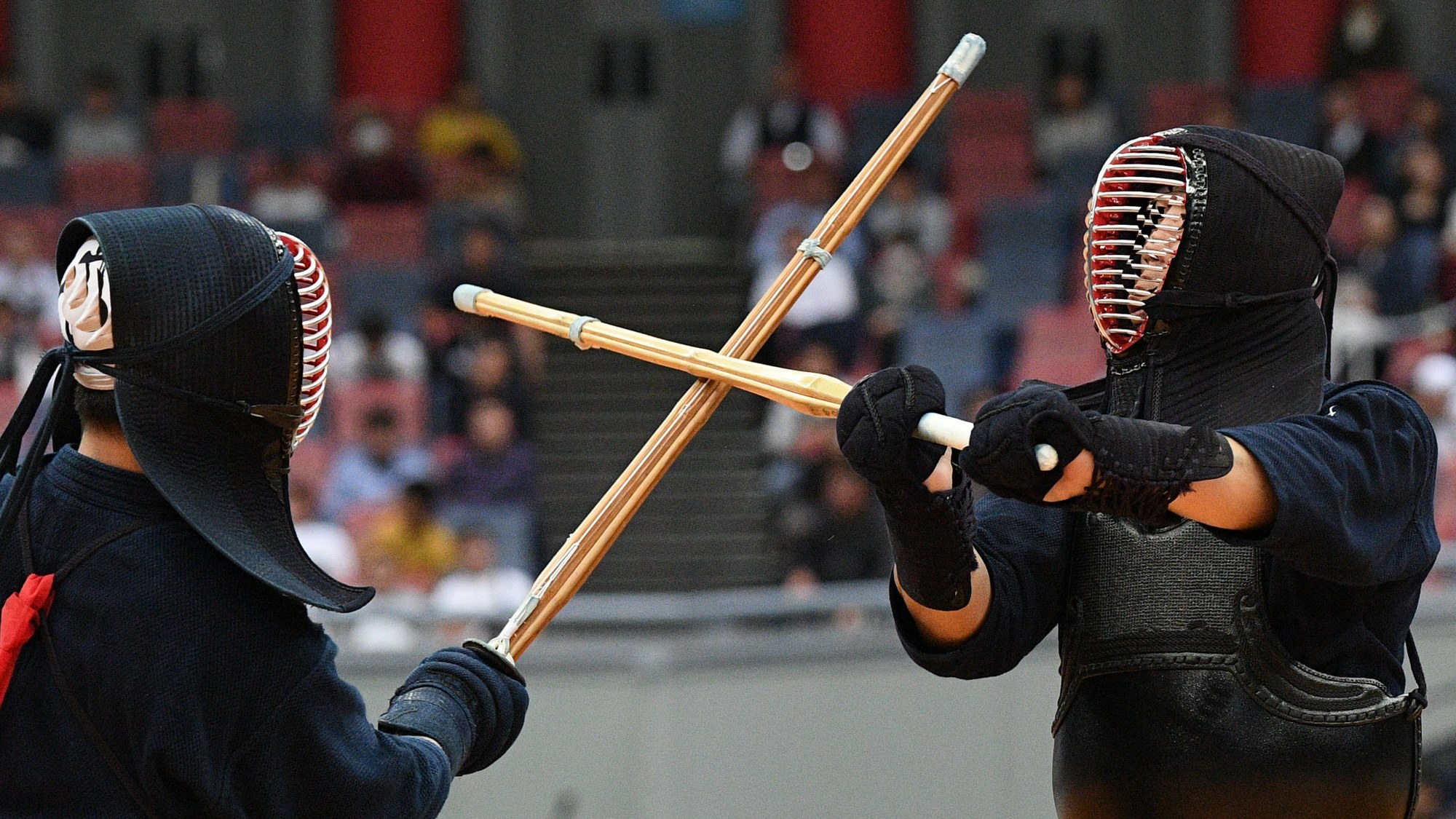
Two figures face each other across a wooden floor, dressed in identical dark blue uniforms. They wear armoured chest plates, hip protectors, padded gloves, and helmet-like masks that hide their faces behind metal grilles. Each holds a bamboo sword in front of them. For a moment nothing happens: kamae, the ready stance. Then one shouts and rushes forward, the sword arcing down toward the opponent’s head with a sharp crack. A judge raises a flag.
This is kendo (剣道), the modern Japanese way of the sword. It descends from the sword-fighting techniques of the samurai era, but it was reorganised in the late 19th and 20th centuries into a sport, a discipline, and a lifelong practice. The bamboo sword (shinai) replaces the steel blade. The armour (bogu) makes full-contact strikes possible. The path runs from children’s beginner classes to master ranks that take decades to reach.
This article looks at what kendo is, how it moved from live-blade kenjutsu into the modern bamboo-sword form, why a practitioner can spend years on a single cut, and why the art has such a strange relationship with silence and shouting.
Table of Contents
- What kendo is
- Shinai and bogu
- From kenjutsu to kendo
- The four strikes
- Kiai and the shouting
- Ki-ken-tai ichi
- The grading system
- Beyond Japan
What kendo is
A kendo match takes place on a wooden floor (shiaijo) in a marked square, between two practitioners who attempt to score points by striking specific targets on the opponent’s armour with a bamboo sword. The target areas are restricted to four: the head (men), the wrists (kote), the torso (do), and the throat (tsuki). Strikes to other parts of the body do not count even if they land cleanly.
A point requires more than contact. Judges look for yuko-datotsu — a valid scoring strike — which combines the correct target, cutting motion, timing, the simultaneous arrival of body, sword, and kiai (the loud shout that names the target), and visible follow-through (zanshin, residual awareness). A clean-looking hit that arrives before the kiai, or lands without the right body posture, may not score. The standard is strict, and many strikes are waved away.
Matches are short — usually three to five minutes — and won by the first practitioner to score two points (nihon-shobu). They take place in front of three judges, each holding red and white flags. A point is awarded only when at least two of the three flags are raised. This consensus requirement keeps the standards consistent and reduces the influence of any single judge’s bias.
Beyond competition, kendo practice means long sessions of basic drills: single cuts repeated thousands of times against a partner or against air, plus kata, the formal paired choreography that descends from older kenjutsu. The matches are dramatic, but most of the work is repetition that looks simple from the outside and feels anything but simple from within.
Shinai and bogu
The shinai is the bamboo practice sword. It is made from four split staves of bamboo bound together with leather grips and string, with a standard adult competition length of about 118 to 120 centimetres. The construction lets the shinai flex on impact, spreading force through the bamboo instead of concentrating it at one point. That flexibility is what makes full-contact practice possible.
A shinai is not a wooden sword (bokken); the latter is a solid carved practice sword used in kata, paired exercises, and other arts. The shinai is specifically designed for full-speed striking against armour, and an experienced practitioner can deliver a strike with substantial force without injuring an opponent — assuming both the strike and the armour are correctly executed.
The bogu is a four-piece armour set: men (the helmet-mask covering the head, face, and shoulders), kote (gloves with padded forearm protection), do (a chest plate covering the torso and abdomen), and tare (hip-and-groin flaps). It is heavy, hot, and restrictive. New students often find their first hours in full bogu exhausting before practice has even become physically hard. Learning to move inside the equipment is part of the training.
The visual identity of kendo — two armoured figures with bamboo swords — is partly the product of these tools. Strip away the bogu and the shinai, and what remains is the underlying body mechanics, which look much closer to iaido (sword-drawing) and kenjutsu (older sword arts).
From kenjutsu to kendo
Japanese sword arts have lineages going back at least eight hundred years, but the sport now called kendo is much younger. Kenjutsu — the fighting arts of the samurai — was practiced for centuries with sharpened swords (shinken) and wooden practice swords (bokken). It was a warrior skill, not a school sport.
The shinai was developed in the 18th century to allow harder practice without lethal injury, and the bogu armour set evolved alongside it. The Yagyu, Itto, and other major kenjutsu schools used these tools for in-school sparring while continuing to teach traditional kata with live blades. This was the period during which the conditions for modern kendo were created.
The Meiji Restoration of 1868 ended the samurai class. The wearing of swords was banned. Many martial schools collapsed, and their students dispersed into civilian life. Kenjutsu risked becoming a relic. The Japanese government, partly through the Dai Nippon Butokukai (Greater Japan Martial Virtues Society), founded in 1895, organised surviving traditions into a more standardised practice that could be taught in schools and police academies.
The name kendo — emphasising “way” (do) rather than “technique” (jutsu) — signalled the shift. This was no longer only combat preparation. It was also discipline, education, and self-cultivation. The ten core kata (the Nihon Kendo Kata) were codified in 1912. After World War II, kendo was briefly banned by the Allied occupation authorities, then reorganised in the 1950s under the All Japan Kendo Federation, the current governing body of the modern sport.
The four strikes
Kendo has only four valid striking techniques, even though match footage can look much more complicated. They are men (a vertical cut to the top of the head), kote (a cut to the wrist of the sword arm), do (a horizontal cut to the side of the torso), and tsuki (a thrust to the throat). Everything else is footwork, feinting, pressure, and timing built around those four targets.
The men cut is the most fundamental and usually the first strike beginners learn. It is a vertical descent of the shinai from above, ending with the kensen (sword tip) striking the centre of the opponent’s men helmet. Done well, it does not look like a wild swing. It looks like something unfolding along a clean line.
The kote cut goes for the right wrist, the wrist holding the sword. It is a faster, lower cut, typically used as a counter to a men attack or as a way to disrupt the opponent’s grip and timing. The angle is acute; it arrives from above-right, descends sharply, and lands on the kote glove’s striking surface.
The do cut is horizontal, a slash across the torso typically aimed at the opponent’s right side. It requires moving past the opponent in the same motion, ending with the practitioner facing the opposite direction. It is the most spatially complex of the standard cuts.
Tsuki is the thrust to the throat. It is restricted in many practice settings — children’s kendo often does not permit it — because the injury risk is real. Among skilled adult practitioners, it is a legitimate technique that adds a thrusting dimension to an art that can otherwise seem entirely about cutting.
Kiai and the shouting
A defining feature of kendo practice is the loud shout — kiai — that accompanies every strike. It is not optional. As practitioners cut, they call out the target: “Men!” “Kote!” “Do!” “Tsuki!” The shout carries across the dojo, which means a kendo hall during practice is much louder than many first-time visitors expect.
The kiai does several jobs at once. It coordinates breath with the strike, so the exhale lands at the moment of impact. It names the target, which helps judges read intent. It gathers focus into the cut. And, very practically, it puts pressure on the opponent in a sport where hesitation can be felt across the floor.
Beyond the named target shouts, practitioners use a sustained, low kiai during kamae — a continuous vocal energy that fills the space between the two people facing each other. This kiai is more sound than word. An experienced kendoka can make their presence felt before either person moves.
The vocal tradition is one of the elements of kendo that surprises new practitioners most. Many martial arts emphasise silence and stealth; kendo emphasises full-throated commitment. This is rooted in the older sword tradition’s understanding that hesitation is fatal — the kiai is the sound of a person who is not hesitating.
Ki-ken-tai ichi
The technical principle that organises kendo practice is ki-ken-tai ichi — “spirit, sword, and body, as one.” A valid strike requires three things to arrive together: the practitioner’s intent and breath (ki), the cutting motion of the sword (ken), and the forward step of the body (tai). When they meet in the same instant, the strike has the committed quality judges are looking for.
When they do not align — when the sword arrives before the foot, or the kiai trails behind the cut, or the body’s weight has not moved forward — the strike may touch the target but still feel incomplete. These strikes are common, and they do not score. Much of kendo is the patient work of making those three elements arrive together more often.
This principle generalises beyond kendo to other Japanese martial and aesthetic disciplines. The Zen-influenced framing — that the practitioner’s intent, instrument, and body are not separate things but provisional separations of an underlying unity — runs through arts as varied as shodo (calligraphy) and tea ceremony. Kendo makes this principle explicit and sets it as the immediate technical goal.
The grading system
Kendo uses a kyu-and-dan grading system common to many Japanese martial arts. Beginners start at the highest kyu number (often 6th or 7th kyu) and advance toward 1st kyu, then enter the dan ranks beginning at shodan (1st degree) and continuing through 8th dan — the highest contemporary rank.
Dan grades are awarded after formal examinations that include both kata and live practice. The intervals between grades grow longer as the rank rises. Shodan and nidan exams may be taken within a year of each other, but moving from 6th dan to 7th dan requires at least six years of practice at 6th dan level. The 8th dan exam is famously severe, with pass rates often below one percent.
The high-rank grades are not honorary. They are awarded only on demonstrated technical and personal qualities, and the candidates must perform under serious examination conditions. This severity is part of why kendo mastery is treated with substantial respect in Japan — an 8th dan rank represents not just decades of practice but consistent demonstration that the practice has produced something visible.
Beyond Japan
Kendo has spread internationally through the post-war period, partly through the Japanese diaspora and partly through deliberate cultural outreach by the All Japan Kendo Federation. The International Kendo Federation now has affiliated organisations in over sixty countries, and the World Kendo Championships, held every three years, draws competitors from across the world.
National differences in style have emerged. Korean kumdo, sharing roots with kendo, has developed its own competitive culture and federation. European federations have produced strong competitors. Some American and European clubs are considered serious enough that visiting Japanese practitioners take them as legitimate training partners.
Despite this spread, kendo‘s home remains Japan, and serious foreign practitioners often spend extended periods training in Japanese dojos to deepen their understanding. The number of active practitioners is not enormous compared with some martial arts, but the commitment level tends to be high. Kendo attracts people willing to spend years on basic cuts, accept the discipline of the dojo, and find satisfaction in slow, repeated refinement.
What kendo offers, in the end, is a way to practise sword-cutting under contemporary conditions: safely enough to strike, formally enough to score, and precisely enough to judge one cut as more complete than another. It is not the swordsmanship of the samurai. It is what survives when that swordsmanship is reorganised for an age in which carrying a real sword is no longer an option.