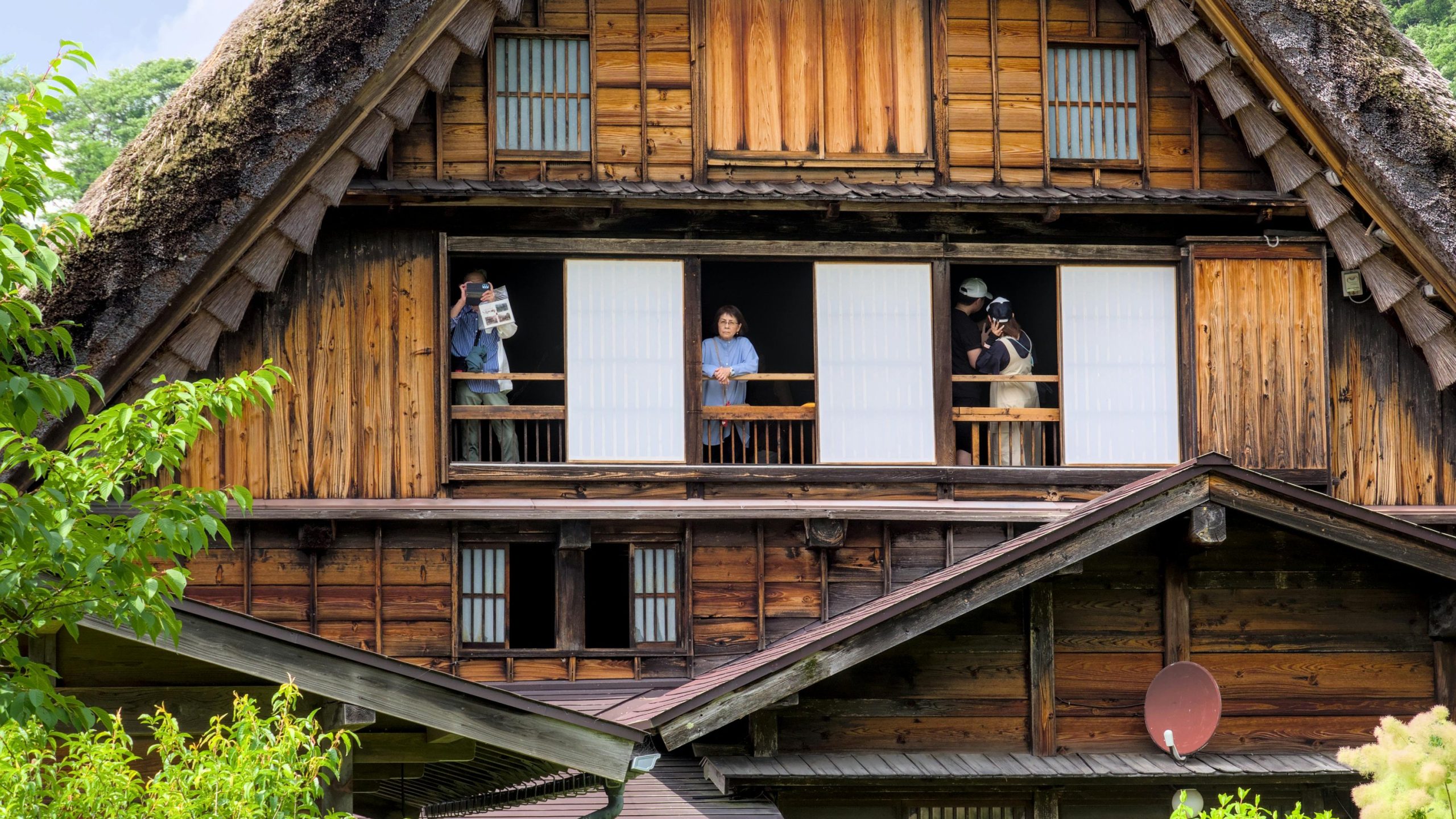
In a valley in Gifu Prefecture, a row of farmhouses stands against a backdrop of forested mountains. Each house has a steep thatched roof — angled almost like hands pressed together in prayer, which is why this regional style is called gassho-zukuri — that descends nearly to the ground. The walls are dark wooden plank, weathered to grey-brown from generations of weather. Smoke rises from a vent at the peak of the roof. The houses are large, two or three storeys tall, and from a distance they look more like architectural sculptures than like ordinary residences.
These are minka (民家), the traditional rural folk houses of Japan. The word literally means “people’s houses” — the houses of ordinary farmers, fishermen, merchants, and craftspeople, as distinct from the formal residences of the samurai and aristocracy. Built mostly between the Edo period and the early 20th century, minka are now disappearing rapidly from the Japanese countryside, with surviving examples being preserved as cultural property, converted to museums, or moved to architectural parks where they can be maintained at public expense.
This article traces what defines a minka, the regional architectural styles that produced different minka forms, the construction techniques (including the famous joinery without nails), the gassho-zukuri houses of Shirakawa-go and the broader UNESCO recognition, and what the surviving minka preserve about pre-industrial Japanese domestic life.
Table of Contents
- What makes a minka
- Regional styles
- Construction without nails
- Thatched roofs and the snow country
- Interior organisation
- Shirakawa-go and UNESCO
- Why they are disappearing
- What survives
What makes a minka
The category minka is broad. It encompasses several substantive distinctions: noka (farmhouses), machiya (urban townhouses), gyoka (fishermen’s houses), and sanka (mountain houses), along with regional and class variations within each category. What unites them is the framing as minka — houses for ordinary people — rather than aristocratic or warrior-class residences (shinden-zukuri, shoin-zukuri, etc.) which have their own architectural categories.
Despite this internal variety, minka share certain common features that distinguish them as a class:
- A heavy, structurally significant wooden frame, typically made of large posts and beams of cypress, cedar, or zelkova
- A thatched, tiled, or wood-shingled roof, often steeply pitched in regions of heavy snowfall or rain
- A clear distinction between the doma (the earthen-floored entrance and work area, typically used for cooking and tools) and the elevated wooden tatami rooms (used for sleeping and formal activities)
- An irori sunken hearth in the central living room, providing heat and cooking facilities
- Engagement with the surrounding agricultural or fishing landscape — the minka was where the work of the household happened, not just where the household slept
These features evolved over centuries in response to Japanese climate, available materials, and the organisation of agricultural labour. The result is architecture that is recognisably Japanese but also recognisably regional — a Hokkaido minka and a Kyushu minka differ substantially despite both being minka.
Regional styles
Major regional minka styles include:
Gassho-zukuri (合掌造り, “hands-clasped construction”): the steep-roofed thatched houses of the mountainous regions of Gifu and Toyama prefectures. The roof angle of around 60 degrees sheds heavy winter snowfall and provides upper-storey space for silk-worm cultivation, which was a major economic activity in these areas. Roofs may be 10 metres or more long, requiring substantial communal labour to thatch and re-thatch.
Magariya (曲がり家, “bent house”): the L-shaped houses of Iwate Prefecture in northern Japan, where the main residential wing connects at right angles to an attached stable. This shared structure allows the household and its horses to share warmth in winter, with the horses’ body heat helping to warm the residential side.
Honmune-zukuri: houses with distinctive ridge-cap features, found in Nagano and Yamanashi.
Yamato-mune-zukuri: the tile-roofed merchant houses of Nara and surrounding regions.
Kayabuki noka: thatched-roof farmhouses found across most of rural Japan, with significant regional variation in the specific thatching techniques and roof shapes.
Funa-yado: the boat-houses of fishing villages along the coast, where structures were built directly above water to facilitate fishing operations.
This regional variation reflects the substantial geographic diversity of Japan — climate, terrain, available local materials, and economic activities all shaped which architectural responses were practical in each area. Minka are not a single style; they are a category of houses with locally adapted forms.
Construction without nails
A celebrated feature of traditional Japanese minka construction is the use of complex wooden joinery in place of metal nails or screws. The structural frame of a minka is held together through carefully cut interlocking joints — hozo, kanawa-tsugi, kama-tsugi, kawai-tsugi, daisen-tsugi, and others — each designed for specific types of structural loads.
The reasons for this approach are practical as well as aesthetic. Iron was historically expensive in Japan; using it sparingly in construction made economic sense. Wooden joinery, properly designed, can perform structural functions as effectively as metal connections, with the additional advantage of being repairable. A failing wooden joint can be assessed, removed, and recut; a failing metal connection often requires replacement of larger structural sections.
The joinery is cut by hand using traditional tools — chisels, saws, planes — operated by master carpenters (daiku) who have undergone long apprenticeships in the techniques. A single complex joint might take a day to cut. The cumulative labour required to build a major minka through traditional methods was enormous, often involving entire village communities working over weeks or months.
The result is structures that have survived for centuries with relatively minor maintenance. A 200-year-old minka still standing today is testament to the durability of well-cut wood-only construction. Periodic re-thatching of the roof, occasional replacement of wall sections, and care of the interior elements have kept many such houses functional through generations of family use and weather exposure.
This nail-less construction is sometimes overstated. Some minka did use small amounts of metal — particularly for specialised joints, for hardware on doors and shutters, and for nails in roofing material — even when the main structural frame relied on wooden joinery. The principle was to use metal sparingly rather than to avoid it entirely. Nonetheless, the dominant feature of minka structural connection was wooden joinery, and the techniques developed for this purpose represent one of the major achievements of traditional Japanese carpentry.
Thatched roofs and the snow country
Many minka — particularly those in mountainous and rural regions — used thatched roofs (kayabuki) made from kaya (a type of grass, typically susuki or kogai). The thatched roof provided substantial insulation, was made from locally available material, and could be re-thatched at intervals of 20 to 30 years using community labour.
The roof was structurally complex. Heavy beams supported a framework of slimmer rafters, over which the thatch was laid in carefully overlapping bundles secured with cord. The pitch of the roof varied by region: in snow-heavy areas, very steep pitches helped shed snow; in less snowy areas, gentler pitches were sufficient. The roof’s thickness — sometimes more than a metre at the bottom edge — provided significant insulation and weather protection.
Re-thatching was a major communal event. The labour required to strip the old thatch, prepare the new material, and lay it across a substantial roof was beyond what a single household could manage. Villages typically organised re-thatching as a rotating obligation — each year a few houses would be re-thatched, with the entire village providing labour. This communal work pattern, called yui, was one of the social structures that supported minka maintenance.
The thatch itself was a renewable resource. Villages maintained dedicated kaya-fields where the grass was harvested annually. The cycles of cultivation, harvest, and use of the grass were deeply embedded in agricultural calendar and community labour patterns. Loss of these supporting structures — through depopulation, abandonment of grass-fields, and the decline of communal labour — has been one of the major reasons for the disappearance of working minka.
In the snow country (yukiguni) of Niigata, Yamagata, and similar regions, minka were built to handle truly extreme winter conditions. Roofs were steep enough that snow shed naturally rather than accumulating to dangerous weights. Walls were oriented to minimise wind exposure. Irori hearths were positioned to provide maximum heat to the most-occupied parts of the house. Specific architectural responses to extreme winter were developed and refined over centuries of trial and error in these regions.
Interior organisation
Inside a typical minka, the floor plan organised the house around two zones: the doma and the elevated wooden floor.
The doma (土間, “earth-floor”) was a space with a packed-dirt or stone floor that ran from the entrance into the heart of the house. It was used for tasks that could not be done on the wooden floor — cooking on a stone kamado stove, processing rice, working on equipment, accommodating guests in muddy clothing. The doma could be quite large in farmhouses, sometimes occupying a third or more of the total floor area.
The elevated wooden floor — typically about 30 to 50 centimetres above the doma — was the residential space. Shoes were removed at the boundary between doma and elevated floor. The elevated floor contained the main living rooms, sleeping areas, washitsu for guests, storage areas, and the irori hearth.
The transition between doma and elevated floor was significant. It marked the threshold between work space and living space, between outside dirt and inside cleanliness, between the rough world and the cared-for interior. This organisation reflected a particular conception of domestic space that prioritised the cleanliness of certain zones while accepting practical mess in others.
The irori sat in the largest living room — the cha-no-ma (tea room) or ima (living room) — and the daily life of the household centred on the area around it. Adjacent rooms might include a formal zashiki (parlour) for guests, an ima (sitting room), a kitchen-adjacent area connected to the doma, and storage spaces. Bedrooms were not always separate; family members often slept in the main living rooms, with futons laid out at night and stored away during the day.
Shirakawa-go and UNESCO
The most internationally famous minka are the gassho-zukuri houses of Shirakawa-go (Gifu Prefecture) and Gokayama (Toyama Prefecture). Several villages in these regions have preserved their traditional architecture and were designated UNESCO World Heritage Sites in 1995 under the title “Historic Villages of Shirakawa-go and Gokayama.”
The gassho-zukuri houses are large — often three or four storeys tall — with steep thatched roofs that meet at angles around 60 degrees. The interior was traditionally divided across multiple floors: the ground floor for residential use, the upper floors for silkworm cultivation, raw-silk production, and storage. The size of the houses reflects the economic importance of silk-related work in these isolated mountain villages, where the season for snow restricted other activities.
The UNESCO designation has had significant effects on these villages. Tourism has become a major economic activity, with several million visitors per year. Some houses have been converted to inns and museums. Traditional crafts and cultural performances are maintained partly for tourist audiences. The villages are preserved in something close to their historic appearance, with new construction restricted to maintain the architectural ensemble.
The downside is that the villages now operate in a hybrid economy that is partly genuine residential life and partly tourist performance. Some long-time residents have moved away, with new owners using the houses primarily as commercial properties. The lived-in qualities of an active minka — with the smoke of working irori fires, the smell of cooking, the daily routines of agricultural life — have been replaced in many cases by maintained-but-not-fully-occupied historical properties.
This tension is real but probably better than the alternative. Without UNESCO designation and tourism revenue, many of these houses would likely have been abandoned or demolished. The preserved village ensemble, even if partially performance, retains something that would otherwise have been lost.
Why they are disappearing
Outside of designated heritage zones, minka are disappearing rapidly from the Japanese countryside. Several factors drive this:
Depopulation: Rural Japan is shrinking. Younger people move to cities for education and work; older residents age and die; rural towns and villages lose population year after year. Minka in depopulating areas are often inherited by family members who do not want to live in them and cannot maintain them. They are left empty, fall into disrepair, and eventually become structurally unsafe.
Maintenance costs: Even maintained, minka require substantial ongoing investment. Re-thatching a roof, replacing damaged structural beams, treating wood for insects, and maintaining the doma and other features all cost money. As fewer working artisans remain capable of these traditional repairs, costs rise. Many owners cannot afford the upkeep.
Modernisation incompatibility: A minka is not easily upgraded to modern living standards. Adding insulation, modern plumbing, central heating, and other contemporary infrastructure requires major modifications that often compromise the traditional structure. Some owners abandon the traditional house and build a new modern one on the same property; others sell the property and move to apartments in nearby cities.
Loss of communal labour: Traditional re-thatching depended on communal yui labour. As villages depopulate and remaining residents age, the available labour for these activities shrinks. A house that needs re-thatching may simply not get re-thatched, leading to roof failure within years.
Earthquake and fire risk: Old wooden structures with thatched roofs are more vulnerable to earthquake damage and fire than modern construction. Building codes in some areas push toward replacement rather than preservation. Insurance is sometimes prohibitive.
The cumulative effect is that the population of working minka is declining steadily, with older houses being lost faster than they can be preserved. Estimates suggest that perhaps tens of thousands of minka remain in usable condition in Japan, down from many hundreds of thousands a century ago. The trend continues.
What survives
Several mechanisms help preserve some minka against the broader decline:
Architectural parks: Several open-air museums in Japan have collected minka from various regions, dismantled them at their original sites, and reassembled them in single locations where they can be maintained as exhibits. The Edo-Tokyo Open Air Architectural Museum, the Japan Open-Air Folk House Museum (Nihon Minka-en) in Kawasaki, and Hida Folk Village in Takayama are major examples. These museums preserve buildings that would otherwise have been lost.
Tourist accommodation: Some minka have been converted to traditional inns or vacation rentals, providing economic justification for maintaining them. This has been particularly successful in regions with established tourism economies. Visitors who want to experience traditional Japanese rural life can stay in actual minka, which provides revenue for the property owners and keeps the houses in active use.
Government cultural property designations: Important minka can be designated as national or prefectural cultural properties, providing legal protection and access to public restoration funding. This protects against demolition or major modification and provides resources for maintenance. The number of minka protected through these designations is small relative to the total but includes the most architecturally significant examples.
Private preservation: Some private owners have made deliberate choices to maintain and live in traditional minka despite the costs and difficulties. These individuals — often newcomers to rural areas, sometimes architecture enthusiasts, sometimes returning generational owners — are a small but committed community of private preservationists.
Movements toward minka renovation: A growing movement in Japan promotes minka as desirable rural housing, with architects and contractors specialising in renovating traditional houses for modern use while preserving their architectural character. This has created a niche market for buyers who want traditional houses with modern amenities.
What survives, then, is a fraction of what existed a century ago, but a meaningful fraction. The architectural parks preserve the most significant examples; the tourist economy maintains the most accessible ones; the cultural property designations protect the most important historically. The rest — the everyday rural minka of ordinary Japanese farming life — are mostly being lost, with each year subtracting from the total. The architecture they represented was both deeply local and broadly Japanese, and its disappearance is one of the quieter losses of contemporary rural Japan. What we have left is the surviving examples and the structures preserved through deliberate effort, which together still constitute one of the world’s most distinctive traditions of folk architecture.