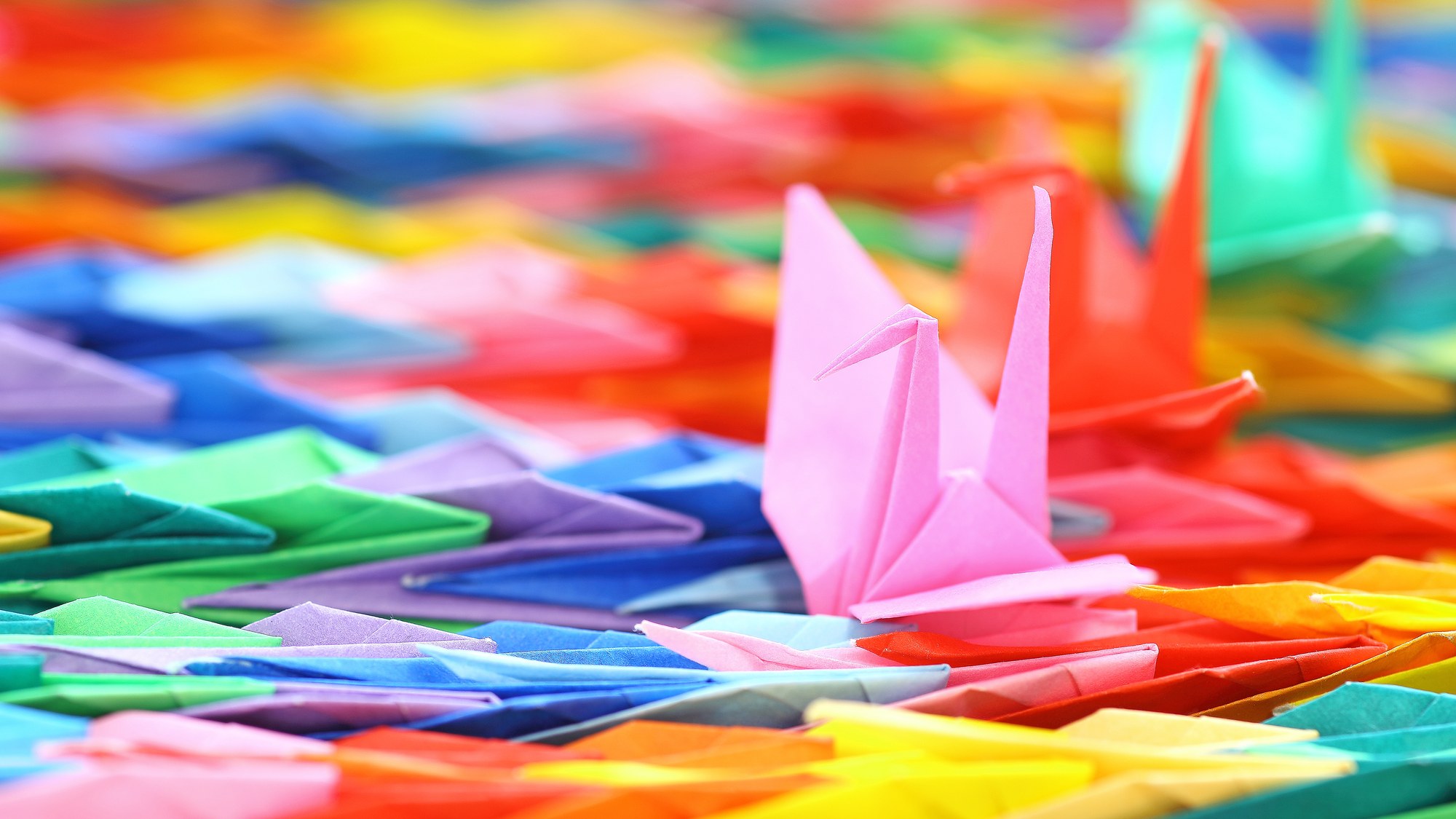
In the recovery wing of a Nagoya hospital, sometime in the mid-1990s, a woman in her sixties received a large paper bag. Inside were 1,000 paper cranes strung on threads, folded by the members of a community center she had never visited. The cranes were in blues and purples because someone had heard she liked those colors. She did not know the people who made them. They did not know whether she would recover. Neither fact deterred anyone.
Senbazuru (千羽鶴) — one thousand cranes — is one of the more direct expressions of a particular Japanese instinct: when the situation is beyond your ability to fix, you can still do something that demonstrates you are trying. The gesture does not promise an outcome. It promises that someone noticed, and cared enough to spend the hours.
This article looks at where that practice comes from, how it is made, what it means, and why its most famous story is both simpler and more complicated than most retellings suggest.
Table of Contents
- What senbazuru literally is
- The crane and its thousand years
- The 1797 book and where origami starts
- How a thousand cranes are actually assembled
- Sadako Sasaki and the Hiroshima connection
- When senbazuru is given: weddings, illness, disaster
- The principle underneath
What senbazuru literally is
The name combines sen (千, one thousand) and tsuru (鶴, crane) — with the initial consonant of tsuru softening to z when it follows another word, giving senbazuru. The “thousand” is not symbolic approximation; it is the actual count. Each crane is folded individually from a square of paper, and they are then strung on threads and bundled, typically in groups of 25 per thread, 40 threads per bundle — though the grouping varies by tradition and practical preference.
A completed senbazuru is usually presented in a large bag, a decorative box, or suspended from a frame. The strung format serves a display function but also a structural one: loose cranes would scatter; strung cranes hold together and can be counted, which matters when the number itself is the point.
The paper is typically origami-gami (折り紙用紙) — the thin, colored, usually pre-cut squares sold in packets in every stationery shop in Japan. For special occasions, more expensive washi (和紙, traditional Japanese paper) is used. The cranes folded from washi have a different hand — stiffer, more textured — and are considered the more formal version. Size varies widely: most folded cranes use 15 cm × 15 cm paper, which produces a crane roughly 8 cm from wingtip to wingtip, but cranes as small as 3 cm are folded by people demonstrating precision, and cranes as large as 30 cm or more appear in ceremonial installations.
The crane and its longevity
The tsuru (鶴) holds a specific position in East Asian symbolic life that differs from its place in Western ornithology. In Japanese and Chinese classical literature, the crane is the bird of longevity — said to live a thousand years — and the companion of immortals and sages. Crane imagery appears in the oldest preserved Japanese poetry (Man’yōshū, compiled ca. 759), in the Noh theater tradition, in ceramic design, and in the noshi (熨斗) decorations that appear on formal gift wrappings including the goshugi envelopes for weddings.
The association with longevity makes cranes appropriate gifts for people who are ill, for weddings (long life together), for the new year (longevity wished for the year), and for occasions marking significant age milestones. The tsuru is paired in iconography with the tortoise (kame, 亀) — another longevity symbol — producing the paired phrase tsuru kame (鶴亀) that appears across decorative arts as a general blessing of long life.
This background is the reason folding one crane has meaning, and folding a thousand amplifies that meaning quantitatively. It is not just symbolic. It is arithmetic: if one crane wishes you long life, a thousand cranes wish it one thousand times over.
The 1797 book and where origami starts
The earliest surviving printed document describing senbazuru folding is Hiden Senbazuru Orikata (秘伝千羽鶴折形, “Secret Techniques of Folding a Thousand Cranes”), published in 1797 during the Edo period. It is also, by current scholarly consensus, the oldest surviving book devoted entirely to paper folding.
The book describes 49 designs — variations on the crane form that can be folded from a single sheet of paper pre-cut into a grid of connected squares, producing multiple linked cranes from one piece of paper. This technique, called renzuru (連鶴, linked cranes), requires cutting precise internal slits before folding and produces structures where two, four, eight, or more cranes are physically connected by their wingtips. Some of the designs in the 1797 book are extremely difficult and have been reconstructed only by specialized researchers in the modern period.
The existence of this book establishes two things: the senbazuru tradition as a codified practice (not folk tradition that simply accumulated) was present by the late Edo period; and paper folding in Japan had already developed, by 1797, a sufficient body of technique to warrant a dedicated instructional text. The word origami (折り紙) itself — oru (fold) + kami (paper) — appears in other Edo-period documents as a general term for paper folding, but the 1797 book is the oldest documented link to the thousand-crane tradition specifically.
How a thousand cranes are actually assembled
The practical challenge of senbazuru is simply time. A person who folds cranes regularly can complete one in about two to three minutes. At that rate, a thousand cranes represents thirty to fifty hours of folding. Most senbazuru are therefore collective projects — distributed across a group of people, each folding some portion, with the cranes collected and strung at the end.
The distribution is often organized in packets: a school class might divide 1,000 cranes among 40 students, each responsible for 25. A workplace group might distribute packets of 50. The collection point is usually someone with the patience and the needle-and-thread skills to string them into the final presentation format.
Threading requires a needle long enough to pass through the center of the folded crane body, a strong thread (nylon fishing line is common), and a spacer bead or knot between cranes to keep them from bunching. The traditional assembly groups 25 cranes per thread; 40 threads total make 1,000. The threads are then gathered and tied at the top to a ring or dowel from which the whole bundle hangs.
Folded cranes accumulate lint, are fragile in humidity, and fade in direct sunlight. A senbazuru is a consumable — it is not made to last decades. This is partly the point. The effort embedded in the object is real; its impermanence is accepted.
Sadako Sasaki and the Hiroshima connection
Sadako Sasaki (佐々木禎子, 1943–1955) was two years old when the atomic bomb was dropped on Hiroshima in August 1945. She was approximately 1.6 kilometers from the hypocenter. She appeared to survive without injury and grew up normally through elementary school, becoming a fast runner. In 1954, at age eleven, she was diagnosed with leukemia — a late effect of radiation exposure, as was the case for many survivors in the years following the bombing.
While hospitalized, she began folding cranes. The account most widely circulated — that she was trying to reach 1,000 cranes in order to be granted a wish — derives partly from a Japanese legend that a deity will grant a wish to anyone who folds 1,000 cranes, and partly from the posthumous account written by her family. The details vary across sources: some say she reached 1,000 and kept folding; some say she fell short. She died in October 1955, at age twelve.
Her classmates subsequently organized to fold cranes and raise funds for a memorial. The Children’s Peace Monument (Genbaku no Ko no Zo, 原爆の子の像) was erected in Hiroshima Peace Memorial Park in 1958, depicting a girl holding a crane. It became the focus of an ongoing practice: school groups across Japan, and later internationally, fold and send senbazuru to Hiroshima as a gesture of peace. The park receives millions of cranes annually and has designated collection points throughout the grounds.
Sadako Sasaki’s story is documented through her family’s records, classmates’ accounts, and the hospital documentation. The precise details — exactly how many cranes she folded, her stated intentions — are less certain than popular retellings suggest. What is certain: she folded cranes during her illness, she died at twelve, and her classmates responded to her death by building the memorial tradition that now connects the object to Hiroshima’s history in the international imagination. The practice predated her; she became its most visible symbol.
When senbazuru is given: weddings, illness, disaster
The senbazuru appears in three main contexts in contemporary Japan: weddings, illness, and disaster recovery.
At weddings, the senbazuru represents the wish for long life together. They are often a gift from a school class or friend group to the couple — hand-folded, sometimes in the wedding colors, presented with the threads displayed in a decorative arrangement. The connection to hatsumode and the broader new year’s ritual of wishing is present here too: the senbazuru is a concentrated wish, and weddings are the occasion that most calls for concentrated wishing.
For illness, the gesture follows the same logic as the hospital scenario that opened this article. The number communicates duration of effort — someone spent that many hours — and the crane’s longevity symbolism communicates the specific hope. The senbazuru cannot cure anything. It can demonstrate that the patient is not forgotten, which is a different and not trivial thing.
After major earthquakes and disasters, senbazuru donations flow from schools and community groups to affected areas. After the 2011 Tōhoku earthquake and tsunami, affected communities received cranes from across Japan and internationally. The gesture is sometimes criticized as empty — what does paper do for someone who has lost a house? — but the people who receive them often report that they matter. The argument that a gesture “does nothing” misses what gestures are for.
The principle underneath
The senbazuru works because it resolves a particular problem: what do you do when you want to help but cannot actually help? Japanese social life contains a number of practices that function in this register — the omamori amulet from a shrine, the carefully selected gift, the precisely worded expression of sympathy — objects and forms that allow care to be communicated in situations where direct action is not possible.
What is distinctive about the senbazuru is the arithmetic visibility of the effort. You can see the hours. You can almost feel the deliberateness of each individual fold, each individual crane, multiplied a thousand times. It cannot be produced quickly or carelessly. This is the point. The object testifies to sustained attention in a way that a single expensive gift does not.
The thousand cranes do not promise a thousand years. They prove that someone spent their limited hours — hours that could have gone elsewhere — making something that served only one purpose: to show you that you are worth that much.