A man in dark robes sits on the wooden floor of a temple. He holds a thick bamboo tube to his lips, slightly tilted downward, and begins to blow. The first note is unstable — breathy, with audible air around the tone — then settles into a clear, sustained pitch. He plays a slow phrase, the notes bending up and down within a half-step, the breath audible as part of the sound. The piece has no obvious melody by Western standards, no rhythm in any regular meter. It is closer to extended meditation than to music.
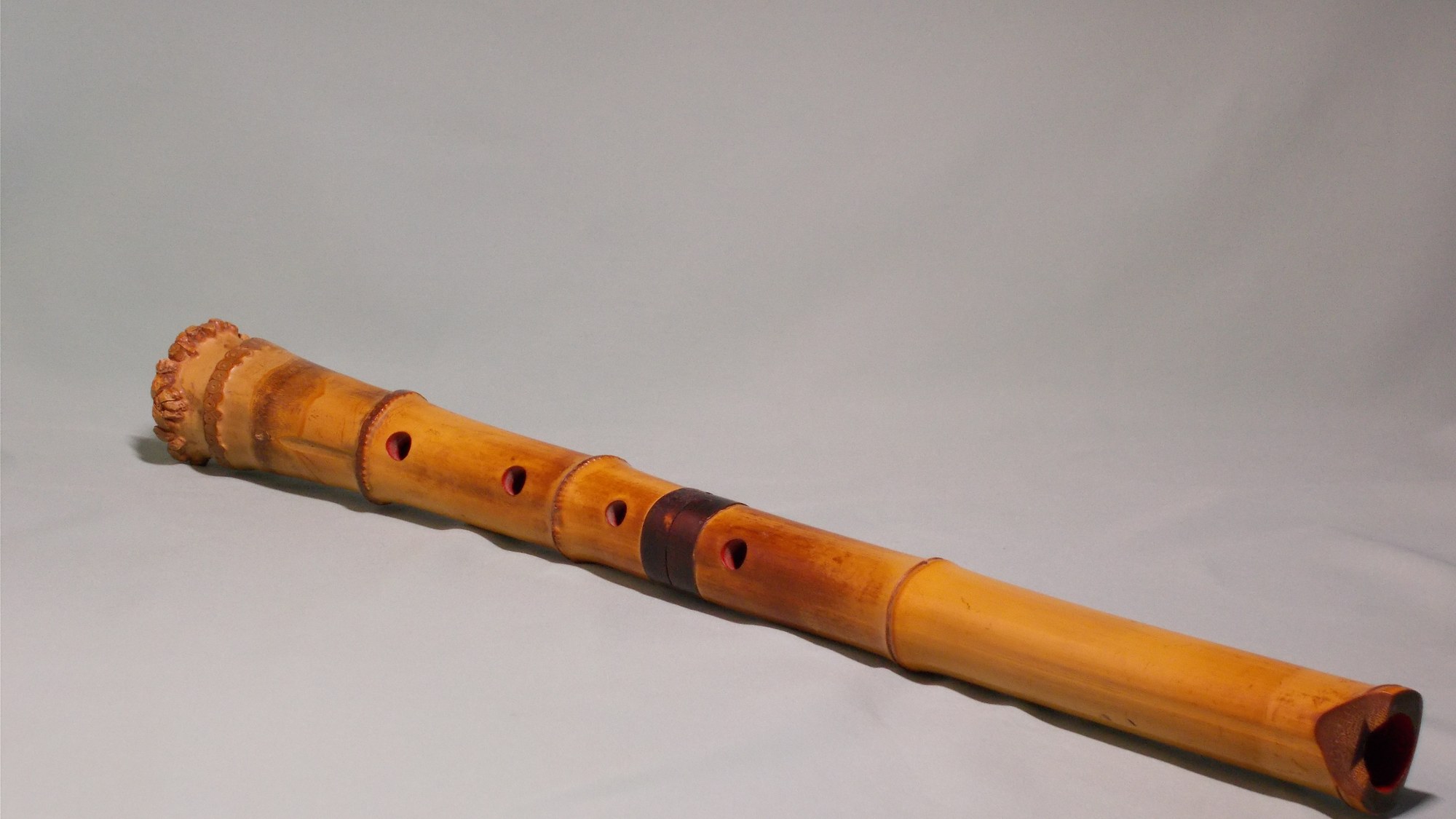
This is shakuhachi (尺八), the Japanese end-blown bamboo flute. It has only five finger holes, one of the smallest finger-hole counts of any wind instrument, and yet its expressive range covers more than two octaves and includes microtonal nuances that other flutes cannot reach. It has been played for over a thousand years in Japan, mostly in religious and ritual contexts, and it has had one of the more unusual histories of any traditional Japanese instrument — including a period when it was the legal property of a specific Buddhist sect of itinerant priests who used it as a spiritual tool rather than as an instrument of music.
This article traces what shakuhachi is, the Zen-monk traditions that shaped its repertoire, how a sect outlawed in 1871 nonetheless preserved a continuous lineage of playing, and why a bamboo tube with five holes has become one of the most intensely studied instruments by Japanese and international students.
Table of Contents
- What the instrument is
- Five holes, two octaves
- The Fuke Zen monks
- Honkyoku, the original pieces
- After the ban
- The breath as the instrument
- International students
- Contemporary music
What the instrument is
A shakuhachi is a length of bamboo, vertical end-blown, with the player’s lower lip resting against the cut edge of the bamboo’s open top. The standard instrument is approximately 54.5 centimetres long — the length being the source of the name (shaku and hachi are old Japanese units of length, with the standard shakuhachi being one shaku and eight sun long). The bamboo is taken from the root section of a specific species (madake), where the wall is thickest and the natural curvature of the root provides the characteristic flared bottom shape.
The instrument has four finger holes on the front and one thumb hole on the back, for a total of five holes. The holes are larger than those of Western recorders or flutes, allowing for half-holing and angle-changing techniques that produce notes between the standard finger positions. The bore — the inside of the bamboo tube — is shaped through cutting and polishing to produce the desired acoustic response.
Construction quality varies enormously. A simple student instrument can be purchased for roughly the cost of a beginner Western flute. A serious professional shakuhachi, made by a respected luthier with carefully selected bamboo and finely tuned interior, can cost more than a luxury car. The variation reflects both the difficulty of finding bamboo with the right properties and the time required to shape the bore correctly. A fully professional shakuhachi may take a maker months to complete and may be played for decades by its owner.
The sound is distinctive and instantly recognisable. The breathy attack on each note, the natural pitch instability that the player must learn to control, the slight buzzing on certain notes, and the wide range from soft whisper to forceful blast all combine to produce a tone that is unlike any other flute. The instrument’s voice is described variously as “wooden,” “wind-like,” “vocal” — all are partial descriptions of a sound that is genuinely unique.
Five holes, two octaves
The shakuhachi‘s five-hole design might seem to limit its musical range, but the instrument actually achieves more than two octaves of pitch through several techniques.
The first octave is produced with normal blowing pressure and the basic finger combinations. The fundamental scale is pentatonic — five notes per octave — corresponding directly to the five holes when one is uncovered at a time.
The second octave is produced by overblowing — increasing breath pressure to drive the bamboo into higher harmonic resonance. The same finger positions that produce first-octave notes produce, with stronger breath, the corresponding second-octave notes. This requires significant breath control, particularly to produce the second octave reliably without slipping back down.
Notes between the basic scale steps are produced by partially covering finger holes, by changing the angle of the lip against the bamboo, or by adjusting the head position. These techniques — meri (lowering pitch by tilting the head down) and kari (raising pitch by tilting up) — are central to the shakuhachi‘s expressive vocabulary and require long practice to control. A skilled player can bend pitches by quarter-tones or smaller, producing the microtonal ornamentation that defines traditional shakuhachi music.
The result is an instrument that is mechanically simple but technically demanding. A beginner can produce the basic notes within a few weeks of practice. Producing them reliably, with controlled tone and pitch, takes years.
The Fuke Zen monks
The most distinctive period in shakuhachi history was its association with the Fuke sect of Rinzai Zen Buddhism. From roughly the 17th century until 1871, the shakuhachi was the official instrument of the komuso (虚無僧, “monks of nothingness”) — itinerant priests of the Fuke sect who travelled the Japanese countryside playing the shakuhachi as a form of meditation.
The komuso were distinctive figures. They wore broad woven baskets (tengai) that covered their entire heads, hiding their faces. They carried only a shakuhachi, a begging bowl, and minimal possessions. They walked from temple to temple, playing as they walked, soliciting alms from villagers in exchange for the music. The basket hat reinforced the idea of anonymity — they were not individuals but representatives of the sect.
The Fuke doctrine treated shakuhachi playing as suizen (吹禅), “blowing meditation” — a parallel practice to zazen (sitting meditation). The shakuhachi was not music in any Western sense; it was a tool for meditative breath practice, and the pieces (honkyoku) were structured around long sustained notes, breath cycles, and silence rather than melody and rhythm.
The Fuke sect had certain privileges from the Tokugawa shogunate, including the right to travel between domains without restriction — useful in a period when most travel required formal permission. This made the sect attractive to former samurai whose lords had fallen, who could become komuso and continue moving freely while ostensibly doing religious practice. The mixing of religious and political functions was unusual.
Honkyoku, the original pieces
The original shakuhachi repertoire is honkyoku (本曲, “original pieces”) — a body of compositions developed by Fuke monks for their meditative practice. Many honkyoku are believed to be centuries old, though attribution and dating are uncertain because the pieces were transmitted orally rather than in written notation for much of their history.
A honkyoku piece typically has no fixed rhythm. The performer plays at the speed of their own breath, with notes lasting as long as one full exhalation. Pauses between notes can be substantial — long enough that an audience accustomed to Western music might wonder if the piece has ended. The structural unit is the breath cycle rather than the bar line.
Melodically, honkyoku pieces are pentatonic but heavily ornamented with microtonal bends, breath effects, and dynamic variations. A single note may begin breathy and unstable, develop into a clear sustained tone, then bend down a half-step before fading. The character of the note matters as much as which note it is. Pieces are played slowly enough that each note can be experienced as a separate event.
The piece Kyorei (虚鈴, “empty bell”) is one of the most famous honkyoku, attributed to the founder of the Fuke sect and treated as the foundational piece of the tradition. San’an (産安) is played in connection with safe childbirth. Mukaiji (霧海篪, “flute through the misty sea”) evokes water and fog. The titles often suggest specific meditative imagery, though the pieces are not programmatic in a literal sense; they are vehicles for breath practice rather than musical illustration.
After the ban
In 1871 the Meiji government banned the Fuke sect, along with many other traditional Buddhist sub-sects, as part of broader religious reforms. The komuso lost their legal status. The shakuhachi, which had been effectively the property of Fuke priests, became available for general use.
This could have ended the shakuhachi tradition entirely; it instead transformed it. The Kinko-ryu school, named after Kurosawa Kinko (a former komuso who had gathered and codified honkyoku in the late 1700s), continued to teach the traditional pieces but now to lay students. The Tozan-ryu school, founded in 1896 by Tozan Nakao, developed a new repertoire integrating shakuhachi with the koto and shamisen in chamber music ensembles.
These two schools — Kinko and Tozan — became the dominant shakuhachi lineages of the modern period. Kinko-ryu maintained closer ties to honkyoku and the meditative tradition; Tozan-ryu emphasised ensemble playing and the development of new compositions. Both produced large numbers of trained players in the late 19th and 20th centuries.
The post-ban period also saw the shakuhachi increasingly incorporated into traditional ensemble music — sankyoku (chamber music for koto, shamisen, and shakuhachi), seasonal pieces, and accompaniment for traditional dance. The instrument had migrated from monastery to concert hall, but the honkyoku repertoire was preserved alongside the new compositions.
The breath as the instrument
A defining feature of serious shakuhachi practice is attention to the breath itself. The player is not just blowing air to produce notes; they are using their entire respiratory system as part of the instrument. Diaphragmatic breath control, embouchure (the position of lips and mouth against the bamboo), and the angle of the head all contribute to the sound, and small variations in any of these produce different musical results.
This breath orientation has both practical and meditative consequences. Practically, shakuhachi requires substantial breath conditioning — long lung capacity, the ability to sustain notes through full exhalation, and the patience to allow notes to develop slowly. Meditatively, the focus on breath connects directly to Zen practice, where breath awareness is foundational. Many serious shakuhachi players treat their practice as much as a form of meditation as a form of music.
The traditional honkyoku repertoire encodes this breath orientation. The pieces require long held notes that test breath capacity, deliberate silences that test the player’s comfort with stopping, and microtonal control that requires constant breath adjustment. A piece is not “performed” in the usual sense of musical performance; it is “blown” (fuku), and the verb choice carries philosophical weight.
This physical-meditative focus is part of why shakuhachi attracts certain types of students. People drawn to the instrument tend to be drawn to the breath practice as much as to the music. The community of serious students includes meditation practitioners, yoga teachers, singers, and others for whom breath work is already a central concern. The instrument acts as a focusing tool for breath training that has applications beyond music.
International students
The shakuhachi has, somewhat unexpectedly, attracted significant international interest. American players began studying seriously in the 1960s and 1970s, partly through Japanese teachers who relocated to the US (notably Yamaguchi Goro and his students). European communities developed in the 1980s and 1990s. Australia and New Zealand have produced active shakuhachi communities. The international student population is small but committed, with active festivals, summer schools, and exchange programs.
Several factors drove international interest. The instrument’s connection to Zen Buddhism appealed to Western seekers who had found Buddhism through other paths. The breath-meditation aspect attracted yoga practitioners and sound healers. The simplicity of the instrument (five holes) suggested accessibility, even though serious mastery is anything but accessible. And recordings of major Japanese masters circulated internationally from the 1960s onward, providing reference material for distant students.
The international community has had complicated relationships with traditional Japanese teachers. Some teachers have welcomed foreign students; others have been more cautious about transmitting deep tradition to people who lack the cultural context. International players have sometimes had to navigate questions about authenticity, cultural appropriation, and what constitutes legitimate transmission of a tradition that historically belonged to a specific Buddhist lineage. These conversations are ongoing.
The result is that shakuhachi now exists as both a Japanese tradition and an international one, with significant cross-pollination between the two. Major contemporary shakuhachi festivals draw players from dozens of countries. Some non-Japanese players have reached substantial technical levels and have themselves become teachers within the tradition. The instrument’s home remains Japan, but its practising community is genuinely global.
Contemporary music
Beyond the traditional honkyoku and ensemble repertoire, shakuhachi has appeared in contemporary classical music, jazz, world music, and film soundtracks throughout the late 20th and early 21st centuries. Composers such as Toru Takemitsu wrote major works featuring shakuhachi, integrating traditional Japanese sound with Western orchestral idioms. Shakuhachi recordings appear on jazz albums, fusion records, and ambient music releases.
Film soundtracks have used shakuhachi to signal “Japan” or “meditation” or “wilderness” — sometimes well, sometimes superficially. The instrument’s distinctive breathy tone is recognisable enough that even brief appearances in soundtracks can establish atmosphere. This cinematic exposure has helped expand awareness of the shakuhachi internationally, though it has also produced the cliché of shakuhachi-as-shorthand-for-Japan that some serious players find reductive.
Contemporary shakuhachi composers — both Japanese and international — have continued to write new music that uses the instrument’s traditional voice in modern contexts. Some of this work returns to honkyoku forms with contemporary rhythmic or harmonic frameworks; some integrates shakuhachi with electronics, with non-Japanese ensembles, or with experimental performance practices. The instrument has shown itself to be more adaptable than its specialised history might have suggested.
What has remained constant, across these contexts, is the attention to breath as the basis of the instrument. Whether played by a traditional master in a temple meditation hall or by a contemporary performer in a concert hall, the shakuhachi requires the breath to do most of the expressive work. The bamboo tube, the five holes, the fingering technique — all of these matter, but they are vehicles for the breath. This is the source of the instrument’s distinctiveness, and it is what has kept it alive across a thousand years of changes in the contexts of its use.