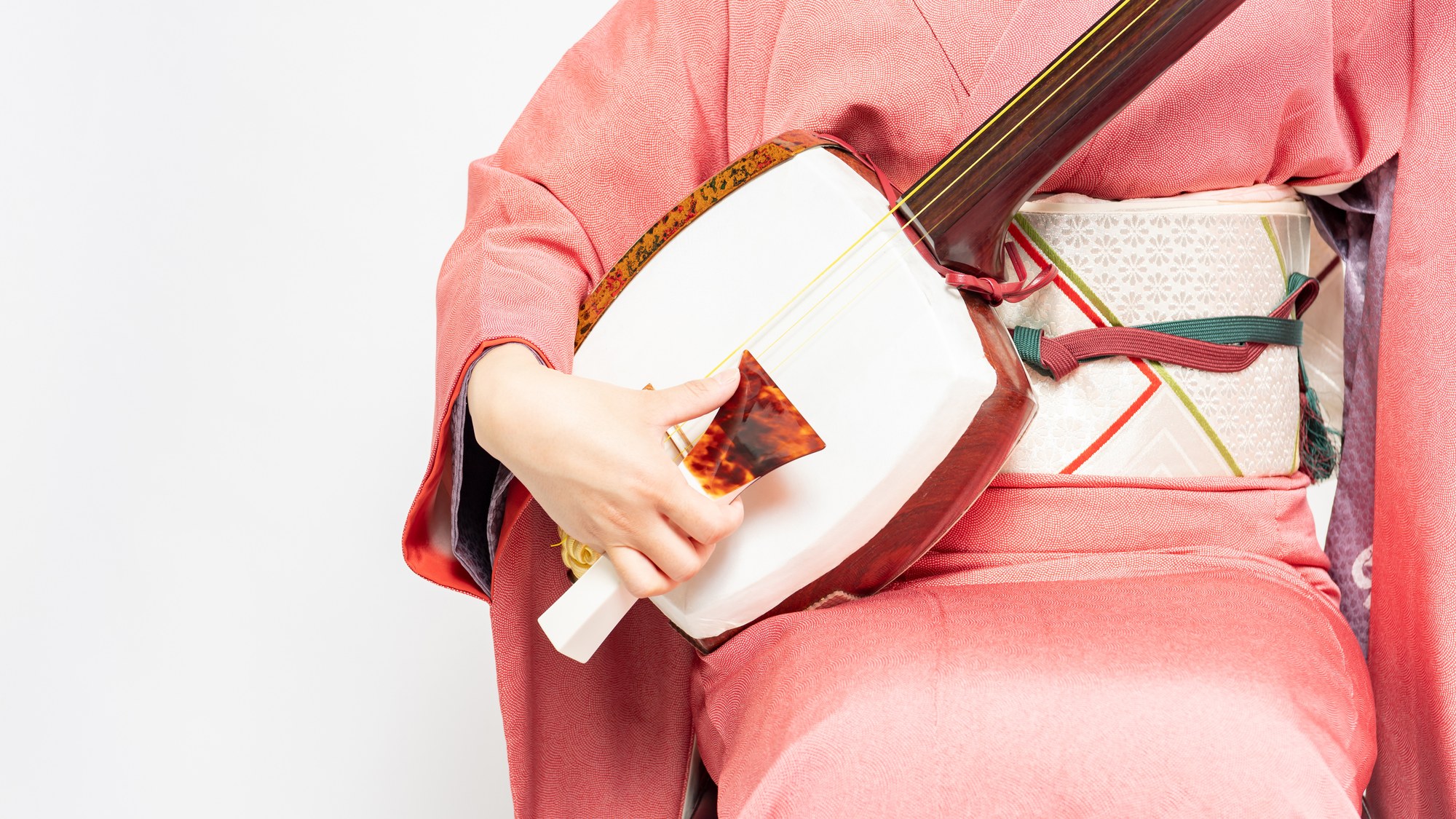
In a small room above a restaurant in a Japanese castle town, an old woman sits with a long-necked instrument across her lap. She strikes one string with a thick wooden plectrum. The note that comes out is not polished in the way a harp note is polished. It is sharp, slightly buzzy, with a hard little bite at the front and a slow decay behind it. She plays a phrase, and the melody bends and slides in a way Western musical language never quite knows what to do with.
This is the shamisen (三味線), a three-string instrument that has accompanied geisha houses, kabuki theatres, puppet plays, and folk gatherings for roughly four hundred years. It looks almost plain — three strings, a small drum-like body, no frets — but the sound is unmistakable, and surprisingly hard to reproduce on anything else.
This article follows the shamisen as an object and as a sound: how it came to mainland Japan from Okinawa, why different traditions use different versions of it, and how younger players are carrying it into music its early makers could not have imagined.
Table of Contents
- What the instrument is
- The Okinawa route
- Three traditions, three instruments
- The bachi, the skin, the sound
- Tsugaru and the northern revolution
- The geisha association
- Contemporary revival
- Why it resists translation
What the instrument is
The shamisen has three silk or nylon strings stretched along a long, fretless neck (sao) into a small, squarish body (do) covered on both faces with stretched animal skin. The skin acts as the resonator. When a string is struck, the vibration travels through the bridge into the skin, which gives the note its volume and edge. The body is small — much smaller than a guitar’s — but the skin lets it cut through the noise of a kabuki theatre or a crowded teahouse.
The strings are plucked or struck with a bachi (撥), a triangular plectrum, usually held in the right hand. The left hand presses the strings against the unfretted neck to change pitch, sliding between notes instead of jumping neatly from fret to fret. The lack of frets is not a missing feature. It is where much of the instrument’s expression comes from: the slides, bends, and small pitch inflections that make the line feel alive.
There is no standard tuning. The three open strings are tuned to one of several common patterns — honchoshi, niagari, sansagari — depending on the piece. Players retune mid-performance if needed.
The Okinawa route
The shamisen‘s ancestor is the sanshin (三線), an Okinawan instrument that had itself arrived from China during the Ryukyu Kingdom’s trade era. The sanshin uses snake skin (originally python) to cover its body, and its sound is brighter and more delicate than the shamisen‘s.
The instrument crossed from Ryukyu to mainland Japan in the late 16th century, arriving in Sakai, near Osaka, and then spreading through the merchant cities of the Edo period. Mainland makers changed it quickly. Snakeskin was not available in sufficient quantity, so they used cat skin, and later dog skin, which gave the instrument a denser sound with more low-end presence. The neck grew longer. The finger pick became a heavy bachi. The result was louder and more percussive, well suited to the entertainment worlds taking shape in Edo and Kyoto.
By the 17th century the shamisen had become indispensable to the popular performing arts. It accompanied kabuki plays, bunraku puppet theatre, and songs performed in pleasure quarters by geisha. It was urban, commercial, and a little disreputable — a working musician’s instrument, not a courtly one.
Three traditions, three instruments
A shamisen is not one fixed instrument with one fixed repertoire. It exists in three main forms, each with its own neck thickness, strings, bachi, and musical world.
The hosozao (細棹, thin-neck) is the lightest and quickest. It accompanies nagauta (長唄), the lyrical music of kabuki, and is built for ornamented melodic playing. The thin neck allows the player to slide quickly between pitches.
The chuzao (中棹, medium-neck) handles jiuta (地唄) and kouta (小唄) — chamber music originally played by geisha for small audiences. Its sound is somewhere between the bright hosozao and the heavier instruments below.
The futozao (太棹, thick-neck) is the heaviest, with the deepest, most rumbling tone. It accompanies gidayubushi (義太夫節), the narrative singing of bunraku puppet theatre, where the music must convey both intricate emotional detail and the dramatic weight of stylised tragedy. It is also the instrument of Tsugaru-jamisen, discussed below.
Players usually specialise in one of these traditions. Crossing between them is possible, but not casual; the techniques and aesthetic priorities are different enough that the instruments can feel like close relatives rather than one thing.
The bachi, the skin, the sound
The bachi is strange if you come to it from guitar picks. It is large — sometimes close to the size of a small fan — and made of wood, plastic, ivory, or tortoiseshell, with a beveled striking edge. It is held with the whole hand rather than pinched between fingertips, and it hits the string and the skin at nearly the same moment. That percussive thwack is not an accident. It is part of the sound.
The skin is also acoustically critical. Cat skin produces a particular tonal characteristic that synthetic substitutes have struggled to match. Animal welfare concerns and supply scarcity have pushed many makers and players toward kangaroo skin, dog skin, or composite synthetic materials, but traditionalists argue that none of them sound exactly like a cat-skin shamisen. The debate is ongoing and unresolved.
Skins also wear out. A heavily played shamisen may need reskinning every few years, and more often for performers who strike hard. The body goes back to a luthier, who removes the old skin, stretches a new one across the frame, and adjusts the tension. That tension matters: tighter skin gives a brighter, more aggressive voice; looser skin sounds warmer and rounder.
Tsugaru and the northern revolution
The most aggressive shamisen tradition is Tsugaru-jamisen, which developed in the Tsugaru region of Aomori Prefecture in northern Japan in the late 19th century. It grew largely around blind itinerant musicians (goze) who needed a style powerful enough to stop people, gather a crowd, and earn money in cold mountain villages.
Tsugaru-jamisen uses the heaviest futozao instrument, but plays it more like a percussion instrument than a melodic one. The bachi strokes are forceful, fast, and often improvised; the music has a driving, virtuosic quality that resembles flamenco guitar more than chamber music. Soloists often play long improvised passages between the verses of folk songs, demonstrating technical skill the way a jazz soloist would.
For a long time, this tradition was regional and somewhat marginal within Japanese music. In the 20th century, figures such as Takahashi Chikuzan toured nationally and recorded widely, bringing Tsugaru-jamisen to a broader audience. By the late 20th century it had become the shamisen style most visible outside Japan.
The geisha association
For many people outside Japan, the shamisen is tied first to geisha: women in elaborate kimono entertaining guests at exclusive teahouses with conversation, dance, and music. The association is real, but it is only one slice of the instrument’s life. Geisha did study shamisen as a core art, and the chamber music played in ozashiki banquet rooms is an important part of the repertoire. Still, the instrument ranges far beyond that setting.
The geisha association shaped one image of the shamisen: refined, intimate, performed by women in formal dress. That image is not wrong, but it can hide the rougher Tsugaru tradition, the kabuki and bunraku settings where the player is often male and half-invisible to the audience, and the folk contexts where the instrument simply keeps village singing moving.
The image’s persistence in tourist marketing has the side effect of making the actual instrument seem more decorative and less serious than it is. This is changing slowly as international audiences encounter Tsugaru virtuosos and contemporary players.
Contemporary revival
The shamisen nearly vanished from young Japanese musical life during the 1970s and 1980s, as Western pop and rock dominated the market and traditional music came to feel old-fashioned. Its revival came partly through charismatic players and partly through deliberate cross-genre experiments.
The Yoshida Brothers (Ryoichiro and Kenichi), playing Tsugaru-jamisen with a contemporary edge, became visible internationally in the early 2000s through video games and film soundtracks. Their style preserves traditional technique but borrows pacing and energy from rock and electronic music. Younger players have followed: bands combining shamisen with bass and drums, players collaborating with hip-hop artists, conservatories teaching shamisen to children whose parents grew up considering it antique.
The instrument has also received unexpected exposure through anime and video games. Soundtracks use shamisen riffs to signal “Japan” to global audiences, and some listeners then go looking for the real instrument. The path from soundtrack curiosity to serious study is narrow, but it exists.
Learning the shamisen is not easy. The fretless neck makes intonation a constant negotiation, the bachi technique takes months to settle into the hand, and much of the repertoire is transmitted orally rather than through Western-style notation. Textbooks exist, but they often assume access to a teacher. International students usually start with online lessons and a basic imported instrument.
Why it resists translation
The shamisen sounds the way it does because its choices do not transfer neatly to other instruments. The skin resonator, the unfretted neck, the percussive bachi strike, the silk strings, the regional tunings — each part contributes to a sound that other instruments can imitate but never quite become.
It is also tied to musical traditions that do not fit cleanly into Western listening habits. The pentatonic and modal scales, the rhythmic conventions of nagauta and gidayu, the relationship between voice and accompaniment in geisha music — these are coherent on their own terms. They lose something when forced into Western harmonic explanations.
That is part of why the instrument still matters. It is one of the clearest cases in Japanese music of a sound that has not been absorbed into the global pop-classical blend. Whether played in a Kyoto teahouse, at a Tsugaru festival, or inside a contemporary fusion ensemble, the shamisen remains recognisably itself: three strings, a skin-covered body, and a bachi strike that no synthesiser has quite learned to fake.