On a winter night in Osaka’s Dotonbori district, a vendor stands behind a heavy iron griddle pocked with rows of half-spherical hollows. He pours batter across the whole surface, drops a cube of octopus into each hollow, scatters tempura crumbs, pickled ginger, and green onion on top, and waits about ninety seconds. Then the flipping starts. With two thin metal picks, he turns each ball a little at a time, letting the still-liquid batter flow into the hollow as it rotates, until thirty browned, steaming spheres sit in neat rows.
This is takoyaki (たこ焼き), literally “grilled octopus.” It is the food most closely tied to Osaka, the dish visitors line up for and locals make at home with a dedicated griddle. It is also a small piece of culinary engineering: a hot, mostly liquid centre held inside a thin shell, made possible by the exact shape of the pan.
This article follows takoyaki from Osaka street food to national comfort food: what it is, how it was invented in 1935, why the griddle matters so much, and how a regional snack became one of Japan’s most recognisable foods.
Table of Contents
- What takoyaki is
- The akashiyaki ancestor
- The Aizuya invention
- The griddle
- The flip
- The toppings and the sauce
- Osaka and national spread
- Takoyaki at home
What takoyaki is
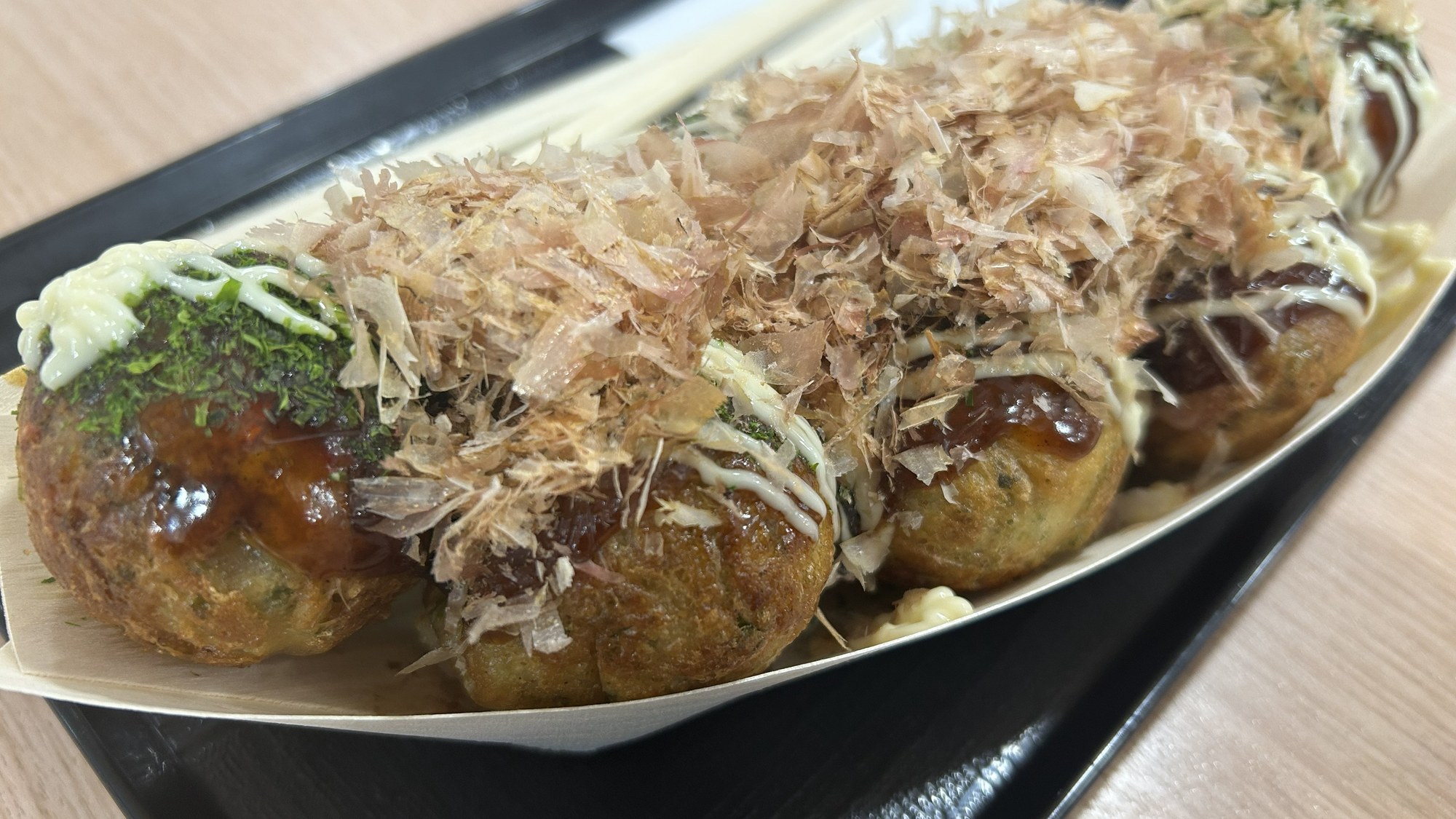
A finished takoyaki ball is roughly spherical, about three to four centimetres across. The outside is golden brown, with a lightly crisp shell that gives way under pressure. Inside is a soft, almost custardy centre — barely set batter — around a piece of octopus, chopped green onion, pickled ginger (beni shoga), and tenkasu (tempura batter crumbs). The whole thing is brushed with sweet-savoury sauce, drizzled with mayonnaise, and topped with shaved bonito flakes (katsuobushi) that move in the steam.
The first bite is hot in a way that catches the unaware. The interior is closer to scalding than to merely warm, because the batter holds heat efficiently and because takoyaki is meant to be eaten immediately after cooking. Locals develop a technique of biting carefully, allowing steam to escape, then chewing the octopus and softer interior together.
The flavour is busy in the best way: dashi-rich batter, briny octopus, sweet sauce, savoury bonito, sharp pickle, all in a single mouthful. The texture is the stranger part. Most fried foods promise crispness all the way through. Takoyaki is deliberately soft inside.
The akashiyaki ancestor
Takoyaki‘s direct ancestor is akashiyaki (明石焼き), a similar octopus dumpling from the city of Akashi in Hyogo Prefecture. Akashiyaki is older — it has roots in the 19th century — and is structurally similar: a round dumpling cooked on a hollowed griddle with a piece of octopus inside.
The differences matter. Akashiyaki batter contains more egg, giving it a softer, almost custardy texture throughout. Press it too firmly and it will not behave like takoyaki at all. It is dipped in clear dashi broth before eating, rather than covered in sauce. There are no toppings. The flavour is delicate and broth-forward.
When the technique moved from Akashi to Osaka in the early 20th century, Osaka cooks pushed it in a different direction: stiffer batter, a more substantial filling, sauce instead of broth, and a more theatrical presentation. The cooking method was shared, but the personality changed. Akashiyaki still has its loyalists, but takoyaki became the version Japan knows best.
The Aizuya invention
The conventional origin story of takoyaki points to a specific shop: Aizuya (会津屋), founded in 1933 in Osaka’s Nishinari district. The shop’s founder, Tomekichi Endo, was making radioyaki — a similar griddle dish using beef and konnyaku — when a customer from Akashi told him about akashiyaki with octopus.
Endo experimented with octopus, modified the batter, and by 1935 was selling what he called takoyaki. The original Aizuya version did not use sauce; it was eaten plain or with a light salt-and-soy seasoning, similar to akashiyaki. The sweet brown sauce that became signature takoyaki came later, with other shops adapting the recipe through the 1940s and 1950s.
Aizuya is still in business in Osaka, still serving takoyaki in the older style. For travellers who want the historical version, it is a useful contrast to the heavily sauced street-stall style: saltier, simpler, and more directly about dashi and octopus.
The griddle
The defining piece of equipment is the griddle itself, called a takoyaki-ki (たこ焼き器). It is a heavy iron plate with rows of hemispherical depressions — typically twelve, fifteen, twenty-four, or more, depending on the size — each about four centimetres across. Heat comes from below, either gas (in commercial use) or electric (in home versions).
The depressions are the point. Without them, the batter would spread into a flat pancake, and you would be somewhere closer to okonomiyaki (お好み焼き), Osaka’s other famous batter dish. With them, the batter pools into little reservoirs that can be turned, folded, and built into spheres. The geometry of the griddle becomes the geometry of the food.
Commercial takoyaki griddles can be large, sometimes spanning a metre or more, with banks of hollows that let the cook keep dozens of balls at different stages at once. A skilled vendor in a busy stall may run two or three griddles in parallel, flipping continuously, starting new batches as finished ones are scooped onto plates.
The griddle is also why takoyaki is hard to fake outside Japan. Generic flat griddles produce flat dumplings. The specialised hollowed griddle is widely available in Japanese kitchen stores and online, but it is unusual outside Japan, which means takoyaki in non-Japanese contexts often comes either from a specialist Japanese-style shop or from someone who has imported the equipment specifically.
The flip
The cooking process is theatre. The cook pours batter across the entire surface, not just into the hollows but over the flat metal between them, then drops in octopus and other fillings. The bottoms set first while the surrounding batter stays liquid.
When the bottoms have set, the cook uses two thin metal picks (sometimes wooden) to begin rotating each ball. The flipping motion is precise: lift the partially-cooked ball, fold the surrounding still-liquid batter into the empty hollow underneath, and rotate the ball ninety degrees. Repeat. Each ball is flipped multiple times during cooking, with new liquid batter folding in at each turn until the sphere is complete.
A skilled vendor can flip thirty balls in twenty seconds, working with a rhythm that looks almost casual until you try it yourself. The action is visible from outside the stall, and watching it is part of the attraction. Children gather. Tourists film. The food sells itself before it is even plated.
The flip is harder than it looks. Beginners produce balls that are uneven, with thin edges, gaps, or one side noticeably more cooked than the other. Mastery takes practice, and it is a real skill that takoyaki makers take seriously.
The toppings and the sauce
Once the balls are finished, they are scooped onto a paper boat or small plate, brushed with takoyaki sauce (a thick sweet-savoury sauce closer to British brown sauce than to anything called sauce in Japanese cuisine), drizzled with mayonnaise (often Japanese Kewpie), and topped with aonori (powdered green seaweed) and katsuobushi (shaved bonito).
The bonito flakes are central to the visual impression. They are paper-thin and dry, and the heat from the fresh balls makes them curl and shift as if alive. That tiny movement is part of takoyaki‘s identity in photos and video.
The sauce is sweet, with a soy-and-Worcestershire base, sometimes with fruit or vegetable concentrates added. Brands like Otafuku and Bull-Dog produce specific takoyaki sauces for both commercial and home use. The mayonnaise’s role is to balance the sweetness with fat and acidity.
Some stalls offer variations — cheese instead of octopus, ponzu instead of sauce, negi (green onion) heavily piled on top — but the canonical version remains octopus with sauce, mayonnaise, and bonito.
Osaka and national spread
Takoyaki is so closely tied to Osaka that the word and the city call each other up automatically. Osaka households are famously more likely than the rest of Japan to own a home takoyaki griddle, and the dish is a regular feature of parties where guests take turns at the pan.
The national spread happened gradually in the post-war period and accelerated with the rise of nationally-known chains like Gindaco (築地銀だこ), founded in Tokyo in 1997, which now has hundreds of locations across Japan and increasingly internationally. Gindaco’s version is more uniform than the artisanal Osaka style — they use proprietary equipment, standardised recipes, and the result is consistent rather than craft-driven.
This national chain version has expanded takoyaki‘s reach, but it has also made many people expect a more uniform version of the dish. Travellers who visit Osaka after eating Gindaco often find the local original looser, less crisp, and more variable from shop to shop — qualities locals tend to see as features, not defects.
The dish has also become a staple of konbini prepared food and frozen-food sections — boxed takoyaki you microwave at home is a workable approximation, available at any Japanese convenience store or supermarket. Fresh from a stall in Dotonbori is a different experience, but the everyday accessibility of the dish has helped its national identity solidify.
Takoyaki at home
A defining feature of takoyaki in Japan is that many households have their own electric takoyaki griddle, kept in the kitchen and brought out for parties. This is true in Osaka especially, but increasingly across Japan. The dish translates well to home cooking precisely because the equipment is the only specialised element — the ingredients are simple, and the social act of cooking together at the table is the appeal.
A typical takoyaki party (takopa in casual speech) begins with the host preparing batter and chopping fillings, then setting the griddle on the dining table. Guests pour batter, drop in fillings, and take turns flipping. There is usually an early stage when everyone’s balls look terrible, then a stage when one or two guests reveal suspiciously good technique, then a relaxed stage where imperfect balls are made and eaten continuously.
Home versions allow experimentation — cheese, kimchi, mochi, sausage, and other unconventional fillings appear at parties. Osaka traditionalists view this with a mix of tolerance and amusement; the canonical version is octopus, but home cooking is allowed its own creativity.
What takoyaki shows about Osaka, and through Osaka about Japanese food culture, is how a regional invention can become national without losing its home address. Osaka still owns takoyaki in a way no other city can claim. The dish travels across Japan and abroad, but the centre of authority remains in those original stalls in Dotonbori, where the flip, the heat, and the dashi balance still set the standard.