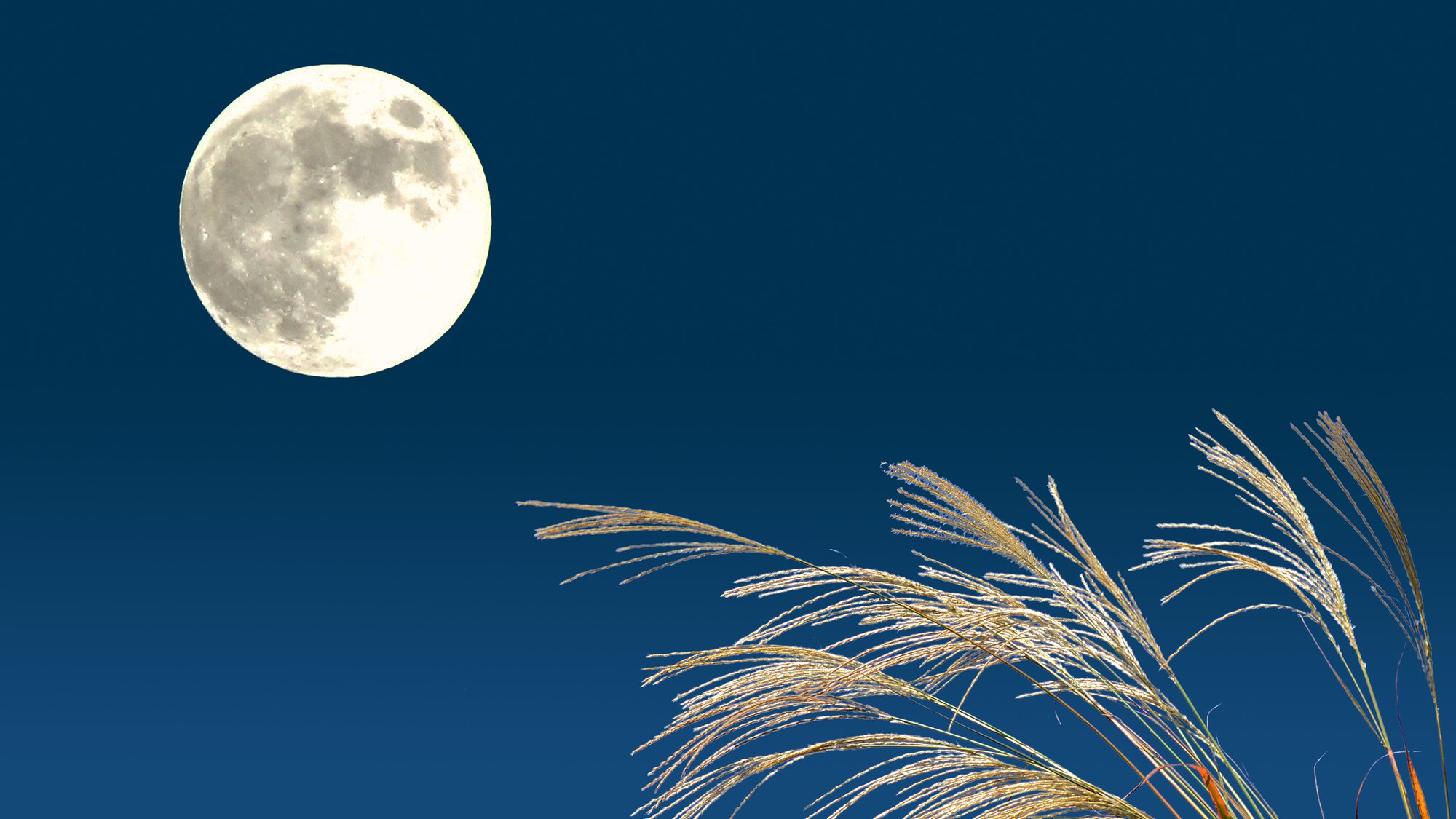
On a clear night in mid-September, a small wooden tray is set on the engawa of a traditional house. Fifteen white rice dumplings sit on it in a little pyramid, beside a vase of susuki (Japanese pampas grass) and perhaps an autumn-coloured persimmon or two. The tray faces outward, toward the moon: a full moon hanging unusually large in the eastern sky. The household gathers for a while, looks, says a few small things, then drifts back indoors, leaving the offering in place for the night.
This is tsukimi (月見), literally “moon-viewing,” the autumn custom that has treated one particular full moon — the harvest moon — as worth stopping for. The name is plain: looking at the moon. The practice is almost as plain: choose a clear evening, arrange a small offering of seasonal foods, and step outside or to a window to watch the moon rise. It is one of Japan’s quieter seasonal customs, less public than hanami in spring or momijigari in late autumn, and that quietness is part of its shape.
This article follows what tsukimi is, how the lunar calendar sets its date, what the offerings mean, and how a custom that arrived from Tang dynasty China became one of Japan’s most recognisable autumn observances.
Table of Contents
- What tsukimi marks
- The night of the fifteenth
- The offerings
- Susuki and the arrangement
- Tsukimi dango and the pyramid
- The rabbit on the moon
- Why it quietened
- Tsukimi in the modern year
What tsukimi marks
Tsukimi is the practice of viewing the autumn full moon, particularly the moon of the eighth month of the lunar calendar, which falls roughly in mid-September of the modern Gregorian calendar. This is sometimes called the jugoya (十五夜) — “the fifteenth night” — referring to the fifteenth night of the lunar month, which is the night of the full moon.
The custom has both aesthetic and agricultural roots. Aesthetically, the autumn moon is said to look especially clear, large, and beautiful, partly because the air is drier than in summer and partly because the moon’s path through the sky makes it easier to see from gardens and engawa. The tsukimi moon is often described as having a different quality from the summer moon, which sits lower and is more easily softened by haze.
Agriculturally, jugoya falls near the autumn rice harvest, and the moon-viewing is connected to harvest gratitude. The offerings traditionally placed before the moon — rice dumplings, seasonal vegetables, fruits — represent the harvest being acknowledged before any of it is consumed by the household. This blending of aesthetic appreciation and harvest thanksgiving is characteristic of how Japanese seasonal customs handle natural events: not just looking at something beautiful but marking it through a small ritual gesture.
A second, less famous tsukimi falls about a month later — jusan-ya (十三夜), the thirteenth night of the ninth lunar month, around mid-October. Jusan-ya is sometimes called kuri-meigetsu (chestnut bright moon) or mame-meigetsu (bean bright moon) for the seasonal foods offered. The pairing of the two moon-viewings — jugoya and jusan-ya — has roots in the belief that observing one but not the other is unlucky (katami-zuki, “single-side moon”). In modern practice, jugoya is much more widely observed.
The night of the fifteenth
The lunar calendar that governs tsukimi runs roughly six weeks behind the Gregorian calendar. The fifteenth night of the eighth lunar month falls between mid-September and early October each year, depending on lunar cycle. In 2026, for example, jugoya falls on September 25.
The custom wants a clear evening, which is of course exactly what no custom can guarantee. Tsukimi has the same problem hanami has in spring: the weather may refuse to cooperate. Clouds or rain can hide the moon completely, and a moon-viewing evening may become an evening of knowing the moon is there without seeing it. Traditional poetry has made room for this for centuries; the “moon that cannot be seen” — mu-getsu — has its own aesthetic, parallel to visible moon-viewing.
The viewing itself is brief. There is no sustained gazing requirement. A household might step outside for ten or twenty minutes, look at the moon, perhaps recite or remember an old poem about the moon, then step back inside. The offerings remain on the tray for the night. By the next morning, the tray is cleared and ordinary life resumes.
That brevity is part of what makes tsukimi feel different from other Japanese seasonal customs, which often involve sustained activity: hanami parties, autumn-leaf walks, festival outings. Tsukimi is closer to seasonal acknowledgement than to a full event. The point is to mark the moment, not to stretch it.
The offerings
A traditional tsukimi offering tray includes:
Tsukimi dango — fifteen small white rice dumplings, stacked into a pyramid. Discussed in detail below.
Susuki — Japanese pampas grass, with its characteristic feathery silver-white plumes. Arranged in a vase to the side of the dango pyramid. The pampas grass functions as a stand-in for ripening rice; both are tall grass-like plants with seed heads, and susuki arrives in autumn at roughly the same time as the rice harvest.
Seasonal fruits and vegetables — typically including taro (sato-imo), edamame, persimmons (kaki), chestnuts (kuri), and sometimes pumpkin. The exact selection varies by region and household; the principle is that the offering reflects what the local harvest has produced.
Sake — sometimes a small cup of sake is included, particularly in households that maintain a more formal practice. The sake honours both the moon and the harvest deities.
The arrangement is placed somewhere with a view of the moon — typically an engawa (wooden veranda), the side of a window facing east where the moon will rise, or a small garden altar (kami-dana) positioned outdoors for the night. In modern apartments without these features, a windowsill works.
The offering is an act of recognition. The household is acknowledging that the harvest exists, that it came from somewhere, and that the moon is a witness to the year’s accumulation of growth. No one expects the moon to eat the dumplings. The tray is for the people making it as much as for any spiritual recipient.
Susuki and the arrangement
Susuki (薄), Japanese pampas grass, is the visual signature of tsukimi. The tall stalks with feathery white-silver plumes are recognisable across distances and have appeared in autumn paintings, textiles, and design for centuries. Pampas grass grows wild in Japan in late summer through autumn, and even in urban areas it can be found in roadside areas, riverbanks, and abandoned lots.
The susuki in a tsukimi arrangement is meant to evoke ripening rice. The botanical relationship is real — both are tall grasses with similar seed-head structures — and the visual association would have been clearer to historical Japanese audiences who lived adjacent to rice paddies. Susuki serves as a stand-in for rice in a context where placing actual rice stalks on the offering tray would have looked too literal.
A typical tsukimi arrangement uses three to seven susuki stalks, arranged loosely in a vase or jar. The aesthetic ideal is informal and natural rather than tightly composed; the stalks should look like grass that has been gathered rather than like a florist’s arrangement. The plumes catch light from the moon if conditions are right, adding a slight visual dimension to the offering as the moon rises higher.
In addition to or in place of susuki, some arrangements include kikyou (Chinese bellflower), hagi (Japanese clover), or other autumn-blooming plants. The set of “seven autumn flowers” (aki no nanakusa) — susuki, hagi, kikyou, nadeshiko, ominaeshi, fujibakama, and kuzu — is the canonical list of autumn flora associated with the season, and any subset of these can appear in a tsukimi arrangement.
Tsukimi dango and the pyramid
The signature offering food is tsukimi dango — small, plain, white rice dumplings made specifically for moon-viewing. Unlike the dango of everyday Japanese confectionery, tsukimi dango is unsweetened, undecorated, and not skewered. The dumplings are simple white spheres about three centimetres across.
The number is fifteen, matching the fifteenth night of the lunar month (jugoya). The arrangement is a pyramid: nine dumplings on the bottom layer (three by three), four on the middle layer (two by two), and two on the top, with the very top dumpling sometimes considered separate. The exact stacking pattern varies in traditional sources, but the pyramid form is consistent.
The pyramid stands on a small wooden tray called a sanpou (三方), which has three open sides — a traditional offering platform used in Shinto ritual contexts. The sanpou with the dango pyramid is placed where the moon can “see” it, typically on the engawa or by a window.
The dumplings are eaten the following day, usually at breakfast, by family members. They are unsweetened and somewhat plain on their own; common preparations include eating them with kinako (toasted soybean flour), with anko, or grilling them briefly to develop a slight char. In some regions, the dumplings are converted into ozoni (a soup) or other dishes that incorporate the rice form.
Convenience stores and supermarkets sell pre-packaged tsukimi dango sets in the days leading up to jugoya, often complete with a small wooden tray and dried susuki. This commercialisation has made the custom accessible to households that would not make their own dango, and it has helped preserve the practice in urban contexts where the traditional materials would otherwise be hard to source.
The rabbit on the moon
In Japanese folk belief, the dark patches on the moon’s surface — what Western tradition reads as a “man in the moon” — form the shape of a rabbit pounding rice. This is the tsuki no usagi (月の兎), the rabbit on the moon.
The folk story explains the rabbit’s presence: in an old Buddhist tale, a rabbit, a fox, and a monkey were tested by a deity who appeared to them as a starving traveller. The fox brought fish; the monkey brought fruit; the rabbit, having nothing to offer, threw itself onto the fire to feed the traveller. The deity, impressed by the rabbit’s selflessness, placed its image on the moon as a memorial.
In tsukimi contexts, the rabbit on the moon is connected back to the dango. The rabbit is pounding rice (mochi-tsuki — see mochitsuki) in a wooden mortar, and the dumplings being offered are the products of that pounding. The story creates a small symbolic loop: humans offer rice dumplings to the moon, where a rabbit pounds the rice that produces dumplings.
This rabbit imagery is widespread in tsukimi visual culture. Greeting cards, confectionery packaging, school art projects, and decorative items associated with the season often feature the moon with a rabbit silhouette inside it. The image is gentle, child-friendly, and distinctly Japanese — international audiences sometimes find it puzzling that the same lunar markings produce different cultural readings (rabbit, man, hare, woman) across different traditions.
Why it quietened
In modern Japan, tsukimi is observed less actively than other major seasonal customs. Hanami fills cherry-blossom parks every spring with extended parties; tsukimi takes place largely indoors, briefly, and without the social gathering that often makes a custom sustainable. Many young Japanese people are aware of tsukimi but have never actively performed it.
Several factors have eroded the practice. Light pollution in urban areas makes the moon harder to see clearly, reducing the aesthetic payoff of the viewing. Modern apartments often lack the engawa or window-side spaces that made traditional moon-viewing convenient. The lunar calendar itself has dropped out of everyday consciousness, with most Japanese people unaware of when jugoya falls without checking specifically. And the brevity of the custom — its lack of an extended event structure — has made it harder to sustain in busy modern life.
The custom has not disappeared, but it has shifted. Convenience-store advertising for tsukimi-themed products in September keeps the word in public view. Schools sometimes include tsukimi in art and culture lessons. Older households still set out offerings, and some younger households revive the practice deliberately as a form of seasonal attention. But it is no longer the kind of observance nearly everyone would have performed a century ago.
The McDonald’s Tsukimi Burger — a seasonal autumn menu item featuring an egg in the centre that visually evokes a full moon — is in many ways the most widely encountered tsukimi product in contemporary Japan. The cultural reference is preserved even where the underlying ritual practice has thinned.
Tsukimi in the modern year
What survives of tsukimi in modern Japan tends to be the awareness of the date and the seasonal product cycle rather than the household ritual. Confectionery shops sell tsukimi dango in pre-stacked pyramids for buyers who want the visual without making their own. Convenience stores stock tsukimi-themed sweets and bento boxes. Department stores feature autumn-flower arrangements with susuki. Television weather forecasts mention the upcoming jugoya date.
For people who do practise the custom, the gesture remains simple and roughly unchanged: clear an evening, arrange an offering, look at the moon. It is one of the more accessible seasonal customs to revive, requiring no special equipment and no group participation. A single household can observe tsukimi without travel, expense, or coordination — only attention to the calendar and a window facing east.
What tsukimi preserves, even in a thinned-out modern form, is the habit of stopping briefly to mark a moment. The moon will be full whether anyone notices or not. The offering, the arrangement, the act of stepping outside to look — those are the human additions. Like hanami and momijigari, tsukimi gives deliberate attention to a natural event that would otherwise pass on its own. The autumn full moon arrives without help; tsukimi is what people add to it.