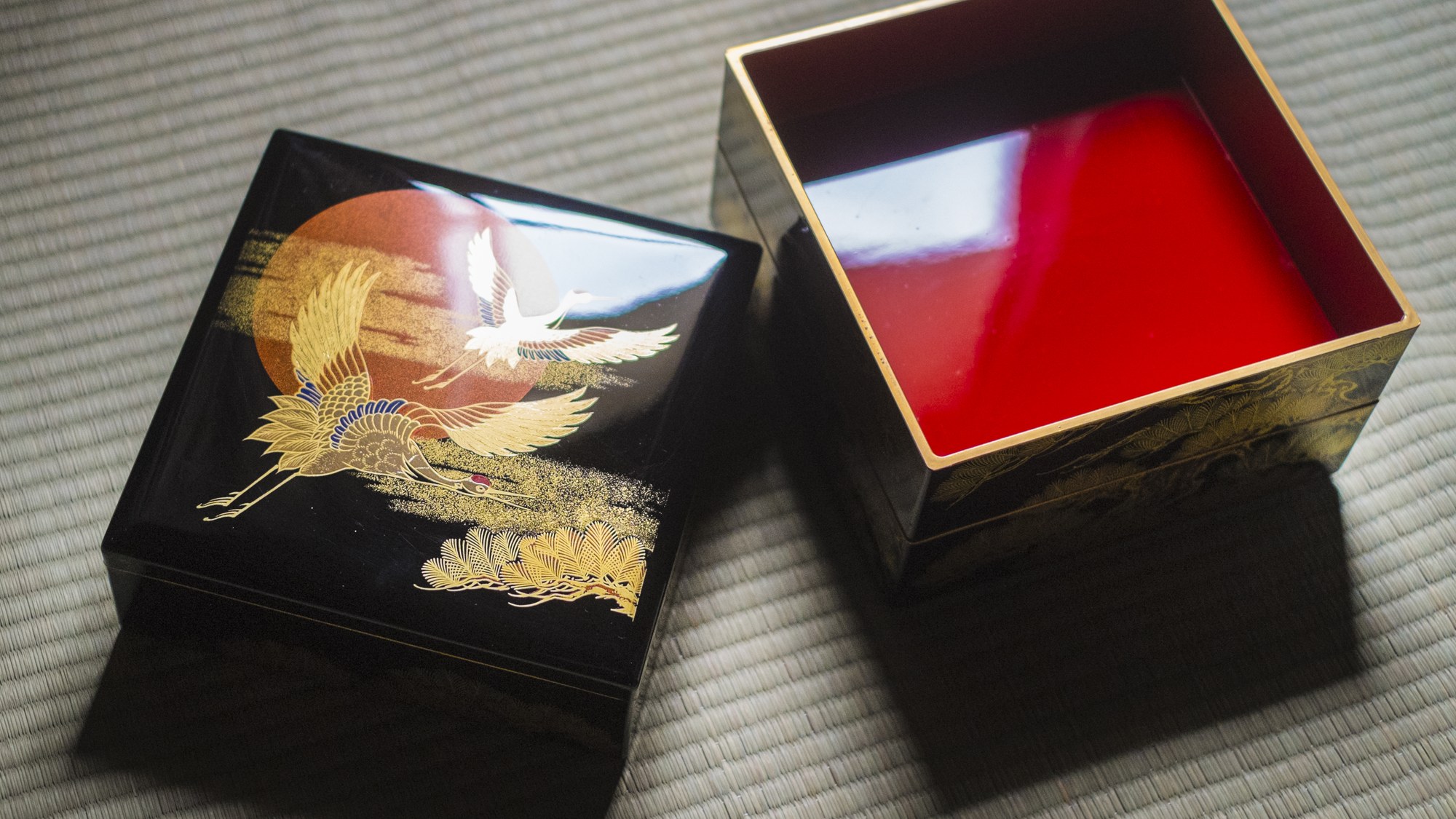
A small bowl sits on a table. It is dark — almost black — with a deep, glossy surface that catches light the way still water does. The interior shows hints of red beneath the black. The bowl is light in the hand, surprisingly so for an object with such visual presence. When fingers touch the surface, the lacquer is warm and slightly textured. The bowl might be 200 years old. It is in everyday use; the family that owns it has eaten soup from it across generations.
This is urushi (漆), the natural lacquer derived from the sap of a Japanese tree, and the family of objects coated with it — urushi-nuri or, in the broader sense, shikki (漆器). Lacquerware is one of Japan’s oldest continuous craft traditions, with documented production going back over seven thousand years. The technique combines a botanical material with refined craftsmanship to produce objects that are durable, beautiful, and deeply specific to East Asian craft tradition. Urushi-coated wood resists water, heat, acid, and decay in ways that other surface treatments cannot match.
This article traces what urushi is botanically, the painstaking process of harvesting and refining it, the multiple-layer coating technique that gives urushi objects their characteristic depth, the major decorative traditions that have developed around the basic lacquer surface, and why a 7000-year-old craft has remained a living tradition in modern Japan.
Table of Contents
- What urushi is
- Harvesting the tree
- Why it cures instead of drying
- The base layers
- Maki-e and decoration
- The allergy problem
- Regional traditions
- Why urushi survives
What urushi is
Urushi is the sap of Toxicodendron vernicifluum, the lacquer tree (also called the varnish tree). The tree is native to East Asia and is closely related to poison ivy and poison sumac — a relationship that becomes practically relevant for both harvesters and users, as discussed below. The sap, when refined and applied to wood, paper, leather, or other surfaces, produces a hard, glossy, water-resistant coating that has been used for millennia.
The raw sap is a milky white liquid that turns black or dark brown when exposed to air and oxidised. Through processing — filtering, heating, and stirring — the sap is converted into clear or coloured lacquer suitable for application. Pigments may be added to produce the characteristic black, red, brown, and other colours used in Japanese lacquerware.
A finished urushi surface is one of the most durable natural coatings known. It is resistant to water, salt, acid, alcohol, and many other substances. It is heat-resistant up to certain temperatures (lower than synthetic lacquers, but adequate for soup, hot tea, and other typical uses). It holds its visual properties — colour, gloss, depth — for decades or centuries. Urushi objects in museums and family collections often look in better condition than would be expected based on age, because the lacquer surface itself is essentially still operational.
The chemistry of urushi is unusual. The active component is urushiol — a phenolic compound that polymerises into a hard, stable surface through enzymatic catalysis. The polymerisation is slow, requires moisture, and produces a uniquely structured molecular network that gives urushi its specific properties.
Harvesting the tree
The harvesting process for urushi sap is labour-intensive and ecologically demanding. The lacquer tree must be approximately 10 to 15 years old before its sap is sufficient for harvesting. Harvesting begins in summer and extends through autumn. A skilled harvester (urushi-kaki) makes a series of horizontal slits in the tree’s bark, gathering the sap that wells out.
The slits must be carefully spaced to allow the tree to recover between cuts. Over a full season, multiple slits are made on each tree, with the harvester working in patterns that maximise yield without killing the tree outright. At the end of the season, the tree is typically felled — modern Japanese harvesting practice has moved toward this single-season approach, where the tree is harvested intensively over four to six months and then cut down.
The yield per tree is small. A mature lacquer tree might produce only 200 to 300 grams of usable sap during its harvesting season. Producing the lacquer required for a single elaborate piece can require sap from many trees. The supply of urushi is therefore inherently limited, and high-quality Japanese urushi — produced from native Japanese trees — has become increasingly scarce.
The harvesting work is also dangerous and unpleasant. Direct contact with raw sap causes severe allergic reactions in most people, similar to poison ivy reactions but more intense. Harvesters develop tolerance over years of exposure but still typically suffer skin irritation, especially during the first few seasons. The work is also seasonal and itinerant — harvesters travel between forest plots through the season — which has not appealed to younger workers in modern Japan.
The number of working urushi harvesters in Japan has declined to a small number — perhaps a few hundred. Most lacquer used in modern Japanese workshops is now imported from China or Southeast Asia, where labour is cheaper and lacquer trees are still plentiful. Domestic Japanese urushi commands premium prices when available and is reserved for the most prestigious work.
Why it cures instead of drying
A defining feature of urushi is that it does not “dry” in the conventional sense. Most paints and varnishes harden through evaporation of solvent — the volatile component evaporates, leaving the solid pigment behind. Urushi hardens through enzymatic polymerisation, which requires specific conditions of temperature and humidity to proceed correctly.
The optimal curing environment for urushi is roughly 25-30°C and 70-85% relative humidity. Outside this range, the lacquer either cures too quickly (producing brittleness or cracking) or too slowly (failing to harden properly). This is the opposite of what most surface coatings require — paint dries faster in dry, warm conditions, while urushi cures faster in warm, humid conditions.
The implication is that urushi application happens in specially controlled environments. Traditional workshops have urushi-buro — humidity chambers where freshly coated objects are placed to cure. The urushi-buro is typically a wooden cabinet with a damp interior, kept at controlled temperature, where lacquered objects rest for hours or days while their coats slowly polymerise.
This curing requirement has practical consequences. Each layer of urushi takes 12 to 24 hours to cure (or longer in less ideal conditions). Multi-layer pieces — which is most serious urushi work — require weeks or months to complete. A complex inlaid lacquerware piece might involve 30 to 50 separate coats, each cured separately, with sanding and polishing between coats. The total time required can be substantial — months to a year for elaborate pieces.
The slow curing also affects the geographic distribution of urushi work. The technique evolved in monsoon East Asia partly because the climate there is naturally conducive to curing. Producing urushi in dry climates (like the American Southwest or northern Europe) requires substantial environmental control and is more difficult and expensive than in Japan or southern China.
The base layers
A typical urushi piece begins with a wooden substrate — often kiri (paulownia), keyaki (zelkova), or hinoki (Japanese cypress) — carved or turned to the desired shape. The wood is selected and prepared carefully, with attention to grain orientation and structural stability. Cracks or weaknesses in the substrate will telegraph through the lacquer coats and produce visible defects in the finished object.
The first coats are typically applied to seal the wood. Sabi-urushi — a base coat made from raw urushi mixed with fine clay or stone powder — fills the wood’s pores and creates a stable foundation. Multiple layers of sabi may be applied, with sanding between coats, until a smooth uniform surface is achieved.
Over the sabi base, the actual lacquer coats are applied. These are thinner and more polished than the sabi. Each coat is applied with a flat horse-hair brush, in the thinnest possible layer that still covers the surface uniformly. After each coat cures, it is sanded smooth — sometimes with traditional natural abrasives like tonoko (a fine clay) — before the next coat is applied.
The number of coats varies by the quality of the work. Simple everyday urushi objects might have 5 to 15 coats. High-end pieces might have 30 or more. The famous lacquerware of Wajima — with its multi-decade longevity and museum-quality finish — typically involves 50 to 70 separate coats, applied over months of work.
The final coats, sometimes called jou-urushi, are the most refined and visible. These are typically clear or coloured lacquer that produces the visible surface finish — the deep gloss, the colour depth, the visible quality that defines the piece. Roiro — the highest-grade black lacquer — is built up through multiple final coats and produces the deep, almost mirror-like surface that is one of the most prestigious finishes in Japanese lacquerware.
Maki-e and decoration
Beyond the basic surface treatment, Japanese urushi tradition has developed elaborate decorative techniques. The most famous is maki-e (蒔絵, “sprinkled picture”) — a method of decorating lacquer surfaces with metallic powders.
In maki-e, the artist paints a design onto the lacquer surface using fresh urushi (still wet). While the lacquer is still tacky, fine metallic powder — gold, silver, or other metals — is sprinkled onto the design through a small bamboo tube. The powder adheres to the wet lacquer; the surrounding dry lacquer is unaffected. After the lacquer cures, additional clear or coloured lacquer is applied over the design, sealing the metallic decoration into the surface.
The simplest version is togidashi maki-e (research-out maki-e), where the metallic decoration is applied directly to the surface and overcoated. More elaborate versions include taka-maki-e (raised maki-e, where the design is built up with multiple layers to create a relief), and kirigane (gold-leaf cuts inlaid into the lacquer surface).
Maki-e requires extreme skill. The artist must work quickly during the brief window when the lacquer is wet enough to accept powder but dry enough not to bleed. The metallic powder must be applied with controlled distribution. The design must be planned carefully because corrections are difficult once the lacquer has been disturbed. Master maki-e artists develop their skills over decades.
Other decorative techniques include raden (mother-of-pearl inlay), chinkin (engraved gold lines pressed into the lacquer surface), tsukezuki-urushi (different coloured lacquers in patterns), and kinma (traceable patterns from Southeast Asia adopted into Japanese practice). Each technique has its own specialists and its own regional traditions.
The allergy problem
The relationship between urushi and the user is complicated by the strong allergic potential of the material. Urushiol — the active compound in raw lacquer — produces severe contact dermatitis in roughly 80% of people who are exposed to it. The reaction is similar to poison ivy contact: burning, itching, blistering, and lasting for several weeks.
This allergic potential is a real practical issue. Workers in urushi workshops who handle raw lacquer typically experience repeated allergic reactions, particularly during the first few years of practice. Long-term exposure produces some tolerance for many practitioners, but not all; some workers cannot continue in the trade because their reactions remain severe.
For users of finished urushi objects, the situation is different. Once urushi has fully cured — after weeks or months — the urushiol has been polymerised into a stable molecular form that is no longer chemically reactive in the same way as fresh sap. Most people can use urushi eating utensils, drink from urushi bowls, and handle urushi objects without allergic reaction. There are exceptions — people with extreme sensitivity may react even to fully cured pieces — but for most people, the finished objects are safe.
This safety gradient is important for the persistence of the craft. If raw urushi were as dangerous as cured urushi is safe, the workshop would have to be entirely segregated from product use. As it stands, only workshop workers face significant allergic exposure; users encounter cured pieces with minimal risk. This division of risk has allowed urushi to maintain a substantial consumer market despite the difficulties of production.
Regional traditions
Several Japanese regions have developed distinctive urushi traditions over centuries. The most prominent include:
Wajima-nuri (Wajima Lacquerware, Ishikawa Prefecture): perhaps the most prestigious modern lacquerware tradition. Wajima objects involve very high coat counts, intricate maki-e decoration, and the use of locally sourced “Jinoko” — a fine diatomaceous earth used in the base coats. Wajima pieces are extremely durable and command premium prices.
Tsugaru-nuri (Tsugaru Lacquerware, Aomori Prefecture): characterised by elaborate multi-coloured patterns visible at the surface. Tsugaru technique involves applying many layers of differently coloured lacquer, then carving down through them in patterns to reveal the layers below. The visual effect is distinctive and immediately recognisable.
Echizen-nuri (Echizen Lacquerware, Fukui Prefecture): generally simpler and more functional, emphasising daily-use objects rather than decorative pieces. Echizen lacquerware has a long history of producing the everyday bowls, trays, and serving pieces used in ordinary Japanese households.
Yamanaka-nuri (Yamanaka Lacquerware, Ishikawa Prefecture): distinguished by its emphasis on the wood substrate. Yamanaka pieces are turned from solid wood and treated with lacquer that allows the wood grain to remain visible. This produces pieces with a quieter, more rustic aesthetic.
Kamakura-bori (Kamakura Carving): a related but distinct tradition where wood is carved with a design before lacquer is applied. The carved depths fill with lacquer and produce contrast between the highlighted carved areas and the surrounding flat lacquer surface.
Each regional tradition has its own designated craftsmen, its own quality standards, and its own market position. Buyers familiar with the tradition can often identify the regional origin of a urushi piece by its style, finish, and decorative techniques.
Why urushi survives
Despite the manifold difficulties — limited raw material, slow production process, allergic exposure for workers, declining number of practitioners, competition from synthetic finishes — urushi continues as a living craft in Japan. Several factors support this persistence.
First, the material’s specific qualities cannot be reproduced by synthetic alternatives. Modern polyurethane and acrylic lacquers can mimic the gloss and durability of urushi but lack its specific aesthetic and tactile qualities. The depth of an urushi surface, the warmth in the hand, the way it ages — none of these are matched by synthetic finishes. For users who care about these qualities, urushi is irreplaceable.
Second, government recognition and support has helped sustain the tradition. Major regional traditions are designated as Important Intangible Cultural Properties, and senior practitioners are recognised as Living National Treasures. These designations come with funding and support that helps preserve teaching networks and maintains the production infrastructure.
Third, premium markets continue to value high-quality urushi. Luxury restaurants, traditional inns, tea ceremony practitioners, and serious collectors of Japanese craft all maintain demand for high-end urushi objects. International markets — particularly in cultures with strong appreciation for craft objects — provide additional demand. Major auction houses sell historical urushi pieces for substantial prices, supporting the value perception that benefits contemporary makers as well.
Fourth, the craft has adapted somewhat to modern conditions. Some workshops have integrated synthetic substrates and modern tools without compromising the lacquer application process itself. Modern urushi objects often combine traditional craft with contemporary design, finding markets among consumers who want both heritage and modernity.
What urushi preserves, in the end, is one of the longest continuous craft traditions in the world. The technique that produces a fully cured urushi surface today is recognisably similar to the technique used in Jomon period (10,000+ years ago) artifacts. The materials, the chemistry, the patient layering — all have been refined but not fundamentally changed. A bowl made by a master craftsman in Wajima this year and a bowl made in 1620 are both urushi objects in the same sense, sharing the same essential properties despite four hundred years of intervening history. This continuity is unusual in any craft tradition, and it is what gives serious Japanese lacquerware its particular weight as cultural artefact.