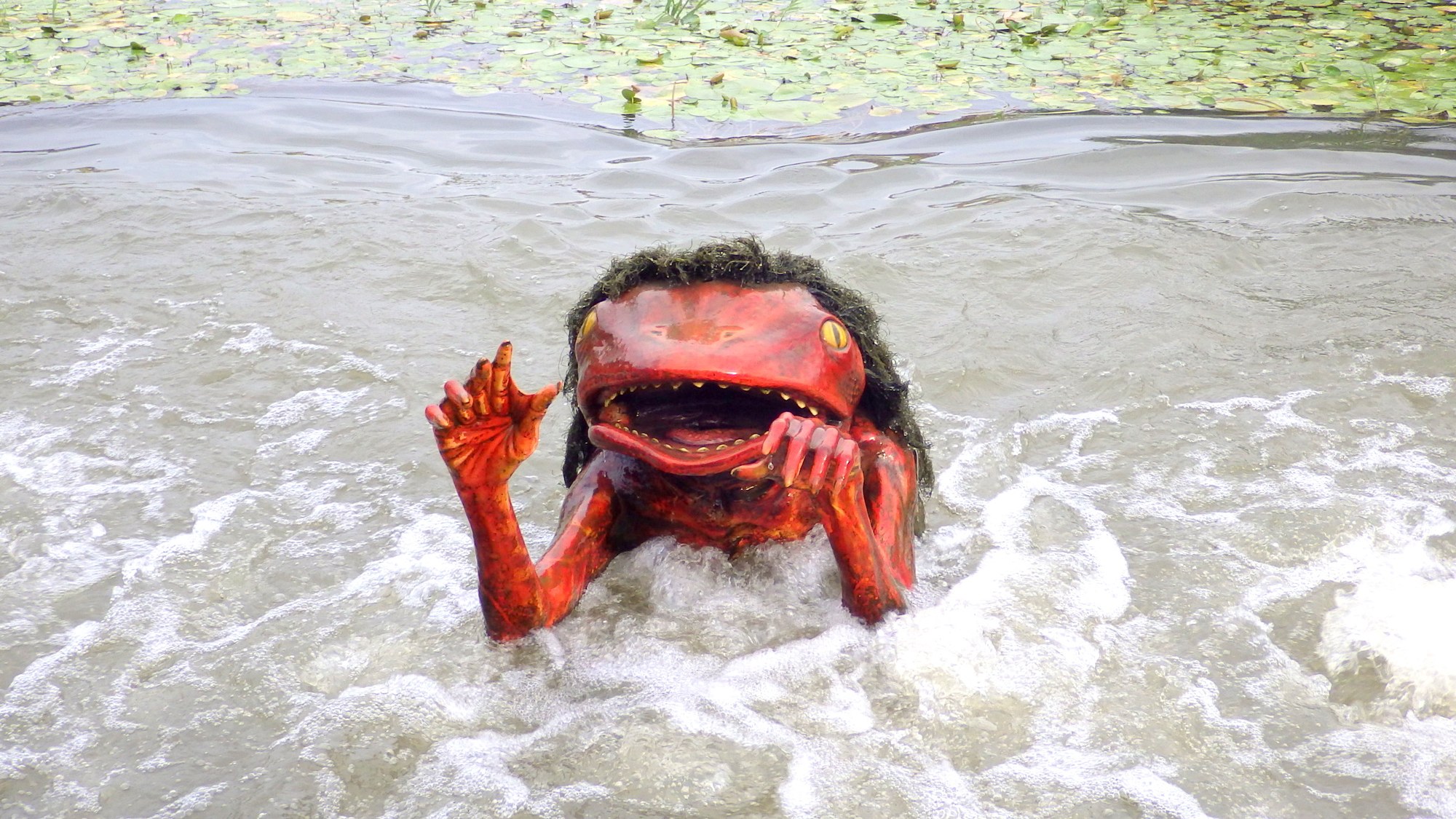
Walk into a secondhand bookshop in Japan and you may find a dog-eared yokai encyclopedia somewhere on the shelves. Not necessarily in an occult section. Maybe between cookbooks and travel guides. Inside are long-necked women who stretch around corners at night, giant sandals that appear at crossroads, river imps with dishes of water balanced on their heads. The tone is often matter-of-fact, almost practical. Japan has been cataloguing its supernatural beings for centuries, and the catalogue has never really closed.
This is not quite Western horror. The creatures are not purely evil, and the proper reaction is often less terror than wariness, negotiation, or even mild affection. A kappa (河童) may drown you if it gets the chance, but it also loves cucumbers and will bow so politely if you bow first that it spills the water from its head and loses its strength. There is a logic to most yokai, and that logic is worth understanding.
This article looks at what yokai actually are — taxonomically, historically, and culturally — and why a category of supernatural belief that should have died with industrialization instead became one of Japan’s most resilient cultural exports.
Table of Contents
- What yokai literally is
- The major types
- Shinto roots and animist logic
- Toriyama Sekien and the great taxonomy
- Yokai as Edo-period pop culture
- The modern revival
- Why they endure
- The principle underneath
What yokai literally is
The word yokai (妖怪) combines two characters: yo (妖), meaning strange, bewitching, or suspicious, and kai (怪), meaning mystery or wonder. A rough translation might be “strange mystery,” which captures the ambiguity better than “monster” or “ghost.”
The term is an umbrella, not a single creature type. Under it sit hundreds of named beings: shapeshifters and fixed-form creatures, dangerous entities and harmless ones, local legends and nationally recognized figures. They range from oni (鬼), the horned figures many Westerners picture first, to kodama (木霊), the gentle tree spirits made internationally familiar by Princess Mononoke.
Japanese also distinguishes yokai loosely from yurei (幽霊, ghosts of the dead), though the boundary blurs. A yokai is more often a non-human entity or a transformed natural thing; a yurei is specifically a human spirit that failed to pass on. Both categories have been part of Japanese life for as long as records exist.
The major types
No taxonomy is perfectly stable, but sorting them by origin helps:
Animal transformations (henge, 変化): Foxes (kitsune, 狐) and tanuki (raccoon dogs, 狸) are the most famous. Both are shapeshifters. Foxes are associated with the Inari deity, can have up to nine tails, and range from tricksters to divine messengers depending on context. Tanuki are more comic — associated with sake, luck, and bellies that function as drums. See also the maneki-neko, which draws on a related tradition of animals as conduits of fortune.
Water creatures: The kappa (河童) lives in rivers and ponds. It has a turtle shell, a beak, and a dish of water on its head that is the source of its power — tip it and the kappa is helpless. Kappa were historically used to explain drowning deaths and were treated with enough seriousness that some riverbanks still have warning signs featuring them.
Mountain and forest beings: Tengu (天狗) are winged creatures of the mountains, depicted either with a crow’s beak or an absurdly long human nose. They are connected to warrior culture and were said to train certain legendary swordsmen. They can be vengeful or helpful depending on whether they have been properly respected.
Snow and cold phenomena: Yuki-onna (雪女, “snow woman”) is a pale, beautiful woman who appears in blizzards and can freeze travelers with her breath. She exists in countless regional variants — some malevolent, some tragic, some both.
Household and object spirits: Tsukumogami (付喪神) are objects that have gained a spirit after a hundred years of existence. Old umbrellas, worn sandals, discarded lanterns — any neglected household item can become a yokai. This category is deeply animist: things have inner lives, and ignoring them is unwise.
Shinto roots and animist logic
The background logic for yokai is Shinto animism: the sense that kami (神, spirits or gods) can inhabit mountains, rivers, trees, weather, unusual rocks. The boundary between a kami and a yokai is partly emotional and partly social. A kami is worshipped at a shrine. A yokai is unpredictable, possibly dangerous, and usually not enshrined.
The Amaterasu tradition — the sun goddess at the root of the imperial line — is the high end of this spectrum. Yokai are the undomesticated end. They are what happens when kami-energy goes un-channeled, un-named, un-shrined. This is why many yokai legends include a resolution in which the creature is appeased, named, and effectively converted into a local protective spirit. The act of naming is the act of domestication.
This also explains why yokai have never entirely disappeared: as long as Japan maintains animist intuitions about the natural world (and it does, in ways both traditional and secular), the category of “strange presence in a place” remains intuitively plausible.
Toriyama Sekien and the great taxonomy
In the eighteenth century, an Edo-period artist named Toriyama Sekien (鳥山石燕, circa 1712–1788) did something unusual: he systematically illustrated the known yokai world in a series of woodblock-print encyclopedias. These were not dry academic texts. They were popular books, sold in Edo to readers who loved the strange and the clever. The books documented existing folklore and, just as importantly, invented new creatures to fill gaps in the taxonomy.
Sekien did for yokai something like what Linnaeus did for species: he gave them printed names, stable visual forms, and the feeling of a complete catalogue. Many creatures now treated as old folklore were either invented by Sekien or fixed into their familiar shapes through his illustrations.
Yokai as Edo-period pop culture
Yokai were not only believed in. They were entertainment. The Edo period (1603–1868) produced kaidan (怪談, ghost story) collections, yokai-themed games, theater, and illustrated books for an urban reading public that enjoyed the supernatural partly because daily life was so orderly.
One popular game was hyakumonogatari kaidankai (百物語怪談会, “gathering of one hundred ghost stories”): one hundred candles were lit, a ghost story was told, and a candle extinguished. As the room grew darker, the supernatural was supposed to approach. Participants blew out the last candle alone. Whether anyone believed this literally, the game made yokai into social entertainment rather than private terror.
This entertainment function continues directly into the modern period.
The modern revival
The postwar yokai revival runs through several distinct channels:
Mizuki Shigeru and GeGeGe no Kitaro: Mizuki Shigeru (1922–2015) is the figure most responsible for yokai’s twentieth-century rehabilitation. His manga GeGeGe no Kitaro, running from the 1960s onward, took Edo-period creatures and placed them in contemporary settings. Kitaro, a ghost boy, befriends rather than fights yokai. The series made yokai sympathetic, curious, and child-safe — a significant reframing.
Studio Ghibli: Films like My Neighbor Totoro (1988) and Spirited Away (2001) deployed yokai aesthetics internationally. Totoro is essentially a forest kami; the bathhouse of Spirited Away is staffed by beings drawn directly from Edo-period imagery. International audiences recognized them as “Japanese supernatural” without necessarily knowing the word yokai.
Yokai Watch: The video game and anime franchise launched in 2013 built an entirely new yokai roster for children, using the Sekien model (systematic illustrated encyclopedia) but in digital form. At its peak, Yokai Watch outsold Pokémon in Japan — a remarkable achievement that showed the format’s endurance.
Why they endure
Several features make yokai unusually durable.
They are local. Every region has its own yokai — creatures tied to specific mountains, rivers, and coastlines. This local grounding means the tradition refreshes itself continuously from regional identity rather than from a single canonical text.
They are taxonomic rather than theological. Yokai are catalogued, argued about, collected. This makes them compatible with secular, scholarly, and commercial treatment without the friction that religious supernaturalism sometimes generates.
They are morally complex. Unlike demons that are purely evil, most yokai are dangerous because they are misunderstood, provoked, or neglected — not because evil is their nature. This makes them available for sympathetic storytelling.
They are funny. A creature that drops its pants to show a glowing buttock (kappa again) does not generate the reverence that shuts down reinterpretation. Comic yokai can be merchandise, mascots, and manga protagonists without the tradition feeling violated.
The principle underneath
What yokai ultimately represent is Japan’s long habit of treating the natural and social world as animated by presences that deserve acknowledgment. The specifics have shifted — most urban Japanese people do not literally fear kappa in rivers — but the underlying structure remains: places and objects have histories, attention is owed, and the world is denser with agency than it looks.
This is why the yokai catalogue never fully closes. New creatures are still invented, debated, and added. Old ones are reinterpreted for each generation. The tradition is not just a leftover from premodern superstition. It is an ongoing cultural practice: a way of staying attentive to the world by giving its strangeness names.