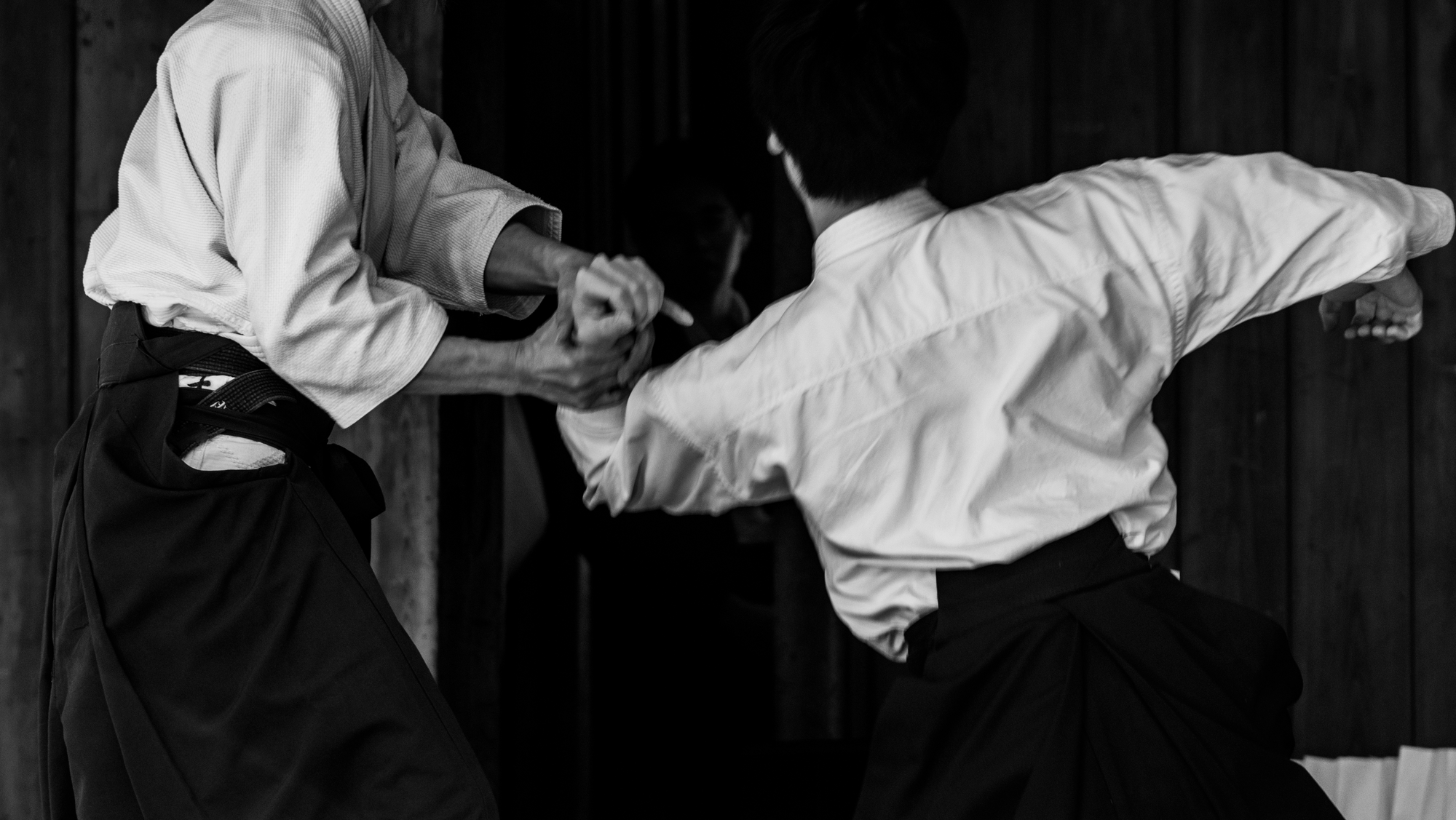
In a dojo in suburban Tokyo, two practitioners face each other on a tatami floor. One steps forward and reaches to grip the other’s wrist. Before contact is fully made, the receiver has shifted slightly off-line, turned the entering arm into a smooth circular motion, and the attacker is suddenly falling — gently — onto the mat. The fall is broken by a practiced roll. They both stand up and try again.
This is aikido (合気道), a Japanese martial art whose entire technical vocabulary depends on receiving an opponent’s attack rather than meeting it. It contains no offensive techniques. It has no competitive matches. Its founder explicitly said the goal was harmony rather than victory. For these reasons it occupies an unusual position in the world of martial arts — practiced widely, often misunderstood, and consistently subject to debate about whether it actually works in real combat.
This article traces what aikido is technically, how Morihei Ueshiba developed it from older martial traditions, what “harmony” means in this specific context, and why a martial art with no competition has spread to nearly every country.
Table of Contents
- What aikido actually does
- Ueshiba and the founding
- The meaning of ai-ki-do
- Irimi and tenkan
- The weapons
- No competition
- The effectiveness debate
- Why it spread
What aikido actually does
A typical aikido technique begins when one practitioner, the uke, attacks: grabbing a wrist, throwing a strike, swinging a wooden sword. The other practitioner, the nage, neither blocks the attack nor counter-attacks. Instead, the nage moves slightly — usually entering at an angle, or pivoting — so that the attacking force misses or overshoots, and then guides the attacker’s momentum into a throw, a joint lock, or a controlled pin on the ground.
The motions are largely circular. Where boxing emphasises straight punches and karate emphasises straight strikes, aikido emphasises rotational and spiral movement. A wrist grip becomes a turning motion that loads the attacker’s arm against itself. A forward strike becomes an entering pivot that places the nage beside the attacker rather than in front of them.
The grading curriculum covers a finite catalogue of techniques — ikkyo, nikyo, sankyo, yonkyo (the four basic joint controls); iriminage (the entering throw); shihonage (the four-direction throw); kotegaeshi (the wrist twist); and others. Each technique can be performed against multiple types of attacks, producing the impression that aikido has hundreds of techniques while in practice it has perhaps two dozen core movements applied to different attack vectors.
Ueshiba and the founding
Aikido was developed by Morihei Ueshiba (1883–1969), a martial artist from Wakayama Prefecture who trained extensively in older Japanese fighting traditions: Daito-ryu Aikijujutsu, sword-arts, spear-arts, and various forms of jujutsu. Ueshiba was an exceptional martial technician and, by the accounts of his students, also a deeply unusual personality — religious, philosophical, given to mystical statements about the nature of conflict.
Through the 1920s and 1930s, Ueshiba was developing what he initially called aikibujutsu and later aikibudo, drawing primarily from Daito-ryu but increasingly emphasising spiritual and philosophical elements drawn from his association with the Omoto-kyo religious movement. His approach gradually moved away from the harsh, combat-oriented framing of older jujutsu schools and toward an art he characterised as a path of self-cultivation in which physical techniques expressed an underlying ethical principle.
By the post-war period the art had been renamed aikido and was being taught publicly. Ueshiba’s son Kisshomaru organised the formal teaching structure (Aikikai) that remains the largest aikido federation today. Branch lineages — Yoshinkan, Shodokan, Iwama-style, and others — developed under students who interpreted Ueshiba’s later teachings differently.
The result is that aikido in the modern sense is barely a century old, but it draws from older Japanese fighting arts that go back centuries. It is a synthesis with a specific founder, a specific philosophical framing, and a specific technical curriculum that is recognisable across most of its lineages despite stylistic differences.
The meaning of ai-ki-do
The name decomposes into three characters: ai (合, harmony or joining), ki (気, energy or spirit), do (道, way or path). The conventional translation is “the way of harmonising energy” or “the path of joining with spirit,” though these phrasings struggle to convey what the term means in practice.
In technical terms, aikido refers to the practice of harmonising one’s own movement with the movement of an attacker — joining their motion rather than opposing it, and redirecting rather than blocking. Ki, in this context, is not a mystical force but a way of describing the unified intention and motion of body and mind. When practitioners talk about ki in aikido, they often mean the integrated direction of effort, the alignment of breath, posture, and technique into a coherent whole.
The philosophical framing — that aikido is about harmony with an attacker rather than defeat of an attacker — generates a particular ethical tone. A nage who throws an uke aggressively, or who completes a joint lock with deliberate damage, has technically performed the technique but has also failed at the underlying principle. The ideal is to neutralise the attack while preserving the attacker, leaving them able to continue.
This framing has theological depth in Ueshiba’s later writings, which connect aikido to a spiritual cosmology drawn from Omoto-kyo and from older Shinto frameworks. Modern practitioners vary widely in how seriously they take these spiritual aspects; some treat them as historical context, others as the central point of the practice.
Irimi and tenkan
The two foundational movement principles are irimi (入り身, entering) and tenkan (転換, turning).
Irimi is the act of stepping toward the attack rather than away from it — but at an angle that takes one off the line of force. The attacker swings, and the nage steps forward and to the side, so that the swing passes through empty space while the nage arrives at a position adjacent to the attacker. From this position the attacker’s balance is exposed and a technique can be applied.
Tenkan is the act of turning — pivoting on one foot, allowing the attacker’s force to pass while the nage spins out of its line. Tenkan is more circular than irimi; where irimi is a forward angle, tenkan is a rotation around a fixed point. Many aikido techniques begin with one or the other and chain into a redirection.
Beginners often start by practising these movements without an opponent, walking through irimi and tenkan footwork in slow patterns to internalise the angles. Even at the basic level the movements look unusual to people coming from other martial arts — aikido practitioners do not face attackers head-on; they constantly move off-line, slightly offset from the direction of incoming force.
The weapons
Aikido preserves a weapons curriculum, though it is taught somewhat irregularly across schools. The two main weapons are the bokken (wooden sword) and the jo (a four-foot wooden staff). Some schools also teach tanto (knife) techniques, primarily as a way for empty-hand practitioners to learn to defend against a knife.
The weapons curriculum is not for combat use. Wooden swords and staffs are training tools that teach the same body mechanics that empty-hand techniques use. Many aikido movements clearly originated in sword arts — shihonage visibly resembles a sword cut completed against the attacker’s joint — and weapons practice is a way to recover that connection.
The Iwama-ryu lineage, descended from Morihiro Saito (one of Ueshiba’s longest-serving students), particularly emphasises weapons practice as core to aikido rather than peripheral. In other schools — including parts of the mainstream Aikikai — weapons may be taught only occasionally or at higher ranks.
No competition
Almost uniquely among major Japanese martial arts, aikido has no competitive matches. There are no tournaments, no point sparring, no ranked competition leading to championship titles. Practice consists entirely of choreographed exchanges between uke and nage in which both know what is being practiced.
This was Ueshiba’s deliberate decision. He believed competition would distort the art, encouraging the development of techniques that won matches rather than techniques that expressed harmony. Without competition, aikido practice has a different rhythm than judo or kendo: cooperative, gradual, and oriented toward the long-term refinement of movement rather than toward winning against another person.
One school — Shodokan or Tomiki aikido, founded by Kenji Tomiki — does include competitive matches with rules adapted to aikido technique. Tomiki’s approach was controversial in mainstream aikido circles and remains a minority lineage, but it preserves the option of testing technique against a fully resisting opponent.
The absence of competition has consequences. It removes the empirical pressure to prove that techniques work under stress, which is one source of the long-running debate about aikido‘s real-world effectiveness. It also shapes the demographics of the art: aikido draws practitioners who are uncomfortable with combat-sport culture, including many older students, women, and people approaching martial arts for self-development rather than fighting.
The effectiveness debate
A persistent question — both inside and outside aikido — is whether the techniques work against actively resisting opponents. Demonstrations within the dojo feature compliant uke who attack with predictable timing, take falls willingly, and do not counter the nage‘s movements. Critics, particularly from MMA and combat-sport backgrounds, argue that this cooperation hides the fact that aikido technique would not function against trained opponents using full resistance.
The defensive position, taken seriously within the art, is that aikido is not optimised for one-on-one ring competition; it is optimised for restraint without injury, for handling someone who may be untrained, drunk, or unpredictable, and for maintaining the practitioner’s own composure. The skills developed through years of practice — balance, awareness, the ability to move efficiently around threats — may transfer to physical conflict in ways that are not directly visible from technique demonstrations.
There is also a serious internal critique within aikido. Some practitioners argue that the art has drifted toward overly compliant practice and toward techniques that look impressive in a dojo but lack the practical grounding of older jujutsu. Reform-minded teachers have pushed for more vigorous attacks, more resistance from uke, and integration with cross-training in other arts. This debate is ongoing and unresolved.
Why it spread
Despite the unresolved questions about effectiveness, aikido has spread internationally to a remarkable degree. Dojos exist in nearly every major city worldwide. The Aikikai federation alone has affiliates in over ninety countries. Visitors from Japan are often surprised by how seriously aikido is taken in places like France, Brazil, and Russia, where strong national lineages have developed.
Several factors drove this. The non-competitive structure made aikido accessible to people who did not want to compete. The philosophical framing appealed to spiritually-inclined Western seekers in the 1960s and 1970s. The technical beauty of the throws made for compelling demonstrations. And early international teachers — including some of Ueshiba’s senior students — established strong programs abroad.
The art’s identity as a Japanese cultural practice, alongside its martial content, also matters. Studying aikido connects practitioners to Japanese aesthetic and ethical frameworks in a way that practice in another martial art might not. The bowing, the dojo etiquette, the use of Japanese terminology, the connection to older traditions like sword arts — all of these turn aikido practice into a form of sustained cultural engagement, which has its own appeal independent of fighting effectiveness.
What aikido offers, in the end, is a coherent system that asks a particular question: can conflict be handled without making it worse? The answer in the dojo is technical, embodied, and refined through long practice. Whether that technical answer transfers to other forms of conflict is a question each practitioner ultimately has to answer for themselves, on the mat and off it.