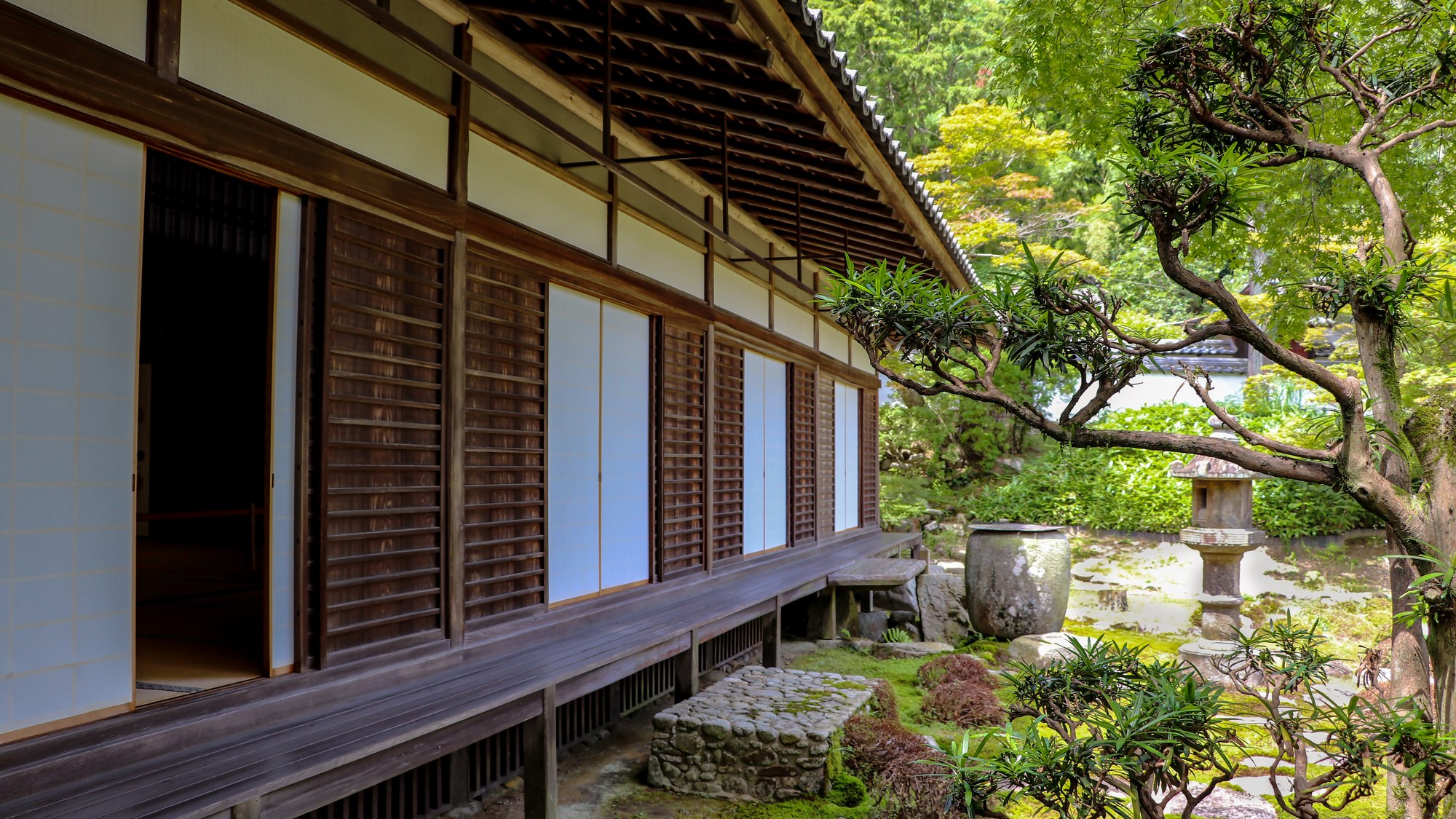
On a summer afternoon in an older Japanese house, the most comfortable place to sit is often a narrow wooden ledge running along the exterior wall, under the deep overhang of the roof, with one’s legs dangling into the garden. This is the engawa (縁側). It is not quite the garden — you are still within the roof’s protection, still in contact with the building. But you are also not inside. There is no wall behind you, no clear transition point where the house definitively ends.
This in-between quality is not a failure of design. It is the point. The engawa is a liminal space, deliberately constructed at the boundary between the domestic interior and the outside world. Every architectural element around it — the sliding doors, the roof line, the garden positioning — is arranged to maintain and extend that ambiguity.
This article traces what the engawa is structurally, how it mediates temperature and light across seasons, why it largely disappeared from modern Japanese housing, and why it keeps reappearing in the cultural imagination.
Table of Contents
- What engawa literally is
- Between shoji and amado
- Summer cool, winter warm
- The social function
- Why modern housing removed it
- The Miyazaki effect
- Contemporary revivals
- The principle underneath
What engawa literally is
The word engawa breaks into en (縁, edge or margin) and gawa (側, side). The edge-side. It is the strip of flooring — typically polished wood or bamboo — that runs along the exterior face of a Japanese room, separated from the garden by a step down or simply by the edge of the floor itself.
Structurally, engawa are positioned outside the main room but under the extended eaves of the roof. The eave overhang — noki (軒) — is deep in traditional Japanese architecture, far deeper than in most Western buildings. This overhang is the roof working as environmental management: it keeps direct rain off the building’s exterior, but also creates a protected zone between the interior and the fully exposed outdoors.
The engawa occupies this zone. It is covered but open. Its floor is raised above ground level — the same elevation as the interior room — but there is no solid wall on the garden side, only the possibility of enclosure through sliding panels.
The floor itself is finished differently from interior rooms. Where the interior typically has tatami matting, which cannot be exposed to moisture, the engawa floor is bare polished wood: durable, cleanable, and able to tolerate the occasional rain splash or tracked-in damp.
Between shoji and amado
The engawa sits in a layered system of sliding panels. On the garden side: amado (雨戸), heavy wooden storm shutters that close fully when weather demands it, completely enclosing the engawa and protecting the more delicate interior panels behind it. On the interior side: shoji (障子), paper-covered wooden lattice screens that let diffused light through while maintaining visual privacy and mild thermal separation.
The engawa is the buffer zone between these two systems. When the amado are open and the shoji are closed, the engawa is a semi-private exterior space — visible from the garden, sheltered by the roof, but with a translucent barrier between it and the room. When the shoji are slid open, the engawa becomes continuous with the interior, extending the floor space outward.
This layering means the relationship between inside and outside is continuously adjustable rather than binary. The choice is not simply “open” or “closed” — it is a spectrum of configurations, each with different thermal, visual, and social implications.
The tokonoma and the engawa operate in complementary ways within the traditional Japanese room: the tokonoma is the interior’s formal focal point, oriented inward and upward; the engawa is the room’s connection to the exterior, oriented outward and downward into the garden.
Summer cool, winter warm
The engawa performs different functions across seasons, and both are genuine.
In summer, the engawa is the coolest place in the house. The deep eave blocks direct sunlight from the interior during the high-sun months, and the open garden-side means whatever breeze is moving through the garden also moves through the engawa. Sitting there in the afternoon, the wood underfoot stays cooler than a closed interior room. Grandparents napping, children doing homework, adults shelling soybeans — the engawa is the default location for activities that require being present in the house without needing to be fully indoors.
In winter, the same space becomes a solar collector. The sun angle drops lower in winter, allowing it to penetrate under the eave and strike the engawa floor directly. The polished wood absorbs heat, and the shoji behind — acting as a crude greenhouse barrier — trap some of that warmth. Sitting in winter sun on the engawa with a kotatsu (炬燵) nearby in the room behind is a specific kind of Japanese domestic comfort with its own cultural weight.
This passive seasonal management — the same architectural element performing cooling in summer and warming in winter — is a product of careful attention to sun angle and airflow. The deep eave is calculated, not decorative.
The social function
The engawa served a particular social role that the interior of a Japanese house did not. The interior — the rooms with tatami — required that footwear be removed at the genkan and that visitors go through the formal protocol of entry. A neighbour stopping by for a brief conversation did not necessarily trigger this whole process.
The engawa could be approached from the garden side without entering the house at all. A neighbour could sit on the step, the host could sit on the engawa floor facing them, and an entire conversation could happen at this threshold without anyone needing to formally enter or leave. The spatial ambiguity served as a social permission slip: you are here, but you are not inside.
This made the engawa the natural location for casual daily exchange, for children crossing between neighbouring gardens, for the kind of incremental neighbourhood contact that does not rise to the level of a formal visit but maintains social fabric over time.
Why modern housing removed it
Post-war Japanese housing construction eliminated the engawa almost entirely in urban and suburban contexts. The reasons are economic, regulatory, and climatic-technological.
Land cost in urban Japan drove floor plans toward maximum usable interior space. The engawa is, in strict economic terms, dead space — covered, protected, but not classified as interior floor area in the ways that matter for real estate value. Eliminating it gave more tatami or Western-style rooms for the same building footprint.
The introduction of mechanical heating and cooling changed the calculus for passive thermal management. Once air conditioning became standard in the 1970s and 1980s, the engawa‘s summer-cooling function became less essential. And air conditioning requires sealed, insulated envelopes — the exactly opposite design principle from a room with a permeable exterior wall. The engawa became an enemy of energy efficiency once energy efficiency was measured in terms of air-tight construction.
Building regulations also shifted. Modern Japanese residential construction is subject to detailed specifications about insulation, air exchange, and energy performance that traditional engawa-based design simply cannot meet without significant modification.
The result is that engawa are now almost exclusively found in older houses, traditional inns (ryokan), temples, and deliberately traditional-style construction. They have become a marker of historical architecture rather than a living feature of everyday housing.
The Miyazaki effect
Hayao Miyazaki’s films have a persistent relationship with the engawa. It appears — sometimes briefly, sometimes extensively — as the space where significant moments happen in Totoro, Spirited Away, and several others. Characters sit on it to observe, to wait, to have the kind of quiet conversation that does not fit inside a busy interior.
This is not coincidental. Miyazaki has spoken about the traditional Japanese house as an environment that shaped a particular relationship between humans and the natural world, and the engawa is architecturally the hinge of that relationship. By placing important character moments on or near the engawa, the films locate their emotional core at the boundary rather than safely inside.
For many viewers outside Japan — and for younger Japanese viewers who have only known sealed apartment interiors — the engawa in these films reads as a kind of impossible domestic space: comfortable but unenclosed, domestic but porous, present but not defensive. The films do not explain it. They use it as background that communicates atmosphere, and the atmosphere is specific enough that it works even for audiences who could not name what they are seeing.
Contemporary revivals
Architects working in contemporary Japanese residential design have developed several approaches to the engawa concept without replicating it literally. Wide window seats, covered terraces with interior-level flooring, transitional zones between glass walls and exterior decking — these borrow the spatial logic without creating the thermal and regulatory problems of a traditional engawa.
Some architects working in traditional styles do reproduce engawa directly, accepting the engineering challenges involved in meeting modern performance standards. The result typically involves concealed insulation, thermally broken joinery, and careful attention to the glass or panel system used on the garden side. It is possible, but expensive.
There is also a cultural-wellness discourse around the engawa that has grown in recent years, presenting it as an example of traditional architecture’s attention to human comfort, nature connection, and mental health — a counterpoint to the sealed, climate-controlled box that characterises most contemporary housing. Whether this leads to actual construction or remains aspirational is harder to measure.
The principle underneath
The engawa is interesting not because it is beautiful — though it often is — but because of what it refuses to be. It refuses to be inside. It refuses to be outside. It holds the boundary open, architecturally and socially.
This refusal is not passive. It takes structural intention: the deep eave that creates the covered-but-open zone, the layered shutter and screen system that makes the boundary adjustable, the smooth wood floor that can tolerate what tatami cannot. Every element is deliberate.
The disappearance of the engawa from modern housing is a trade: we gained thermal efficiency and maximised interior space. We lost a space where the house could be partially open to the world without committing to it. Whether that is a reasonable trade is a question people are starting to ask again, which may explain why a feature that practically ceased being built fifty years ago keeps appearing in films, architecture writing, and conversations about what domestic life could be.