Walk through a summer festival crowd and you will hear it before you see it: a dry, rhythmic clack cutting through the chatter, the kind of sound that seems to carry even in humid air. Someone nearby is wearing geta (下駄), and the wooden base is doing exactly what it was made to do. No other Japanese footwear announces itself quite this clearly. That is not an accident.
Geta are not simply old sandals kept around for nostalgia. They are a small system — timber choice, tooth geometry, thong angle — shaped over centuries around terrain, climate, and dress. To understand why they look so strange at first glance, you have to understand what they were built to deal with.
This article looks at how geta are built, how they pair with different garments, and why a plain-looking piece of wooden footwear carries more cultural information than it first seems to.
Table of Contents
- What geta literally are
- The two teeth
- Paulownia and why the wood matters
- The kara-koro sound
- The hanao thong
- Geta vs zori — which goes with what
- Rain, snow, and the high-tooth variant
- The principle underneath
What geta literally are
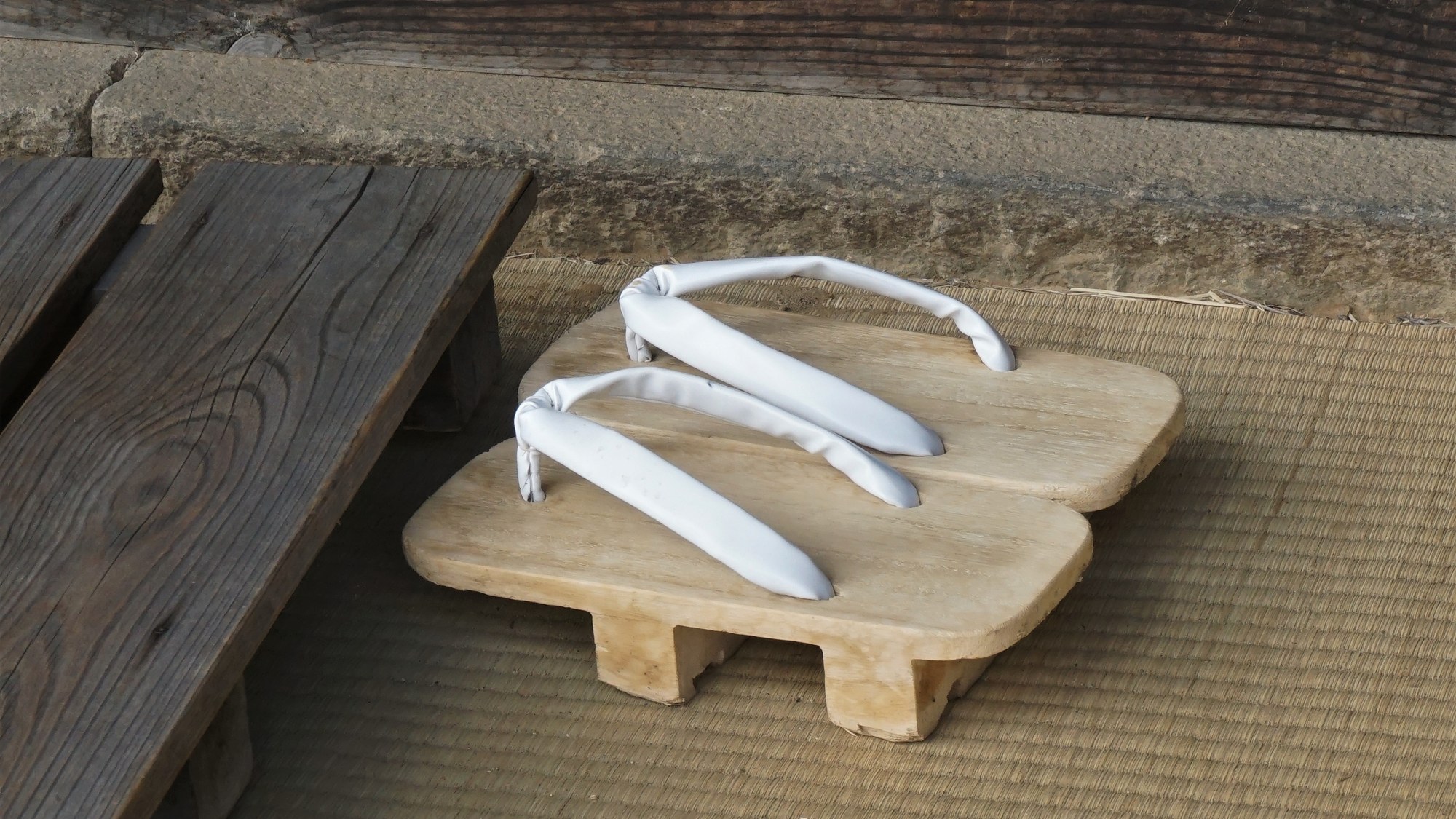
A geta is a wooden sandal elevated off the ground by one or more protruding blocks called ha (歯), literally “teeth.” The body of the sandal — the flat platform the foot rests on — is the dai (台). Two fabric or leather straps pass through holes in the dai and meet in a thong that fits between the first and second toe.
That is the whole mechanism. No buckles, no heel counter, no arch support in the Western orthopedic sense. The foot is held by the thong and by the slight natural curl of the toes over the front edge.
The simplicity is structural, not primitive. Japanese footwear evolved alongside tatami interiors and constant movement between indoors and outdoors. Shoes had to come off quickly at the genkan (玄関), the entryway threshold where outdoor footwear stops. A laced shoe would be a nuisance. A buckled sandal would add ceremony to something done many times a day.
The two teeth
The standard form, called futatsu-ba (二枚歯) — “two-teeth” — places one tooth near the ball of the foot and one near the heel. This is not the only configuration, but it is by far the most recognised.
The two-tooth design raises the foot roughly three to seven centimetres, depending on the style, creating a small gap between the sole and the ground. The reason becomes obvious in wet conditions: mud, puddles, and damp unpaved paths are less likely to reach the hem of a yukata or kimono. The elevation is clothing protection as much as footwear design.
Other configurations exist:
- Ippon-ba (一本歯): a single central tooth, used in traditional mountain practice and associated with tengu (天狗) imagery in folklore. These require genuine balance.
- Tengu-geta: sometimes used interchangeably with the above, named for the supernatural figures often depicted wearing them.
- Flat-soled setta-style variants that blur the line between geta and zori.
The futatsu-ba form survived as the default because it offers the most stable gait on ordinary surfaces while still keeping the foot clear of the ground.
Paulownia and why the wood matters
Most everyday geta are carved from kiri (桐), the paulownia tree. Paulownia wood is unusually light for its volume, low in thermal conductivity (meaning it does not feel cold underfoot in winter), resistant to moisture warping, and fine-grained enough to carve cleanly.
These properties make it ideal for footwear worn directly against bare skin. Cedar and other harder woods are used for higher-end or more decorative pieces, and lacquered geta may use different base materials under the coating. But for standard geta, paulownia has been the dominant choice for several hundred years, and craftsmen in towns with active geta traditions still source it specifically.
The lightness matters more than it might seem. Geta are worn with yukata or kimono, where the wrapped garment already narrows the gait. A heavy sandal would tire the ankle quickly. The walk in geta — a slight shuffle that keeps the sandal from flapping — becomes natural with practice, but it works best when the shoe is not fighting gravity.
The kara-koro sound
The sound geta make is described onomatopoeically as kara-koro (カランコロン), or sometimes shortened to karan-koron. It is close to a hollow knock — wooden teeth on stone or pavement, with the resonance of the air pocket between the two teeth amplifying each step.
The exact sound depends on the surface. Geta on old stone pavement in a temple precinct sound different from geta on concrete. But the tone is always wooden, always percussive, and, at least in the contemporary imagination, always evocative.
In literature and film, the sound functions as a shorthand for summer festivals, the approach of a geisha down a lantern-lit street, or the atmosphere of an older Japan. This association is accurate to real history: geta were the default outdoor footwear for a wide range of people through the Edo period, not a specialist garment or a ceremonial accessory. The sound would have been ordinary, the way the click of hard-soled shoes on marble is ordinary in a European city.
The sound is now rare enough to feel nostalgic. Wearing geta to a summer festival in contemporary Japan is a conscious aesthetic choice, and the kara-koro is part of the effect.
The hanao thong
The strap system — hanao (鼻緒), literally “nose strap” from the position at the front of the sandal — is the part of geta that interacts most directly with the body. Fit matters here. A poorly fitted hanao will blister the skin between the toes within an hour.
Traditional hanao are made from fabric, often chirimen (縮緬), a silk crepe with some give. Synthetic materials are common in contemporary production. The thong passes through three holes in the dai: two near the sides of the ball of the foot and one at the front edge. The V-shape is set when the geta is made, but a craftsperson can restring the straps when the fit needs correcting.
The decoration on hanao is one of the main ways geta are differentiated aesthetically. Formal or semi-formal geta may have embroidered hanao; casual summer geta often use simple cotton in solid colours or stripes. The strap is not incidental — it is visually prominent and chosen to complement the yukata pattern.
Geta vs zori — which goes with what
The most practically useful thing to understand about geta is where they appear and where they do not.
Geta pair naturally with yukata, the unlined cotton summer kimono worn to festivals, fireworks, and outdoor events. The combination is casual and seasonal. The relative informality of both items aligns — wearing formal tabi socks with geta is unusual, and the bare foot or ankle-sock look reads as relaxed and warm-weather appropriate.
Zori (草履) are the appropriate counterpart to formal kimono. Zori are flat or near-flat sandals with a smoother sole, typically lacquered or covered in fabric. They are quieter, lower to the ground, and associated with the dressed-up register of kimono dressing. Tabi (足袋) socks are worn with zori, and the combination requires the foot to be covered.
Wearing geta with a formal furisode (振袖) or a heavily formal kimono would be an unusual pairing — the footwear signals the wrong level of formality. The distinction maps roughly onto: geta is to zori as sneakers are to leather shoes, with the understanding that both are traditional forms and neither is inherently better.
Rain, snow, and the high-tooth variant
For genuinely wet conditions, standard futatsu-ba teeth are not always enough. Takageta (高下駄), high-tooth geta, extend the elevation to ten centimetres or more, lifting the garment well above any standing water or deep mud.
These are associated historically with rainy and snowy regions — the mountainous Tohoku and Niigata prefectures in particular — where the roads during wet seasons became genuinely difficult to navigate in standard footwear. The gait required for takageta is noticeably different, more deliberate, with the ankle doing extra stabilizing work.
There is also ashida (足駄), which refers to geta specifically intended for wet-weather use, typically with a heavier construction and a more water-resistant lacquer on the dai. Lacquered geta also appeared in formal contexts, where the surface finish mattered aesthetically as much as functionally.
Contemporary geta production has contracted substantially from its peak. Most buyers are purchasing for festival wear rather than daily use, and the high-tooth and rain-specific variants are now specialty items rather than standard inventory.
The principle underneath
Geta are legible objects. Every component — the tooth height, the wood species, the hanao material and colour, the presence or absence of lacquer — communicates something about the context of wearing and the occasion being navigated.
This is a quality shared across traditional Japanese material culture: the designed object encodes its use context. A flat dai with simple cotton straps says summer festival and bare feet. Lacquered wood with embroidered hanao says semi-formal outdoor ceremony. The elevated takageta says difficult terrain and weather.
What makes geta unusual is that the code is also acoustic. The kara-koro announces approach, presence, departure. In a culture that built so much around thresholds — the genkan, the boundary between indoors and outdoors, the boundary between garden and room — footwear that announces a crossing makes a certain kind of sense.
The sound was not designed in the modern branding sense. It emerged from the material. But it was kept, recognised, and eventually became part of what geta mean.