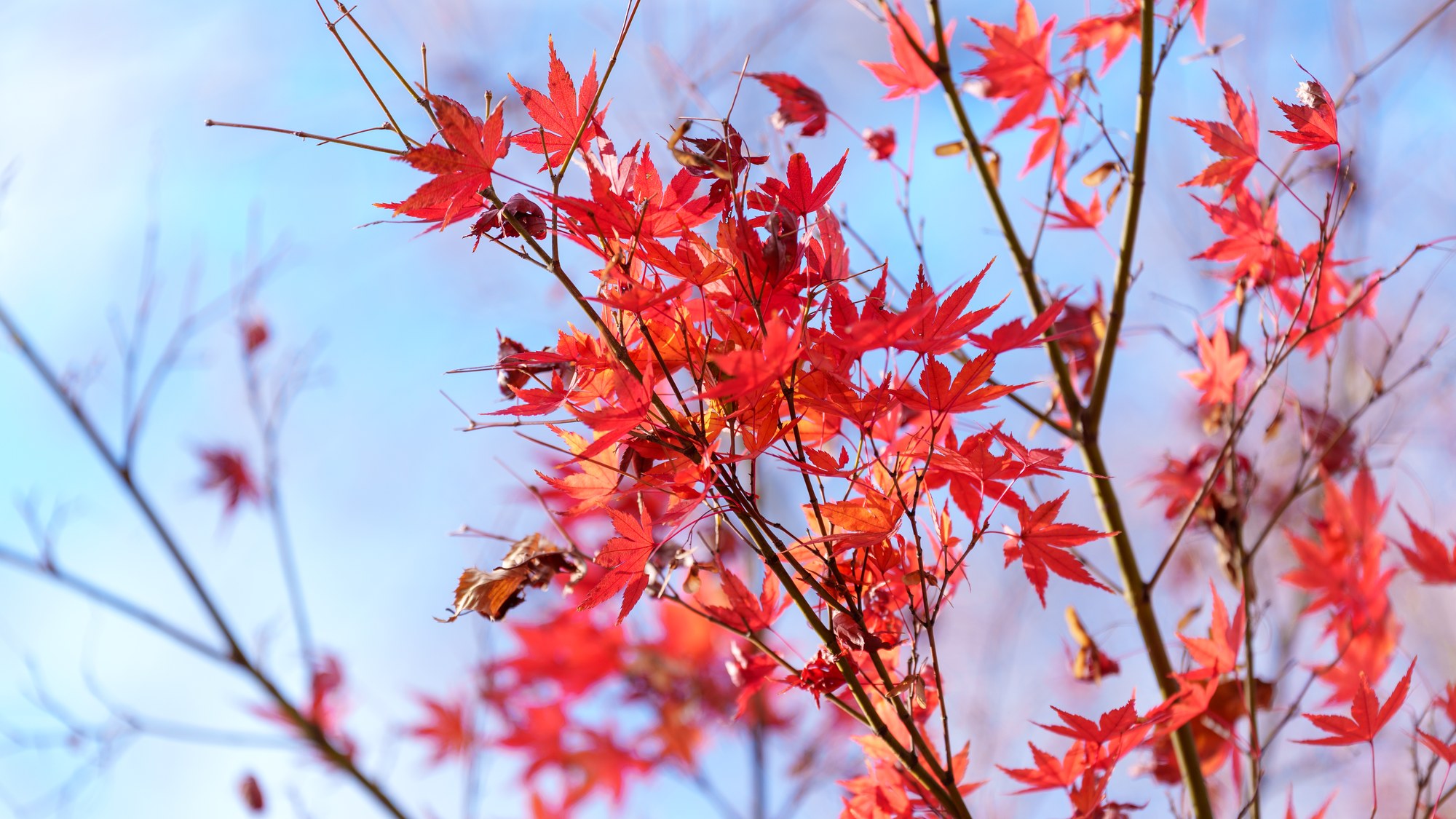
In late November in Kyoto, a temple courtyard slowly fills with people who have come to look at trees. Above them, small Japanese maples have turned from green through yellow into a deep, saturated red, almost crimson against the temple’s grey wooden walls. Visitors stand with cameras, sit on benches with takeaway tea, and drift through the grounds without much hurry. Almost no one is speaking loudly. The mood is close to hanami in spring, but quieter and more inward, with a hint of sadness at the edge.
This is momijigari (紅葉狩り), Japan’s autumn maple-viewing tradition, a seasonal counterpart to hanami. The tree itself is momiji (紅葉, sometimes also written 椛), especially Acer palmatum, the Japanese maple, with deeply lobed leaves that turn red, orange, and yellow before falling. The custom of going out to see them is at least a thousand years old, and many temple and garden plantings were arranged with this season in mind.
This article looks at what momiji means, why people travel to see autumn leaves, how the colours move through Japan, and how maple imagery appears in poetry, sweets, souvenirs, and temple landscapes.
Table of Contents
- What momiji refers to
- Momijigari, the hunt
- The Heian aristocrats
- The koyo front
- The temple pairing
- Momiji in food
- Poetry and mono no aware
- The asymmetry with spring
What momiji refers to
The word momiji is used somewhat flexibly. Strictly, it refers to the genus Acer, particularly Acer palmatum (the small Japanese maple) and Acer japonicum (the larger full-moon maple). These trees have palmate, deeply-lobed leaves — typically five to seven points — that turn brilliant colours in autumn.
More broadly, momiji can refer to the whole mood of autumn leaves turning colour. Koyo (紅葉, “crimson leaves”) is the wider term and includes icho (ginkgo) and other trees, but in everyday feeling momiji often stands in for the season itself.
The appeal is partly the leaf shape and partly the colour gradient. A single Japanese maple rarely turns one clean colour all at once. One branch may be yellow, another orange, another deep red, depending on light, weather, and the maturity of the leaves. A garden full of momiji is best walked through slowly, because the view keeps changing as you move.
Specific momiji varieties have been cultivated for centuries, and Japanese gardeners distinguish among them with the same precision applied to cherry blossom varieties. Iroha-momiji (the small palmate type) is the canonical garden tree. Yamamomiji is more widely distributed in mountainous areas. Hybrids and dwarf cultivars are common in temple gardens and bonsai practice.
Momijigari, the hunt
The compound momiji-gari literally means “maple hunting.” The verb karu means “to hunt,” but here it is metaphorical, a little like saying you are hunting for bargains. No one is hunting anything. The phrase means travelling somewhere specifically to see autumn leaves, often to a famous viewing spot outside one’s usual neighbourhood.
The practice has roots in aristocratic outings, where going to look at autumn maples also meant writing poetry, eating seasonal food, and being seen in the right setting. Today, momijigari can mean anything from a day trip to a famous Kyoto temple to a longer holiday in the mountains during peak colour.
In casual conversation, many people simply say koyo o miru, “to see the autumn leaves.” Momijigari sounds a little more literary and deliberate, which is why it still appears so often in travel writing, seasonal advertising, and cultural explanations.
The Heian aristocrats
The earliest documented references to momiji viewing as a cultural practice come from the Heian period (794–1185), when the Kyoto imperial court developed elaborate seasonal aesthetics. Court diaries and poetry anthologies record outings to view maples at specific locations — Arashiyama in western Kyoto, the slopes of Mount Hiei to the east — and the activity was bundled together with the composition of waka poetry, the wearing of layered seasonal kimono, and the consumption of seasonally-appropriate food and drink.
That aristocratic origin still shapes the feeling around momiji. The leaves are not treated only as a biological event, as trees changing colour because the temperature has dropped. They are treated as something worth making time for. You mark them with a poem, a photograph, a special lunch, or simply a slow walk through a place chosen for the season. The attention is the practice.
This is different from autumn colour in many other cultures. New England foliage, for example, is famous and widely loved, but it is not usually tied to a ritual as specific as Heian poetry gatherings or contemporary Kyoto temple visits. In Japan, the natural event becomes a cultural occasion with its own vocabulary, routes, foods, and expectations.
The koyo front
Just as Japanese television tracks the sakura zensen (cherry-blossom front) in spring, autumn brings the koyo zensen (autumn-leaf front) — a national progression of leaf-colour change that begins in the high mountains of northern Japan in mid-September and reaches the southern islands by early December.
Weather services issue daily forecasts showing where the colour is peaking now, where it is expected next week, and how vivid the leaves are compared with previous years. Tourism boards use those forecasts to promote viewing spots. Train companies run seasonal services to popular areas. A whole travel rhythm forms around the changing leaves.
The peak in Kyoto, where some of the most famous viewing sites are located, falls in mid- to late November. The peak in Tokyo’s mountain margins (Mount Takao, the Hakone area) is similar or slightly later. Northern Honshu and Hokkaido peak earlier; the southern Kyushu peak runs into early December. Travellers planning momijigari trips choose dates and destinations against these forecasts.
The forecasts are useful, but never perfect. Warm autumn weather can delay the colour; cold nights can bring it forward. The best window at any one site may last only a week to ten days, and a heavy rain can strip the branches quickly. Arrive a little early or a little late and the famous photograph becomes something softer, thinner, or already half gone.
The temple pairing
Many of the most photographed momiji sites are temples, and that pairing is not accidental. Temple grounds were often planted with an eye to how the maples would frame the buildings in autumn: dark wood, grey stone, moss, and then the sudden red of the leaves.
Tofuku-ji in Kyoto is the classic example. Its Tsuten-kyo bridge looks down onto a valley dense with maples, and the late-November view from the bridge, with red leaves below an old wooden structure, is one of the standard images of Kyoto autumn. Eikando, Kiyomizu-dera, Daigo-ji, and many other temples have their own set pieces.
Because the viewing often happens at temples, momijigari can also feel contemplative. You approach the gate, maybe offer a small prayer, walk the precincts, then stop where the leaves catch the light. The autumn colour becomes part of a layered experience: aesthetic, religious, social, and seasonal at once.
Many temples also offer evening illuminations during peak colour weeks — raito appu, lighting up the maples after dark with floodlights so the leaves glow red against the night sky. The illuminated displays are a 20th-century addition but have become wildly popular, drawing large evening crowds and extending viewing hours significantly.
Momiji in food
The autumn image carries easily into food. Momiji manju, small sweet cakes shaped like maple leaves and filled with sweet bean paste, are the signature confection of Miyajima island in Hiroshima. Shops near Itsukushima Shrine sell them warm, and they have become one of the area’s best-known souvenirs.
Momiji tempura — actual maple leaves dipped in tempura batter and deep-fried — is a regional specialty of Minoh, north of Osaka. The leaves are pickled in salt for over a year before being battered and fried, producing a crisp, slightly sweet snack with the leaf shape preserved. It is more curiosity than staple food, but it appears reliably at Minoh shops during momijigari season.
Restaurants in tourist areas develop seasonal menus featuring autumn ingredients (mushrooms, chestnuts, sweet potato, persimmon) presented with leaf-shaped garnishes or maple-coloured plating. Wagashi (traditional sweets) shops feature momiji-shaped higashi and namagashi. Bento boxes at viewing sites often include leaf-shaped decorative elements. The visual season is reinforced by the food.
Poetry and mono no aware
The classical poetic anthologies, including Manyoshu, Kokin Wakashu, and Shin Kokin Wakashu, contain hundreds of momiji poems. Many turn on the same feeling that shapes mono no aware: the leaves are beautiful because they are about to fall, and the colour matters because it will not stay.
A famous poem by Sarumaru attributed in the Hyakunin Isshu anthology runs roughly: “Deep in the mountains, treading the scattered crimson leaves, the cry of the deer reaches me — and that is when autumn feels saddest.” The combination of the visual (red leaves) and the auditory (deer cry) and the emotional (sadness) compresses the entire momiji aesthetic into a single 31-syllable poem.
That poetic framing still lingers in modern autumn. People do not need to quote Heian poetry to feel it. Standing under peak momiji, even a casual visitor may shift into a quieter mood than they would have in midsummer. The season almost asks for it.
The asymmetry with spring
Momijigari and hanami are often described as paired traditions — autumn maples and spring blossoms, framing the year. The pairing is real but asymmetric in ways worth noticing.
Hanami tends to be social: parties under the trees, food and alcohol, large groups settled in parks for hours, sometimes loud and celebratory. Momijigari is usually quieter. It is more often a couple or family walking through a temple garden than a large group picnicking in a public park.
The colours themselves help create the difference. Cherry blossoms are pale and bright, tied to beginnings. Maple leaves are saturated and intense, tied to ripeness and ending. The cultural responses follow the mood: louder in spring, more reflective in autumn.
This is part of why momijigari tends to feel more like Western autumn appreciation than hanami feels like Western spring celebration. The autumn mood is somewhat more universal; the contemplative response to fading colour translates more readily across cultures than the spring picnic does. Foreign visitors who join momijigari often understand it intuitively in a way that they sometimes do not understand the noisy, alcohol-fuelled spring blossom parties.
What both traditions share is the habit of seasonal attention: going somewhere specifically to look at trees that have changed in a way that will not last. Whether the response is celebratory or reflective, the act of attention is the constant. In autumn, momiji is one of the clearest invitations Japan offers to slow down and notice the year passing.