There is a photograph taken at Fushimi Inari Shrine in southern Kyoto that has been shared so many times it has become almost a cliché: a tunnel of vermilion torii gates, each one touching the next, the path bending into darkness and then curving back into light. What the photograph almost never captures is the scale. The tunnel is not decorative. It runs for kilometers. There are somewhere between ten and thirty thousand gates on the mountain, donated by businesses and individuals over centuries, each bearing the donor’s name and date on the back post. The front is anonymous. The back is a record.
A torii (鳥居) is the gateway structure found at the entrance to Shinto shrines — and at some Buddhist temples, certain roads, and a handful of secular locations that have absorbed shrine aesthetics over time. The basic form is two upright pillars supporting two horizontal beams. No walls, no door. A gate that marks a threshold without closing it. You pass through; anyone can pass through; the gate does not gatekeep in any conventional sense. What it does is change the quality of the space beyond it.
This article looks at what torii are, how they are built and why, and what their presence actually signals in Japanese spatial and religious thinking.
Table of Contents
- What a torii literally is
- The structure and its elements
- Color and material: white wood vs vermilion
- The kekkai: what the gate actually does
- Inari shrines, foxes, and the thousand gates
- Torii in water
- Visiting protocols
- The principle underneath
What a torii literally is
The name torii (鳥居) is written with the characters for “bird” (鳥) and “resting place” or “residence” (居). One popular etymology says the name refers to birds perching on the crossbeam — birds were considered sacred messengers in ancient belief, and a perch at the shrine entrance would naturally concentrate their presence. Other scholars dispute this, noting that the name may derive from a Korean architectural tradition or simply describe the structure’s shape. The origin is uncertain enough that “bird perch” should be treated as a plausible theory, not settled fact.
What is clear is that torii are ancient. The earliest written references appear in texts from approximately the ninth century, and the structural form likely predates them. Archaeological evidence suggests torii-like structures at shrine sites going back considerably further, though the precise lineage is debated.
The structure and its elements
Even the most basic torii shares a consistent architecture:
- Hashira (柱): the two upright pillars. These are the primary load-bearing elements and are often embedded directly in the ground or in stone foundations.
- Kasagi (笠木): the topmost horizontal beam, which typically projects beyond the pillars on both sides. In the most common styles, this beam curves upward at both ends.
- Shimaki (島木): a second horizontal beam just below the kasagi, found in more elaborate styles (the myojin style) but absent in simpler ones (the shinmei style).
- Nuki (貫): a shorter horizontal beam lower down, passing through or between the pillars to add stability.
These elements combine into a grammar. The shinmei style (as seen at Ise Grand Shrine) uses straight lines, unpainted wood, and no shimaki — severe, austere, ancient in feeling. The myojin style (the one in most photographs) adds the second beam, curves, and paint. Many other regional variants exist, each with slightly different proportions and details.
Color and material: white wood vs vermilion
The most visually striking torii are painted in shu (朱), a deep vermilion made traditionally from mercury sulfide. The color has Shinto associations with life, energy, and the warding of evil — roughly analogous to how red functions in Chinese auspicious symbolism, though the traditions developed independently.
But not all torii are red. The most sacred shrines in Japan use unpainted wood — natural white or grey cedar or hinoki cypress. Ise Grand Shrine, widely considered the central shrine of Shinto and rebuilt every twenty years in a ritual of renewal, uses entirely unpainted hinoki (Japanese cypress). The absence of color reads as purity: nothing added, nothing artificial. Age is the only transformation allowed.
The rule of thumb: unpainted wood tends toward the most ancient, austere, and prestigious shrine traditions; vermilion tends toward shrines where regular donation and replacement are practiced. Fushimi Inari’s gates are vermilion partly because they are donated by businesses seeking prosperity — the color signals active patronage as much as sanctity.
The kekkai: what the gate actually does
The concept behind the torii is kekkai (結界), a term that originally comes from Buddhist Sanskrit (sīmā) and refers to a ritual boundary that separates sacred space from ordinary space. In Shinto usage, a kekkai marks the transition from ke (everyday, profane) to hare (festive, sacred). The torii does not physically prevent passage. It marks the transition.
Passing through a torii is, in principle, a small ritual act — you are moving from ordinary ground to ground inhabited by a kami (神, spirit or deity). For this reason, the proper approach is to walk through the gate rather than around it, and to bow before entering. The center of the path — the seido, literally the “correct path” — is traditionally reserved for the kami to walk, which is why worshippers walk to the left or right rather than straight through the middle. Whether this is universally observed today is another matter, but the logic exists.
The hatsumode New Year visit to shrines is structured around this transition: the crowds passing through torii into shrine grounds are, in principle, crossing from the ordinary world into sacred space, making wishes and receiving the protection of the shrine’s kami. The omamori amulets and omikuji fortune papers sold at shrines are tokens of that sacred space, carried back into ordinary life.
Inari shrines, foxes, and the thousand gates
Fushimi Inari is the most photographed torii site in Japan, but it is also one of over thirty thousand Inari shrines across the country — a remarkable density. Inari is the kami of rice, agriculture, foxes, industry, and worldly success, and the tradition of donating torii gates to Inari shrines dates back at least to the Edo period (1603–1868), when merchant culture boosted donations as a way of soliciting business fortune.
The fox (kitsune, 狐) connection is worth pausing on. Foxes are not the deity — they are tsukai (使い), divine messengers of Inari, roughly the role that the fox plays in the broader yokai tradition. Inari shrine fox statues often come in pairs at the gate, holding scrolls or jewels in their mouths. The fox is an intermediary between human petitioners and divine power, which explains why shrine foxes do not look frightening — they look alert, loyal, capable of delivering a message.
Torii in water
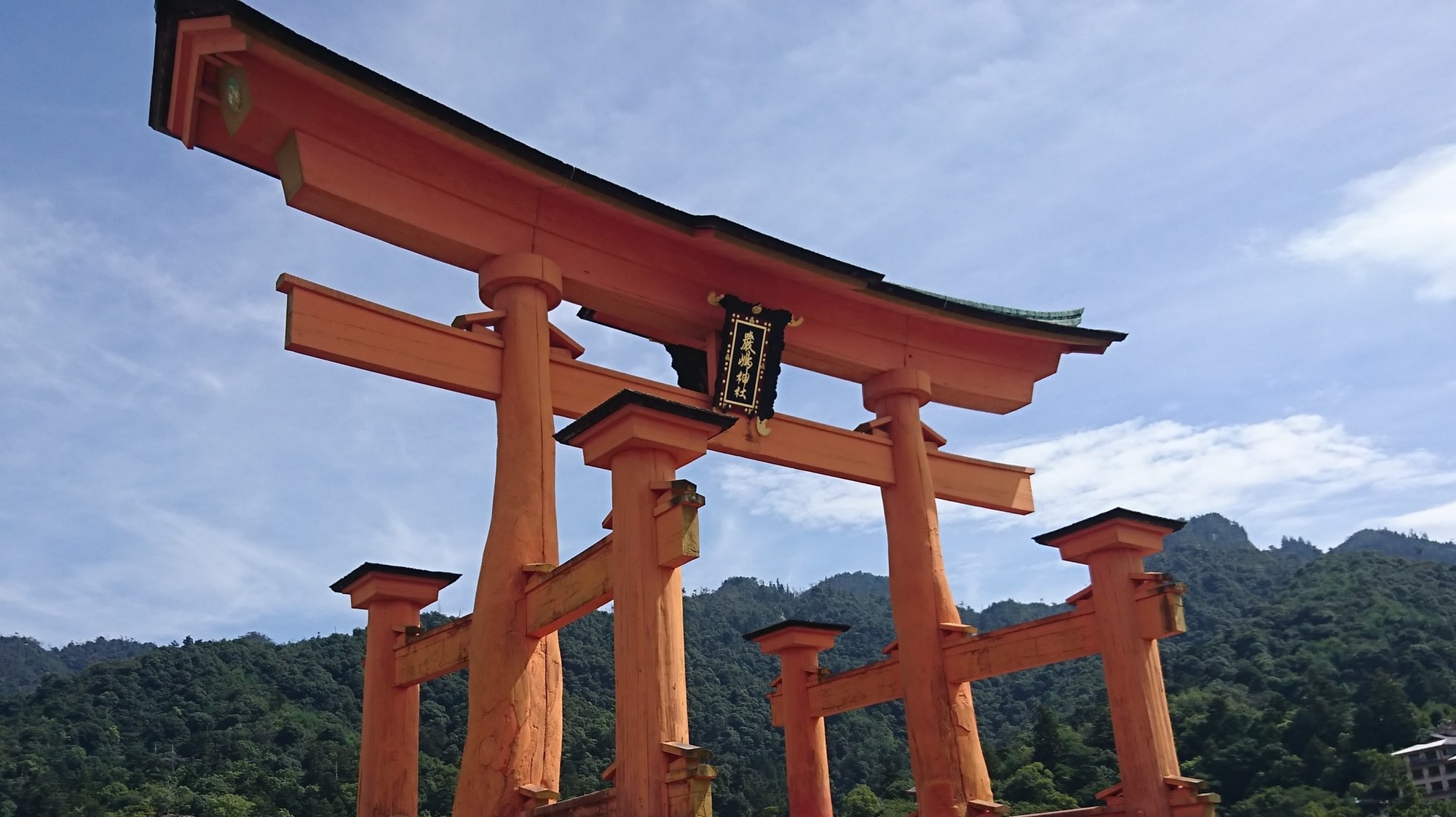
Some of Japan’s most striking torii appear to stand in the sea. The most famous is at Itsukushima Shrine (厳島神社) on Miyajima island in Hiroshima Bay, where a large myojin-style gate stands in the tidal shallows — at high tide appearing to float, at low tide accessible on foot. The shrine itself dates to approximately the sixth century, though the current buildings and gate are from the twelfth century or later.
The water placement has a practical-spiritual logic: the island itself was considered so sacred that ordinary people were not permitted to set foot on it in early periods. The shrine was approached by boat, and the torii stood at the water’s edge as the boundary marker between secular and sacred. As access rules relaxed over centuries, the gate’s position in the water remained as a mark of the original arrangement.
Visiting protocols
A few practical notes on how torii figure into shrine visits:
Bow at the torii, not inside it. The conventional moment to bow is before stepping through the gate, not while standing in the opening. You are acknowledging the boundary before crossing it.
Walk to one side of the central path. The center is the kami‘s path. This is most observed in formal shrine approaches; in crowded tourist contexts it is largely impossible.
You do not need to be Shinto to enter. Shrines are generally open to everyone. The protocols are conventions of respect, not requirements of belief. Non-Japanese visitors are not expected to know them in detail; attempting them with good intent is entirely sufficient.
The torii facing the approach matters. Torii typically face the main approach road (sandō, 参道). Multiple torii on a single approach form a sequence, each one bringing you closer to the inner sanctum. The first torii is the outermost boundary of sacred space; subsequent ones mark inner transitions.
The principle underneath
The torii captures something central to Shinto spatial thinking: sacred space is not enclosed, it is demarcated. There are no walls in the conventional sense; there is no barrier that keeps the impure out. There is only a threshold that makes a distinction visible. You could walk around the gate. The fact that you don’t — or shouldn’t — is the entire point. The gate works through acknowledgment, not enforcement.
This reliance on recognized thresholds rather than enforced barriers appears throughout Japanese spatial culture: the genkan entry step at a house, the noren curtain across a shop doorway, the low rope (shimenawa) around a sacred rock. Space is organized by markers that everyone agrees to see. The torii, standing open on both sides with nothing between its pillars but air, is the cleanest version of this idea.