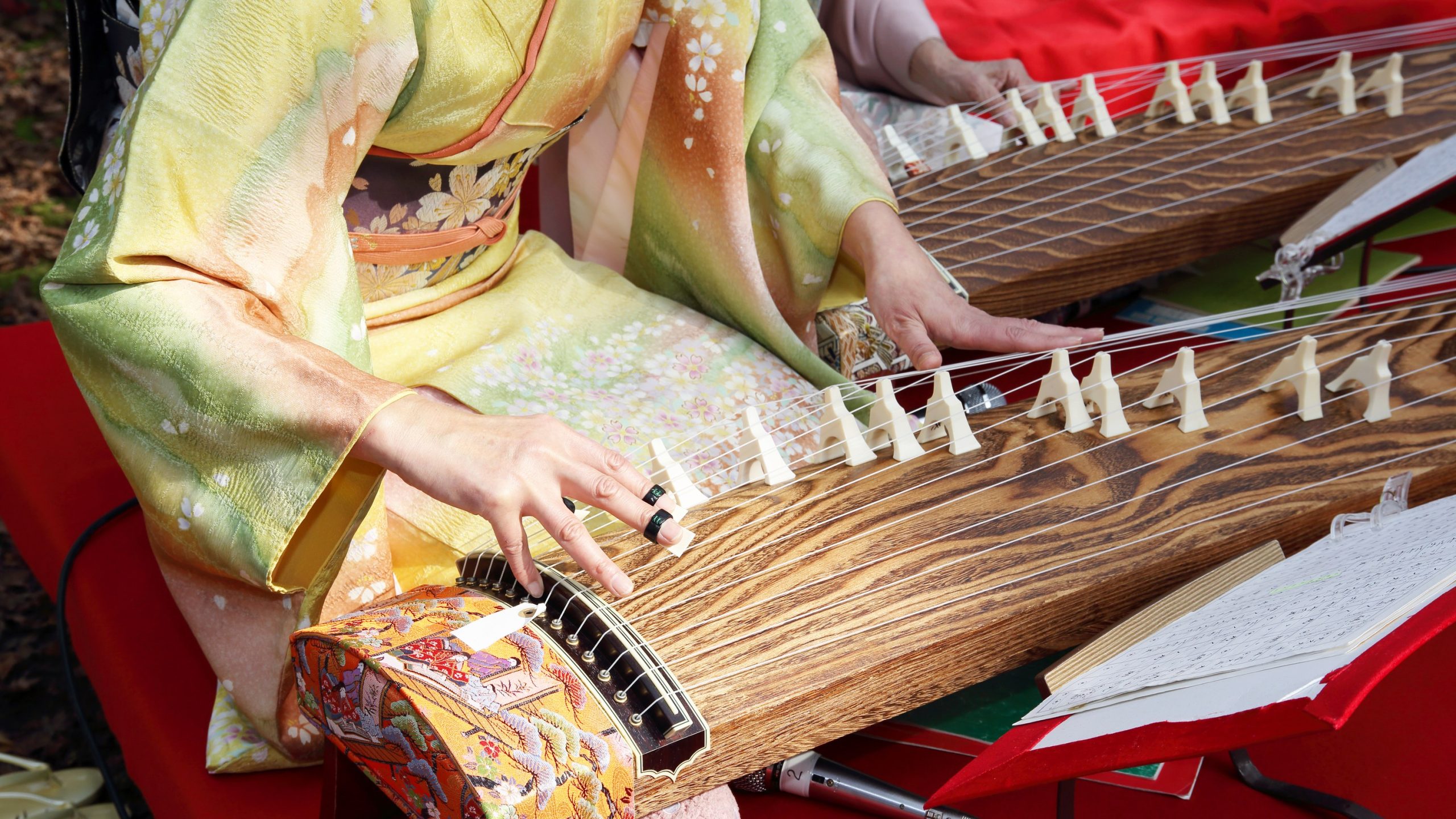
In a tatami room in Kyoto, a woman in formal kimono kneels before a long, low wooden instrument. She wears small ivory plectra on the thumb, index, and middle fingers of her right hand, and her left hand rests lightly on the strings further down the instrument’s length. The instrument is over a metre and a half long — wider than her shoulders — and supported on small carved bridges that arch above its surface. She plays a few notes. The sound is bright, plucked, sustained — a clear ringing tone with long natural decay, and an acoustic warmth that comes from the substantial wooden body resonating beneath each string.
This is the koto (箏 or 琴), Japan’s classical thirteen-string zither. It has been the central instrument of Japanese chamber music for over a thousand years, originally imported from Tang dynasty China but subsequently developed into a distinctly Japanese tradition. It is the instrument most commonly heard in Japanese tea-ceremony settings, in the formal Edo-period chamber music known as sankyoku, and in the soundtrack background of countless period films. It is also one of the more visually identifiable instruments — a long horizontal piece of carved wood that no other tradition has quite an equivalent for.
This article traces what the koto is structurally, how it differs from its Chinese ancestor, the role of moveable bridges in producing scale changes, the schools that have shaped modern playing, and the unexpected fact that koto practice has produced one of the most active contemporary Japanese chamber music traditions.
Table of Contents
- What the koto is
- The bridges and tunings
- From Tang China to Heian court
- Yatsuhashi Kengyo and the blind musicians
- The three-instrument ensemble
- The fingerpicks
- Schools and modern teaching
- Contemporary koto
What the koto is
A koto is a long, narrow wooden instrument, typically around 180 to 200 centimetres long, made from a single hollowed length of paulownia wood (kiri). The body is gently arched on the top surface — convex, like the back of a turtle — and slightly concave on the underside, with sound holes cut into the bottom panel. The shape is functional: the arched top surface supports the strings under tension, while the hollow body acts as a resonator.
Thirteen silk or nylon strings run the full length of the instrument, attached at the player’s right end (the head, ryukaku) and tied off at the left end (the tail, ryubi). Each string passes over a small individual movable bridge (ji) somewhere along the length of the instrument. These bridges raise the strings off the surface of the wood and divide each string into a vibrating section (between the bridge and the right-hand end) and a tied-off section (from the bridge to the left-hand end).
The player sits or kneels at the right end of the instrument, with fingerpicks on the right hand for plucking and the left hand free to press strings down behind the bridges, bending pitch upward. The right hand produces the basic notes; the left hand adds ornamentation and microtonal pitch variation.
The visual identity of the koto is distinctive — a long horizontal piece of wood with a row of bridges marching down its length, the strings catching light, the player kneeling formally to one side. The instrument’s size and the formality of its playing posture mark it out from any portable instrument; koto playing is unambiguously a seated, prepared activity rather than a casual one.
The bridges and tunings
The most distinctive feature of koto construction is the moveable bridges. Each of the thirteen strings has its own small wooden bridge, held in place by string tension and friction with the body’s surface. The bridges can be moved by the player along the instrument’s length, changing the effective vibrating length of each string and therefore changing its pitch.
This means a koto can be retuned for different pieces by sliding the bridges to new positions. A standard tuning called hira-joshi uses a specific pentatonic scale common in Japanese chamber music; other tunings — kumoijoshi, iwato, nakazora — produce different scale patterns suitable for different pieces. The retuning takes a few minutes and is done before each piece, often as a small ritual that begins a performance.
The presence of moveable bridges is one of the major differences between the Japanese koto and its Chinese ancestor, the guzheng. Both have similar string counts and similar overall construction, but the guzheng uses fixed bridges and adjusts pitch through different left-hand technique. The Japanese tradition’s moveable-bridge approach gives slightly different acoustic characteristics and allows for different kinds of compositional flexibility.
The bridges themselves are small carved pieces of wood, often beautifully made and considered objects of craft in their own right. A high-quality koto may come with a set of bridges that the owner uses for years; replacement bridges are available but the originals develop a worn fit that experienced players value.
From Tang China to Heian court
The koto arrived in Japan in the 7th or 8th century from Tang dynasty China, where its ancestor was the zheng (now guzheng). At first the instrument was used in gagaku — the imperial court music tradition — as part of an ensemble that also included flutes, drums, and other strings. Gagaku koto (also called sou no koto or simply gakuso) had specific repertoire and tunings tied to court ritual.
Through the Heian period (794–1185), the koto spread beyond imperial court contexts and into the homes of aristocratic women, who learned to play as part of the broad cultural training expected of their class. The instrument appears extensively in The Tale of Genji and other Heian literary works, where its sound is associated with refined emotional expression — particularly with longing, contemplation, and aesthetic depth.
By the medieval period (12th-16th century), the koto had developed into something distinct from its Tang Chinese ancestor. The repertoire was different. The playing techniques had evolved. The instrument’s social position had shifted from courtly ritual to domestic chamber music. The Japanese koto was no longer a Chinese import but a Japanese instrument with Chinese origins.
This pattern — a Chinese cultural import being absorbed and modified until it becomes recognisably Japanese — is common across many Japanese arts, from Buddhism to writing to architecture. The koto is one of the clearer musical examples of the process. By the time we encounter modern koto music, its identity as a Japanese instrument is unambiguous, even though its origins are not.
Yatsuhashi Kengyo and the blind musicians
A pivotal figure in the koto‘s modern history is Yatsuhashi Kengyo (1614-1685), a blind musician who worked in 17th-century Kyoto. Yatsuhashi composed many of the foundational koto pieces still performed today, established teaching lineages that continue in modified form, and modified the koto‘s standard tuning to the hira-joshi form that became canonical.
Yatsuhashi’s blindness is significant for two reasons. First, the title kengyo refers to the highest rank in a guild of blind musicians (todoza) that operated in Edo-period Japan, providing structured employment and social standing for blind individuals through music, massage, and acupuncture. Many of the most important koto and shamisen musicians of the Edo period were blind. The koto repertoire developed within this guild context, with techniques and pieces transmitted between blind teachers and blind students through oral instruction and physical demonstration.
Second, Yatsuhashi’s compositions — particularly the Rokudan no Shirabe (Music in Six Sections), still considered a foundational piece — established a formal template for koto music that subsequent composers built upon. Rokudan has six sections of fixed length, each with a similar internal structure, with melodic and rhythmic variation distributed across the sections. Listening to a performance reveals the architecture: clear sections, controlled variation, restrained emotional expression that builds gradually rather than dramatically.
The blind-musician tradition continued to dominate koto practice through the Edo period and into the early Meiji era. After the Meiji Restoration ended the official guild system, sighted musicians entered the tradition in larger numbers, but the lineages traceable back to Yatsuhashi and his successors continue to be the foundation of contemporary koto practice.
The three-instrument ensemble
The most common chamber music context for the koto is sankyoku (三曲) — literally “three pieces” — an ensemble of three traditional instruments: koto, shamisen, and shakuhachi. The three instruments are layered in counterpoint, with each contributing a distinct timbre and rhythmic profile to the music.
In sankyoku, the koto typically provides the harmonic foundation and the more sustained melodic material. The shamisen contributes the rhythmic drive and percussive accent. The shakuhachi adds breath-driven melodic lines that float above the plucked strings. The combination produces a richer texture than any single instrument could, and the chamber-music repertoire built around this ensemble is substantial.
A typical sankyoku performance is formal in setting: a tatami room, the players in kimono, the audience seated quietly, the music unamplified. Performances are not theatrical in any obvious sense; they are extended exercises in coordinated listening, where the three players must respond to each other’s timing and phrasing in real time.
The repertoire includes both pieces composed specifically for sankyoku ensemble and arrangements of solo koto or shamisen pieces with the other instruments added. Some of the canonical pieces — Rokudan no Shirabe, Chidori no Kyoku, Hachidan no Shirabe — are played both as koto solos and in full ensemble versions, with each version having its own musical character.
The fingerpicks
The right-hand technique uses three fingerpicks (tsume) attached to the thumb, index, and middle fingers. The picks are small ivory or bone caps with a curved striking edge, fitted onto leather or fabric finger sleeves. Different schools use different styles of pick — some flatter, some more rounded — and the choice of pick shape affects the tone produced.
The picks allow the player to pluck the strings with controlled force and angle without injuring the fingers themselves. They also produce a clearer, brighter attack than fingertip plucking would. The koto‘s characteristic ringing tone depends partly on the picks — a player using their fingertips alone would produce a softer, less defined sound.
The technique of pick playing is an entire study. Beginners spend significant time learning the basic stroke patterns: kakezume (a quick double pluck), waren (a sliding stroke across multiple strings), hikiren (a sustained pull), and others. Each stroke produces a specific musical effect, and the basic vocabulary must be reliable before more advanced technique can be attempted.
The left hand, free of picks, produces the koto‘s expressive ornamentation. The most common left-hand technique is oshide — pressing a string down behind the bridge to raise its pitch — which allows the player to bend notes upward by a half-step or a whole step. Oshide is essential to traditional koto music; many pieces depend on the bend produced by pressing a string for their melodic shape. Without left-hand technique, the koto would sound rigid and percussive; with it, the instrument has a vocal quality that approaches singing.
Schools and modern teaching
Modern koto teaching is organised through schools (ryu) that trace back to particular master teachers. The two largest are Ikuta-ryu (founded by Ikuta Kengyo in the late 17th century) and Yamada-ryu (founded by Yamada Kengyo around 1800). The schools differ in fingerpick shape, in fingering conventions, in ornamentation style, and in the specific repertoire they emphasise.
A serious koto student belongs to one school and studies within that lineage. The school provides the curriculum, the certification path (with ranks awarded by formal examination), and the teacher network. Students typically study with one primary teacher for years, advancing through pieces in a prescribed order and being awarded names and ranks within the school.
This formal teaching structure has both preserved the tradition and created some rigidity. Beginners cannot easily move between schools without difficulty. New compositions must be evaluated against established standards. Cross-school collaboration is possible but requires careful attention to stylistic differences. The result is a tradition that is well-maintained but somewhat conservative.
Despite this conservatism, the koto tradition has remained genuinely active. Major koto schools have thousands of students. Public concerts are regular. Recordings are produced. Children’s koto programs exist in some Japanese schools. The number of professional players is small but stable, and the broader teaching network keeps the tradition alive.
Contemporary koto
Beyond the traditional sankyoku and solo repertoire, the koto has found contemporary applications. Composers in the 20th century — most prominently Michio Miyagi (1894-1956) — wrote pieces that combined koto with Western instruments, expanded the tuning systems, and developed new playing techniques. Miyagi’s Haru no Umi (The Sea in Spring), composed in 1929 for koto and shakuhachi, has become one of the most internationally recognised pieces of Japanese chamber music.
Modern composers have continued to extend the koto‘s capabilities. Some have built larger instruments — the jushichi-gen (17-string) and the nijugen (20-string) bass koto — to expand the instrument’s range. Others have integrated koto with electronic effects, with jazz ensembles, with rock and pop music, and with non-Japanese musical traditions. The instrument has shown itself to be more adaptable than its formal teaching tradition might suggest.
International interest in the koto exists but is more limited than for shakuhachi or taiko. The instrument’s size and weight make it harder to transport. The formal teaching structure can be intimidating to non-Japanese students. And the chamber-music context, while beautiful, is less immediately accessible to international audiences than the more dramatic forms of Japanese music. Nonetheless, koto communities exist in major cities worldwide, with active teachers, regular performances, and growing followings.
What the koto offers, in the end, is one of the clearest cases in Japanese music of an instrument whose tradition has been continuously alive across more than a thousand years. The same notes, in the same modes, played with similar techniques, can be heard now and could be heard in the Heian aristocratic chamber. The continuity is unusual; few traditions of any kind, anywhere, have maintained this kind of unbroken thread for so long. The thirteen strings, the moveable bridges, the kneeling player, the sankyoku ensemble — all remain functioning elements of a contemporary practice that is also a thousand-year-old practice. This is what gives koto music its particular weight, and it is part of why the tradition continues to draw new students into the long discipline of learning it.