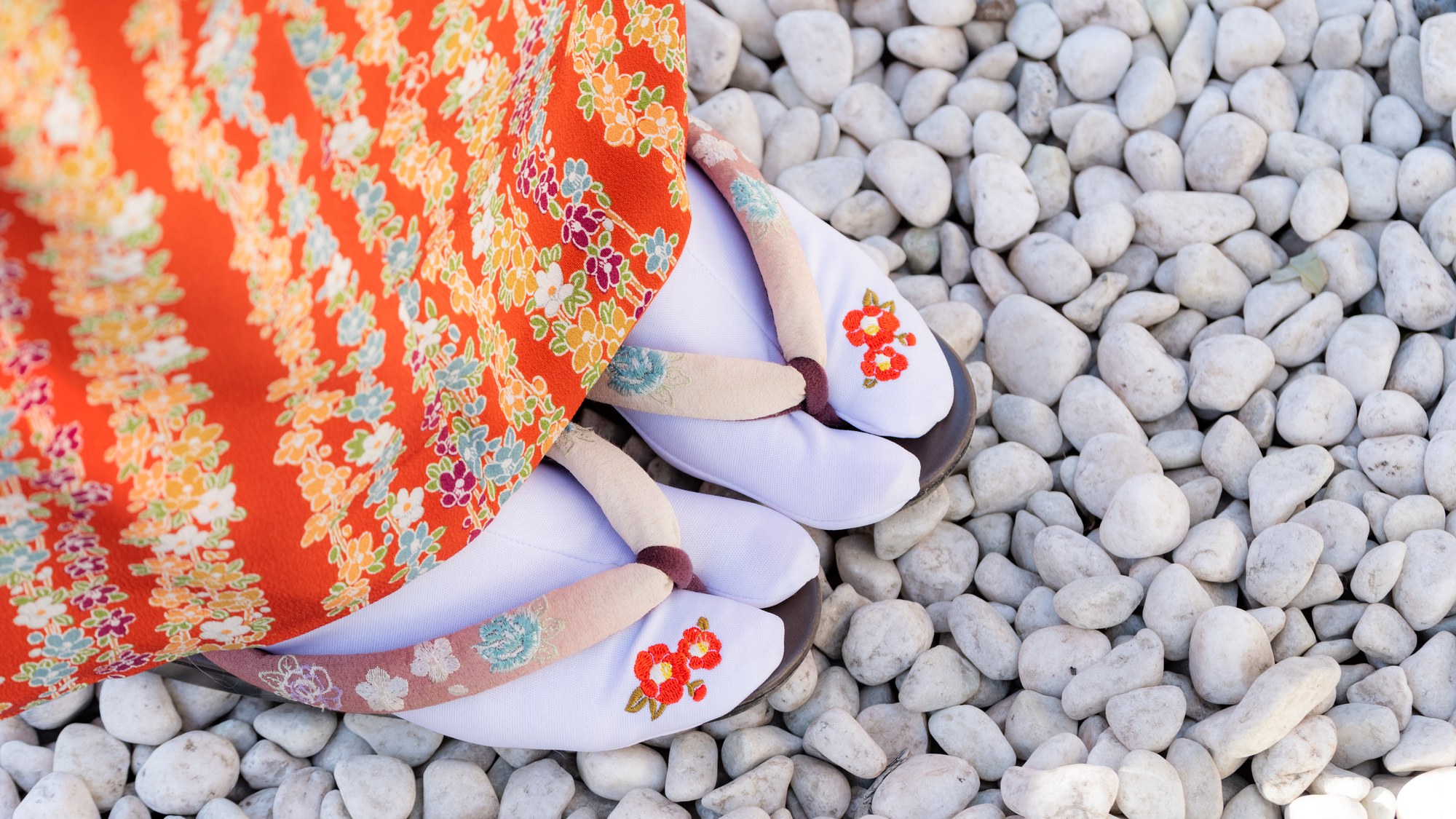
Slide into a pair of tabi (足袋) for the first time and your foot notices before your brain does: the big toe is on its own. Not slightly separated, but given a whole little room of fabric. The rest of the toes sit together, and the seam between the two sections is sturdy enough to tell you this split is not decorative.
This is not a modern ergonomic innovation. Tabi predate almost every form of Japanese footwear currently in use, and the design was arrived at for reasons that had nothing to do with comfort in the Western athletic sense. The split toe is a consequence of the sandal, not the other way around.
This article looks at tabi as a designed object: why the split exists, how the kohaze hooks work, why white carries formality, and how the same basic idea ended up on construction sites as rubber-soled workwear.
Table of Contents
- The split toe and why it exists
- Kohaze — the hook fastening
- White tabi and the formality gradient
- Coloured and patterned tabi
- Jika-tabi — the rubber-soled descendant
- Ninja, iron tabi, and the fiction
- Tabi in contemporary use
- The principle underneath
The split toe and why it exists
The split in tabi exists because of the thong. Traditional Japanese footwear — zori, geta, geta sandals specifically — holds the foot with a strap (hanao) that passes between the first and second toe. A sock has to make room for that strap, or the whole setup stops working.
Socks without the split would be pushed down or torn by the thong within minutes of walking. The split is not a comfort feature; it is a compatibility feature. The tabi is designed around the geometry of the sandal’s point of attachment.
This relationship between sock and sandal appears in other cultures that used thonged footwear, but tabi took it unusually far. A traditional tabi is more constructed than a Western sock: reinforced sole, seamed upper, divided toe, and an opening at the ankle, all cut from flat cloth and fitted with real precision.
Traditional tabi are made from white cotton. They are fitted rather than stretchy; historically, they had almost no elastic, which is why the back of the sock opens so the foot can get in. Putting them on is a small act of dressing, not the quick tug of an ordinary sock.
Kohaze — the hook fastening
The opening at the back of the ankle is closed by kohaze (鐶), small metal hooks that clip into fabric loops. A standard tabi has four kohaze, sometimes fewer for casual styles, occasionally more for ankle-height variations.
The hooks are flat, like a staple bent into a partial arc. They grip the loop under tension and hold firmly enough to last a full day of wear, but release with a pinch of the fingers. This matters because tabi are laundered frequently — white fabric worn against skin in a climate with humid summers needs regular washing — and the kohaze must be unclipped before each wash.
In practice, fastening kohaze quickly is one of the small skills you pick up when dressing in traditional Japanese clothing. It is awkward for a day, then ordinary. The hooks are small enough to disappear under the hem of a kimono, and the back seam sits toward the heel, where it does not draw attention.
Kohaze have been refined over centuries but the mechanism is essentially unchanged. Alternative closure systems — snaps, velcro — exist in cheaper modern production, but traditional tabi still use the hook-and-loop system, and the kohaze themselves are often finely finished pieces of metal.
White tabi and the formality gradient
White tabi is formal tabi. This is one of the steadier rules in kimono dressing, and it appears across formal and ceremonial settings: furisode (振袖) for coming-of-age ceremonies, tomesode (留袖) for weddings, tea ceremony, traditional performing arts, Shinto priestly dress.
The logic has a practical root: white shows dirt. Clean white tabi tell other people, quietly, that the wearer arrived clean and has not been doing manual work. It is a legibility convention, not unlike white gloves in Western formal contexts, but centuries of use in ceremony, tea practice, and the performing arts have given it extra weight.
Wearing coloured or patterned tabi with formal kimono reads as either a deliberate breaking of convention (acceptable in some contemporary contexts) or an error. Wearing white tabi with a casual yukata reads as overthinking it.
Coloured and patterned tabi
Away from the formal register, tabi loosen up. Coloured, striped, and patterned versions range from plain indigo to small komon (小紋) prints, and they are perfectly at home with everyday kimono, casual outings, and contemporary mixed dress.
The contemporary market has also moved beyond kimono wearers. Boutique makers produce tabi in heavy cotton, wool blends, and modern patterns for people who simply like the feel of toe separation. The idea is not far from five-toe socks in the West, though tabi keep the older two-section shape instead of separating every toe.
There is also a market for tabi-style shoes: flat-soled footwear with the split toe built in, designed to be worn without a separate sandal. Some high-fashion brands have incorporated the tabi toe separation as a design element in ankle boots and sneakers, which has introduced the shape to audiences entirely outside Japanese dress traditions.
Jika-tabi — the rubber-soled descendant
Jika-tabi (地下足袋), literally “ground-contact tabi,” are tabi with a thick rubber sole attached directly. They are not worn with sandals — the rubber sole replaces the sandal entirely.
These are working footwear, and they remain common on construction sites, in forestry, in traditional performing arts that involve physical floor contact, and in some religious festival contexts. The rubber sole provides grip, the split toe allows natural foot spread and grip on surfaces like scaffolding or uneven ground, and the fabric upper is lighter and more flexible than most safety boots.
The combination of split-toe grip and a full rubber sole is genuinely useful for skilled manual work on irregular surfaces. Workers who use jika-tabi regularly often say the toe separation helps with balance in ways a standard work boot does not. This is not nostalgia dressed up as utility. It is a practical preference among people whose work depends on their feet.
Jika-tabi are manufactured by a relatively small number of producers, with the Marugo brand holding a particularly significant market position. The product has changed little since its introduction in the early twentieth century, when it adapted the traditional tabi form for industrial use.
Ninja, iron tabi, and the fiction
Popular media, especially English-language ninja films and games from the 1980s onward, helped fix the idea of reinforced or iron-soled tabi for stealth, wall climbing, and silent movement. The image is vivid, and it has stuck.
The historical record for this specific equipment is thin. Shinobi (忍び), the actual historical practitioners of covert operations in feudal Japan, used a wide variety of practical tools, and footwear that minimised sound would have been sensible. Some historical and reconstruction sources suggest that thin tabi worn without sandals did allow quieter movement than wooden geta.
The iron-soled version with toe spikes — a climbing and combat tool — appears more prominently in fictional ninja aesthetics than in verified historical accounts. It has become part of the iconography regardless, and contemporary producers make reproduction pieces for martial arts practitioners and enthusiasts. Whether the iron reinforcement was historical practice or retroactive mythologising is genuinely unclear, and the cautious answer is: probably some of each.
Tabi in contemporary use
Tabi are still used by people who regularly wear traditional dress: kimono teachers, tea practitioners, performers in traditional arts, and people who choose kimono for everyday wear. For them, tabi are not a costume detail. They are basic dress infrastructure, something to buy, wash, replace, and keep in the drawer.
The contemporary kimono revival — a loose movement toward wearing kimono more casually and outside set occasions — has brought a small revival of interest in tabi among younger wearers. Coloured tabi with casual kimono, or tabi worn with Western trousers as a style gesture, now appear regularly in street-fashion documentation.
For most Japanese people today, tabi appear at festivals, New Year’s visits to shrines, and weddings — the same contexts that bring out traditional dress generally. The split-toe sock remains recognisable, even to people who have never worn kimono, as a marker of formal or traditional occasion.
The principle underneath
Tabi show a design logic that appears again and again in traditional Japanese material culture: the object belongs to a system. The split toe makes little sense without the sandal thong. The kohaze make little sense without a fitted, non-elastic sock that has to be removed and washed. The white formality rule makes little sense without a broader code of dress signals.
To understand one element, you have to look at the neighbouring elements that shaped it. In that sense, tabi are less an unusual sock than a small key to the system around them: the sandal, the kimono, the threshold at the genkan where shoes come off, the ceremony that decides what kind of white is appropriate.
The functional has always been the cultural here. That is the principle.